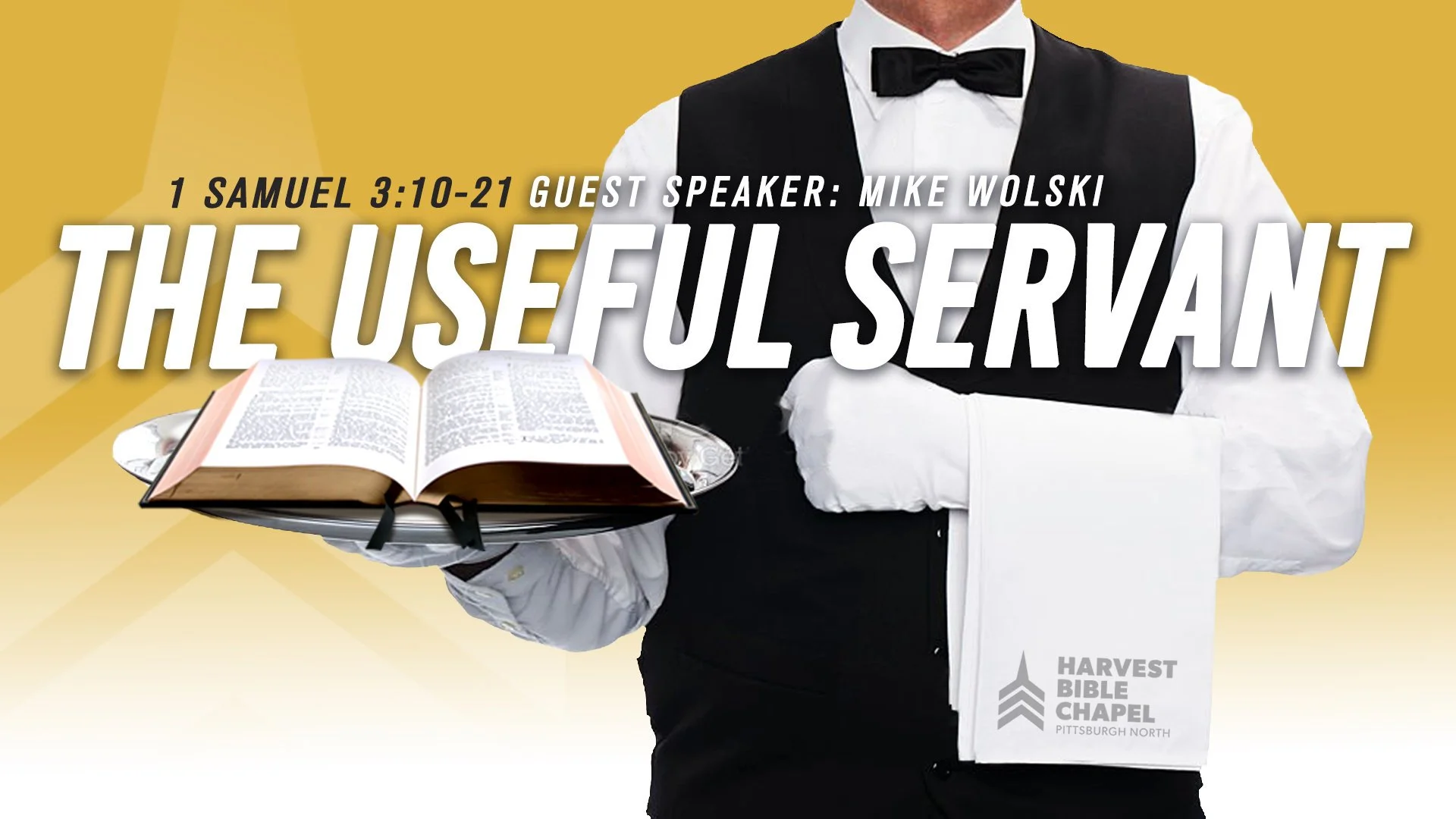
The Useful Servant

Introduction:

Characteristics of a Useful Servant: (1 Samuel 3:10-21)

  1. A Useful Servant: is Submissive to God's Word. (1 Sam 3:10-14)
  2. A Useful Servant: Truthfully Speaks God's Word. (1 Sam 3:15-18)

    Proverbs 30:56 - "Every word of God proves true; he is a shield to those who take refuge in him. Do not add to his words, lest he rebuke you and you be found a liar."

  1. A Useful Servant: is Blessed by God's Word. (1 Sam 3:19-21)

Steps we can take when Declining in Usefulness:

  1. Step Away
  2. Step Up

Sermon Notes (PDF): BLANK
Hint: Highlight blanks above for answers!

  • 00:00-01:32

    Well good morning church. I look around and I see there's actually a fairly large crowd here and it's not because of me rather it's because the world is closing in on 8 billion people. We've all got to go somewhere right? Well did you know that statistically and this number is highly debatable that there are 2 billion of those people that claim to be Christian right of the Christian faith. I all, you take the opposite of that, that means that three-quarters of the population on this earth is not Christian. Or to put it another way, they don't know who the Almighty Creator of this earth is, God. And to me that's a shocking thing, right? Because if the world were to end today, those six billion people would be destined for an eternity separate from God. Needless to say, there is much work to be done for advancing God's kingdom. Now to do that God uses servants. Servants who evangelize publicly through books, music, radio, television. Servants who go on missions and proclaim the gospel locally and in remote regions of the world. Servants who preach at their own churches and encourage their flocks, and servants that hold small groups at their homes, binding individual families together, servants at all levels.

    01:34-02:49

    God has called us to serve him and each servant has a specific purpose and impact for his kingdom. You don't have to be an R.C. Sproul, Chuck Smith, you don't even have to be a Jeff Miller, a Rich Sprunk, or a Dan Thompson. Serving God can take on many forms. The commonality though that all servants need to hold to, whether you're a large public figure, a local pastor, or just some guys in the back in an AV booth, is this. Are you useful? Are you useful? Is what you're doing useful for God's kingdom? This isn't a trick question, it really is a simple yes or no answer. Now for the majority of the people here at Harvest Bible Chapel, Pittsburgh North, the immediate and clear answer would be, "Yeah, what I'm doing here is useful. I'm an elder. I help guide the congregation in the direction of the church. I'm useful. I'm on the worship team. I play music or sing and lead the congregation in praising God. I am useful. I work in Children's or Arrow. I teach and lead the next generation in their understanding and personal relationship with God. I am useful.

    02:50-03:09

    Or I'm in assimilation. I greet and I welcome the congregation, helping people prepare themselves and their hearts for service. I am useful. Now I won't go through all the ministries that we have here, but you can take each one we have and understand they are purposefully at our church because they are useful.

    03:11-03:14

    This is why we don't have a glitter-throwing ministry or origami ministry.

    03:15-03:18

    There is no bring-your-pet-to-church ministry or bubble-blowing ministry.

    03:20-03:24

    Now, I realize those last examples are a bit ridiculous, but chew on this question.

    03:26-03:31

    What about the ministries and servants that think they're being useful but aren't?

    03:33-03:38

    How many people think they're doing God's will, but in his eyes, you're far from useful.

    03:39-03:41

    What about the more dangerous position to be in?

    03:42-03:46

    When you're not only not useful, but harmful to those around you.

    03:47-03:56

    The ones deceived, turning a blind eye to sin, or having their own agenda, thinking they're useful, but in actuality are a poison to those around them.

    03:58-04:02

    That's why today we're going to be focusing on characteristics of useful servants.

    04:03-04:08

    how we as servants of God can ensure that we are useful for his kingdom.

    04:09-04:13

    Our passage today is 1 Samuel 3, 10 through 21.

    04:14-04:25

    And in it, we're gonna be looking at two individuals, Samuel and Eli, both servants of God, but only one of them God saw going forward as useful for his kingdom purpose.

    04:27-04:34

    So as you're turning there, I want to provide some backstory as to who these two individuals are and what's already transpired in the book of Samuel.

    04:35-04:40

    So Samuel at this point is a young and upcoming boy who has been dedicated to the Lord by his parents.

    04:40-04:43

    He's under care of Eli, the priest at Shiloh.

    04:44-04:48

    And where we're picking up is right after Samuel's first encounter with God.

    04:50-04:58

    In the verses prior, the Lord verbally calls out to Samuel and he mistakes the Lord's voice for his master Eli's.

    04:58-05:10

    So he comes rushing over to Eli and he says, "Here I am." But then Eli's like, "I didn't call you." So this happens three times and Eli catches on and realizes that the Lord is speaking directly to Samuel.

    05:11-05:12

    So here we are in verse 10.

    05:13-05:17

    Samuel is anticipating the Lord and we see God is about to speak again.

    05:18-05:19

    So we'll pick up here, verse 10.

    05:21-05:25

    "And the Lord came and stood calling us at other times, "Samuel, Samuel.

    05:26-05:36

    "And Samuel said, 'Speak, for your servant hears.' "Then the Lord said to Samuel, "Behold, I am about to do a thing in Israel at which the two ears of everyone who hears it will tingle.

    05:37-05:42

    On that day I will fulfill against Eli all that I have spoken concerning his house, from beginning to end.

    05:42-05:52

    And I declare to him that I am about to punish his house forever for the iniquity that he knew, because his sons were blaspheming God, and he did not restrain them.

    05:52-06:07

    Therefore, I swear to the house of Eli that the iniquity of Eli's house shall not be atoned for by sacrifice or offering forever." So again, we're talking about characteristics of a useful servant, right?

    06:08-06:18

    That's our theme. So what do we see here? So on your outline, first point to be made is a useful servant is submissive to God's Word.

    06:20-06:25

    So we kind of launched into that passage, and it's kind of a bit of a meatball to digest, right?

    06:26-06:30

    God's declaration to Samuel sent things from 1 to 10 super quick.

    06:31-06:43

    But I'd like us instead to break this into two chunks and focus instead on God's servants in this passage, Eli and Samuel, and what they did, how each of them responded to God's word.

    06:44-06:45

    Did they fully submit?

    06:47-06:49

    First, let's take a look at Samuel.

    06:50-06:55

    In verse 10, in the fact the verses prior, Samuel is called by God and each time he responds.

    06:56-06:58

    He responds immediately and declares that he is listening.

    07:00-07:06

    Now, this might seem like a simple step of obedience, but as any parent can relate, it's a thing of beauty.

    07:07-07:10

    It shows he's eager to be used and to be useful as a servant.

    07:12-07:18

    Eli, on the other hand, is receiving a rebuke here because he did not fully submit to God's word.

    07:19-07:24

    See, in the last chapter, you get an introduction to some family issues Eli has.

    07:24-07:26

    two worthless sons.

    07:27-07:28

    And those aren't my words, by the way.

    07:28-07:30

    Those are God's written in his word.

    07:31-07:38

    They don't know the Lord and they were serving in the temple not with Eli, doing some things that they ought not to.

    07:38-07:41

    You can read about that in the chapter prior.

    07:42-07:47

    I mean, you know, this kind of reminds me of certain American politicians that we have in their sons, right?

    07:49-07:55

    But anyways, so Eli knew what they were doing but he didn't fully deal with it.

    07:55-08:00

    He told them, "Cut the malarkey, Jack." But when they didn't listen, he didn't pursue any further.

    08:01-08:09

    He received instruction from God to reign in his sons, but chose not to fully submit and accomplish the instructions the Lord had given to him.

    08:10-08:12

    This is why Eli received such a harsh rebuke.

    08:13-08:14

    He was disobedient to God's word.

    08:16-08:17

    Samuel, on the other hand, listened.

    08:18-08:20

    He was ready to hear from the Lord, right?

    08:20-08:21

    He is a zealous and eager.

    08:22-08:32

    And I know in my own walk, I can recall this time, the on-fire phase where I was eager to learn, to dig into God's word, to join every Bible study I could and dedicate myself fully, right?

    08:32-08:33

    Good old days.

    08:34-08:35

    But life has gotten busy.

    08:36-08:40

    You know, the areas that I serve the Lord across my life has expanded.

    08:40-08:42

    I've got responsibilities like Eli.

    08:42-08:45

    I'm married, I have three kids and a developing career.

    08:46-08:48

    I'm not just learning the ropes like Samuel.

    08:49-08:52

    And I have more than just myself to take care of.

    08:53-08:57

    You know, I don't always seem to have the time and tend to put God on the back burner.

    08:58-09:01

    And I'm sure there's a bit of personal laziness involved.

    09:02-09:06

    But the zealousness and eagerness to be a useful servant isn't always there.

    09:07-09:13

    Whether it be within my family, job, or serving in AV, is my service to God always useful?

    09:15-09:18

    Am I truly listening to God's words to guide my actions?

    09:18-09:21

    Or am I slipping into Eli territory?

    09:21-09:30

    Am I tricking myself into thinking I'm doing enough or just ignoring what God wants me to do because I have my own agenda to fuss over?

    09:32-09:40

    You know, some of you might be in that same reality, feeling like you've been walking with God a long while, but after a while, that spark kind of fades.

    09:41-09:44

    Like when you get a new car, right?

    09:44-09:45

    You're all excited about it.

    09:45-09:47

    At first, you take care of it.

    09:47-09:48

    You get the ultra car wash.

    09:48-09:51

    you armor all the dash and you vacuum the floor mats.

    09:52-09:54

    But then you go on a long road trip, right?

    09:54-10:05

    You get some muddy shoes on the floor, you spill Chick-fil-A fries down the side of the driver's seat and the center console, and that's where all the places where crumbs go to die, and you never reach down there, right, unless you drop your keys or your phone down there.

    10:07-10:15

    But the point is, months go by, and the dedication and care you have towards that initial thing is gone.

    10:16-10:18

    Other priorities fill up, right?

    10:18-10:20

    I'll get the dent in the door fixed eventually.

    10:22-10:25

    My point here is life changes.

    10:25-10:30

    People get married and have kids, responsibilities grow and shrink in different areas.

    10:31-10:34

    We can easily get wrapped up in are we doing enough?

    10:35-10:40

    But instead we should be asking ourselves, are we doing what God wants us to do?

    10:41-10:45

    Are we submitting to his word and therefore being useful?

    10:46-10:48

    I mean, we have his word with us in the Bible.

    10:49-10:53

    His eternal words that help shape and mold us in whatever phase of life we're in.

    10:55-11:04

    There's so many families here, and I see young couples like Matt and Lexi that's serving children's ministry or serve on missions trips together and pour into kids.

    11:05-11:38

    But I also see couples like the Howells that pour not only into their own children, but invite other children into their household to pour into them and to serve God in that capacity. Both families in very different phases of life, but usefully serving God because they submit to his instruction. Eli had his own instruction from God as to what he needed to do. So did Samuel. But we can't compare God's actions based on their current life situation. Rather, we look at their responses to God.

    11:38-11:49

    Clearly, Samuel had the right one. Where we are in life and our ability or Capacity to serve will change, but our response to God ought not to.

    11:50-11:53

    For us to be useful servants, we need to submit to God's word.

    11:55-12:04

    Coming back to the passage, Samuel is given this judgment on Eli and his household, and in the next verses, we'll see how he breaks the bad news.

    12:05-12:09

    So let's pick back up in the next part of the text, verses 15 through 18.

    12:10-12:11

    Verse 15.

    12:13-12:20

    Samuel lay until morning, then he opened the doors of the house of the Lord, and Samuel was afraid to tell the vision to Eli.

    12:21-12:28

    But Eli called Samuel and said, "Samuel, my son." And he said, "Here I am." And Eli said, "What was it that he told you?

    12:29-12:30

    "Do not hide it from me.

    12:30-12:39

    "May God do so to you and more also "if you hide anything from me of all that he told you." So Samuel told him everything and hid nothing from him.

    12:40-12:42

    And he said, "It is the Lord.

    12:43-12:53

    "Let him do what seems good to him." On your outline, point number two to be made about a useful servant is they truthfully speak God's word.

    12:56-13:00

    So after the Lord speaks to Samuel, Eli wants to know what God told him, right?

    13:00-13:31

    And I found this part a little bit tongue-in-cheek, well, almost kind of a dark humorous, 'cause Eli goes hard after Samuel, and I'm paraphrasing here, but he's like, "Listen, you need to tell me what God told you, and you better do it now, and you better not leave anything out, because if you do, I want God to do to you tenfold more." And Samuel's just sitting there, probably gave a awkward pregnant pause, and was just like, "Well, Eli?" And then he just lays it all out there, right?

    13:32-13:32

    Kind of awkward.

    13:34-13:50

    But Eli takes it like a champ, to his credit, and says, "Okay, let the Lord do what's good to him." I do find Eli's response a bit mature in knowing that God is harshly rebuking his entire family, but it's not like he didn't see it coming.

    13:51-13:55

    After all, he was a priest/judge of Israel for decades at this point.

    13:55-13:59

    He received fair warnings from, and clear instructions from the Lord prior.

    14:00-14:04

    We saw in the previous verse that he did not submit to God's words fully.

    14:05-14:07

    But let's focus in on Samuel.

    14:07-14:10

    And how do you think he felt in this situation?

    14:11-14:17

    He was given the weighty judgment from God on someone that he was training under, his mentor and teacher.

    14:18-14:30

    The passage says he was afraid, but I can't imagine the full breadth of anxiety and stress he could have been under knowing that he was about to deliver a bombshell on Eli and his entire family.

    14:31-14:34

    However, to his credit, Samuel didn't lie.

    14:35-14:37

    He told him everything and hid nothing away from him.

    14:37-14:45

    He spoke God's truth to Eli, did not compromise, did not shy away, did not sugarcoat it, just gave it straight up.

    14:47-14:50

    Full stop, no cap, as the kids would say today.

    14:52-14:55

    You can tell there's a generational gap just by the responses there.

    14:58-15:01

    That kind of got me thinking, what if he didn't?

    15:01-15:04

    What if he added or removed from God's words?

    15:05-15:14

    Well then he wouldn't have been a useful servant. God doesn't say something with the intentions for it to be minced, abridged, tweaked, condensed, or modified.

    15:15-16:03

    You can't be a useful servant if you're not going to speak truthfully speak God's Word. So put yourself in Samuel's place. Have you ever had to deliver bad news? Something as weighty as what Samuel had to do with Eli? Well if you've ever shared the gospel with someone, that's pretty much the worst news our flesh can hear. We all fall short of the glory of God. We all are destined to hell because of our sin. I can't do this on my own. I need to submit to a Savior. You yourself might have heard that bad news before from someone, but really you're hearing exactly what God needs you to hear his pure unadulterated promises and salvation through his son Jesus Christ.

    16:05-16:12

    And not to spoil the surprise, but once our flesh gets over this, the gospel is the greatest news we could ever hear.

    16:14-16:26

    Like Eli, we have a choice. Believe and be saved or punt it down the road over and over again until it's too late. That's what happened to Eli. He refused to act upon what what the Lord told him to do.

    16:27-16:33

    So God decided he was going to fulfill all that he had spoke against his household.

    16:34-16:35

    Now that can happen to us.

    16:36-16:41

    We get the invitation over and over again until our hearts get too hardened or we tragically pass away.

    16:43-16:51

    Today is the day you can accept the truth of salvation through Jesus Christ and start your path forward as one of God's useful servants.

    16:53-16:57

    Coming back to speaking his word truthfully, you might wonder, what's the big deal?

    16:58-17:02

    I might've tweaked something slightly to earn favor with someone, but it worked out, right?

    17:03-17:08

    Well, no, God is serious about the precision and correctness of his word.

    17:09-17:14

    Proverbs 30, five through six says, "Every word of God proves true.

    17:14-17:16

    "He is a shield to those who take refuge in him.

    17:16-17:23

    "Do not add to his words, lest he rebuke you "and you be found a liar." You see that?

    17:24-17:24

    Add nothing.

    17:25-17:30

    Conversely, if we leave things out, it's kind of like adding through subtraction, right?

    17:30-17:31

    Negative numbers.

    17:32-17:35

    But the point is you're changing the intention of his word.

    17:36-17:55

    I can imagine when we misuse God's words, he's pulling his hair out, metaphorically, and saying, "You know, that's not what I said." And bringing up another parenting example, in my household we have two young speaking kids, And the one thing often worked on is listening and repeating instructions.

    17:57-17:58

    I'm sure many parents can relate to this.

    17:59-18:08

    But when you tell a four-year-old anything, it often enters their ear, goes around the brain, back out the other side, and then jumps into oblivion.

    18:10-18:17

    Right after that happens, you're either left with a blank stare or a pondering child trying to recall what you just told them five seconds ago.

    18:19-18:19

    So what happens?

    18:20-18:21

    Well, let me set a scene for you, right?

    18:22-18:24

    This is between me and my son.

    18:24-18:27

    So here I am, getting things ready to go, and this is my son.

    18:30-18:32

    Don't act like you haven't used the TV as a babysitter.

    18:32-18:33

    Come on.

    18:34-18:35

    (audience laughing)

    18:36-18:39

    But I'm there and I go, "Silas, you need to turn that off.

    18:39-18:40

    "We're getting ready to go.

    18:40-18:41

    "We're going to the store.

    18:41-18:48

    "We need to pick up a few things and we'll be back." No, "Silas, did you just hear what I said?" Yeah, okay, what did I say?

    18:49-18:50

    No, we're not going to grandma's house.

    18:50-18:52

    No, just turn.

    18:53-18:55

    I said when we come back, you can finish it.

    18:55-18:57

    What, no, you don't have to go to bed.

    18:57-18:58

    What are you talking about?

    18:59-18:59

    (audience laughing)

    19:00-19:01

    Can anybody relate to this?

    19:03-19:06

    I mean, I think our Lord can, right?

    19:09-19:14

    He gives us his word written down and we still aren't always able to speak it truthfully.

    19:15-19:20

    Like my son, we aren't listening or willfully come up with their own interpretation of what's being said.

    19:21-19:29

    Whether you're a parent, a boss, a teacher, a leader, placing a takeout order, you want your words to be heard and not changed.

    19:30-19:33

    Like imagine if you contracted out Ryan Stroop to do some caulking.

    19:35-19:39

    And you want neutral white, but instead he puts in a Pepto-Bismol pink.

    19:40-19:41

    And his reasoning?

    19:42-20:08

    He got a whole bunch of this stuff on discount at Ollie's, and he felt it better to substitute it something that would give it a nice pop. I don't know about all of you, but I would be furious. So why do we think that when we make these executive decisions to modify what God says that he too wouldn't feel this way? Eventually you're gonna get to the point where God says, "Listen, you need to get back on the bench. You aren't listening because you're not speaking my word truthfully.

    20:08-20:17

    So I'm going to use a servant who will." Who cares if people are getting offended, Right? My word is truth and is what everyone on this entire planet needs to hear.

    20:18-20:22

    You get your act together, then fine. You can get back in the game, but right now, I cannot use you.

    20:24-20:26

    That's a trap we can all fall into, right?

    20:26-20:29

    Deciding to be people-pleasing instead of God-pleasing.

    20:30-20:39

    Now I know it's a challenge when talking about God to a complete stranger, but it's even harder when delivering a rebuke to a fellow brother or sister in Christ.

    20:40-20:45

    But understand the authority to speak God's words truthfully is not from us.

    20:45-21:06

    It's from the Lord himself. Sure, people can get mad at you for delivering the truth, you know, they call that shooting the messenger, but the real problem isn't with you, it's with the author of the message. So stand firm. Speak God's words truthfully. It's how we become and stay useful as servants for his kingdom.

    21:08-21:13

    Finally, let's wrap it up with the last bit of text and conclude with verses 19-21.

    21:15-21:21

    Verse 19, "And Samuel grew, and the Lord was with him, and let none of his words fall to the ground.

    21:22-21:27

    And all Israel, from Dan to Beersheba, knew that Samuel was established as a prophet of the Lord.

    21:28-21:44

    And the Lord appeared again at Shiloh, for the Lord revealed himself to Samuel at Shiloh by the word of the Lord." Our last characteristics of a useful servant today is they are blessed by God's Word.

    21:47-21:54

    So the last bit of text is different from the first two because this is a result or an outcome of following the first two points.

    21:55-22:02

    So God has chosen to use Samuel instead of Eli in his household now, so God chooses to bless Samuel.

    22:03-22:07

    not in a generic like blessings, blessings, you know, type of way, right?

    22:07-22:51

    There are very specific things in this verse that God does in his life as a result of submitting to and truthfully speaking his word. He grew, the Lord was with him, Samuel words were listened to by others, he became a well-known and established prophet of God, right? There's very clear and direct evidence in Samuel's life. And it's the same for all useful servants. You know, I will take a a little bit of a cop out here because I can't say exactly how each and every useful servant will be blessed, but if you're following his words and speaking it truthfully, his blessings will show up in your ministry, your household, your workplace, and in your relationships.

    22:54-22:58

    You know, I can imagine Samuel exuded God's presence, right?

    22:58-23:01

    I think we all know a couple people like that.

    23:02-23:07

    Ones that you like being around because they elevate you to a higher standard than you normally keep yourself at.

    23:08-23:13

    People who help you hold your tongue better, make wiser decisions, and keep God in the forefront of your thoughts.

    23:15-23:20

    See, when you're a useful servant, being blessed by his word leads you to be that kind of person for others.

    23:22-23:23

    So where's Eli at this point?

    23:24-23:27

    Well, him and his family are on their way out.

    23:28-23:31

    They were rebuked and God no longer has his blessing upon his family.

    23:33-23:34

    What a tragedy.

    23:36-23:37

    It's not just Eli.

    23:38-23:44

    Sure we all heard of pastors, friends, and other servants that lose their usefulness and subsequently their blessing from God.

    23:46-23:47

    It doesn't have to be that way.

    23:48-23:52

    There's always forgiveness in Jesus Christ that gets us back on track.

    23:54-24:07

    First, ask for forgiveness and seek reconciliation event or behavior caused you to lose your usefulness. Then change your behaviors and recommit to submitting and speaking truthfully His Word.

    24:10-24:29

    So what do we do with these points? We want to be useful servants, so how do we submit and speak truthfully and be blessed by God's Word? Well, each point makes a reference to an authoritative source, God's Word, a wonderfully unchanging and eternal source of truth and and wisdom, read it.

    24:30-24:38

    You can't speak truthfully, submit to, or be blessed by God's word if you don't know anything about it.

    24:39-24:40

    But what else?

    24:41-24:45

    How can we tell if we're useful or maybe we're slipping down that path of uselessness?

    24:46-24:48

    Well, first we need to take stock in where you're at.

    24:49-24:50

    Are you submitting to God's word?

    24:51-24:52

    Are you speaking it truthfully?

    24:52-24:54

    And do you see God's blessings?

    24:55-24:56

    If so, great.

    24:57-24:59

    probably a good indication that things are good.

    24:59-25:02

    You are useful and you're seeing God work through your servitude.

    25:03-25:04

    Keep that up.

    25:04-25:07

    Be an encouragement for others in the faith.

    25:08-25:11

    But what if you aren't seeing his blessings, right?

    25:11-25:15

    There's struggles or hardships or it's just a missing of his presence.

    25:17-25:35

    Well again, I can't speak to every individual situation because some of us will go through some short-term trials, But if there is a persistent long-term waning of evidence, chances are there's something wrong with your submission or your truth speaking of his word.

    25:36-25:38

    And that's where I wanna leave us with some action plans.

    25:39-25:40

    What we can do in this situation.

    25:41-25:43

    Because again, not all is lost.

    25:44-25:48

    We have two potential responses when we see ourselves declining in usefulness.

    25:49-25:54

    So again on your outline, letter A, we can step away.

    25:56-26:01

    So this involves situations where you've been potentially stretched too thin, right?

    26:01-26:09

    You aren't being fully useful in any one of the given areas of responsibility that you have in God's kingdom, right?

    26:10-26:23

    And in this category, I wouldn't say people are trying to be malicious or doing beyond their means because they want to do a subpar job, but perhaps it's done out of obligation.

    26:24-26:34

    Maybe other things in life have stretched you and you haven't quite yet reigned in other areas so that you can be more useful in that new area that God has put you in.

    26:35-26:42

    But no matter the reason, there is no shame in trimming the fat and letting go of things that God is closing the doors to.

    26:44-26:54

    You know, I've seen many examples in my life and in others where things happen and people can't fully commit to the excellence required in an area of service for God's kingdom.

    26:55-26:56

    And that's okay.

    26:56-27:05

    You know, you need to make sure that your servitude and those more permanent areas of your life, or like your personal relationship with God and your family, those are taken care of.

    27:06-27:10

    And maybe one day you'll be able to come back and serve in that particular area again.

    27:12-27:15

    But a quick callback to our scripture, and in particular, Eli.

    27:16-27:23

    You know, I don't think he really had that luxury to just step away from being a judge and priest of Israel.

    27:23-27:26

    Probably not something he could have done, right?

    27:27-27:28

    You know, he had to deal with his sons.

    27:30-27:33

    And that can be the case for us too, which is why we have a second response.

    27:34-27:37

    Letter B, we can step up.

    27:38-27:39

    Step up.

    27:40-27:55

    I have no statistic on this, but you can, and you can quote me, and I'm just using a gut feeling, But I think the solution for many of us of not seeing the evidence of God in our life and being a useful servant, I think the solution is that we simply just need to step up.

    27:56-28:00

    See, being a servant of God involves all aspects of our life.

    28:02-28:03

    Not just in ministry or the church, right?

    28:04-28:07

    We have our jobs, our family, and personal walk with Christ.

    28:08-28:10

    And in those areas, we can't just simply get rid of them.

    28:11-28:11

    Right?

    28:12-28:15

    which leaves us with no choice but to step up.

    28:16-28:17

    So what do I mean by that?

    28:19-28:34

    Well, it can involve a deeper commitment to praying with your spouse, more time spent with your children in God's word, personal prayer time every morning, every morning, and getting rid of useless time on YouTube or Facebook, they call it meta now, whatever.

    28:35-28:44

    I know I feel convicted in this manner, and there are plenty of opportunities for me to substitute something I want to do with something I need to do.

    28:45-28:55

    So I encourage each and every one of us to be aware of those opportunities, to realize, you know, re-watching the Goonies again this week probably isn't the best use of my time.

    28:56-28:59

    So why don't I give God's word its rightful dues?

    29:01-29:10

    You know, I said that there are two responses because those are the ones that I think we should take, But there is a third response, Eli's response.

    29:11-29:12

    What is that?

    29:13-29:13

    Do nothing.

    29:14-29:15

    Wait for it all to fall apart.

    29:17-29:21

    But church, there shouldn't be any reason for us to do that.

    29:22-29:27

    See, even if you're struggling in a season of life, when things are changing, submit to his word.

    29:28-29:30

    You will become a useful servant.

    29:32-29:37

    If you're being asked about your faith or trying to reach the lost, Speak truthfully His word.

    29:38-29:40

    You will be a useful servant.

    29:41-29:47

    Finally, rejoice in God's word, knowing you'll be blessed as a useful servant.

    29:48-29:49

    Let's pray.

    29:51-29:53

    Lord God, we thank you for today.

    29:53-29:59

    We thank you for your word and for the ability to serve you, God.

    29:59-30:03

    We aren't just around because we are your creation.

    30:04-30:10

    You have a purpose for us and a drive for us to work and to serve your kingdom.

    30:12-30:23

    Please help us to maintain that focus, to understand where you want us to be, where you don't want us to be, so that we can be useful for every purpose that you've ordained for us.

    30:24-30:30

    Thank you, God, or I thank you, God, rather, for this opportunity to deliver your word.

    30:31-30:37

    and pray God that we take this message to heart, find areas where we can better serve you in your kingdom.

    30:38-30:39

    Thank you, Lord.

    30:39-30:42

    We ask this all in your son Jesus's name, amen.

Small Group Discussion
Read
1 Samuel 3:10-21

  1. What was your big take-away from this passage / message?

  2. Why do you think Eli didn’t fully submit to God’s instruction?

  3. In what areas are you lacking useful servitude to God and how can you be better?

  4. What are some ways you’ve seen God’s blessings in your life when serving Him faithfully?

  5. Step away vs Step up… when should each approach be used? Specifically to Step Up, what are some examples of doing this?

Breakout
Pray for one another.

Questions from the Congregation - Part 17

Note: The time signatures [00:00] below indicate the start of a question if you'd like to skip to a particular one of interest in the audio file.

  1. [00:00] - Q: My question is how as followers of Christ are we to equip ourselves and our children (besides prayer) to stand up against evil ideology but particularly LGBTQ agenda in our schools and the "in your face" push throughout media. How do we teach our kids to respond to teachers/peers when confronted with these movements?
    A: See - TBD

  2. [00:00] - Q: Why should I pray for this world if the Bible says that the world is going to get worse?
    A: TBD

  3. [00:00] - Q: There's a lot of dialogue in our country about rights. What rights are actually given to us by God?
    A: See TBD - TBD

  4. [00:00] - Q: In light of many current events, shortages, and inflation, I feel the need to hoard food and necessities. Is it wrong to have an excess of these items in stock. Does that show a lack of faith in God’s provision?
    A: See TBD - TBD

  5. [00:00] - Q: What is a woman?

    A: TBD

  6. [00:00] - Q: What are your thoughts about churches with women pastors? What does the bible say about this?
    A: See 1 Timothy 2:12-15 - TBD

  7. [00:00] - Q: People at work say Christians can swear. Can they swear to be relevant?
    A: See Ephesians 5:4
    TBD

  8. [00:00] - Q: What does the Bible say about the use of Western Medicine example anti depressants, pain killers, medical marijuana, etc.?
    A: See Proverbs 31:6 TBD

  9. [00:00] - Q: Psalms are psalmists praises and often supplications, too. They are not necessarily God's promises. How shall we then treat those supplications? For example 1, Ps 6:23a, Surely goodness and mercy shall follow me all the days of my life. Is this true for US? For example 2, Ps 90:15, Make us glad for as many days as you have afflicted us, for as many years as we have seen trouble. Does this prayer being included in Bible mean approval of this supplication by God? Can WE make the same supplication?
    A: See TBD - TBD

  10. [00:00] - Q: If Jesus was a Galilean Jew, why aren’t we?
    A: See TBD - TBD

  11. [00:00] - Q: Are there spirits outside of angels and demons on earth? Is there any scripture that would lead us to believe that people once they die would be a spirit on earth?
    A: See TBD - TBD

  12. [00:00] - Q: Are we missing something when it comes to the Sabbath and the value of rest? Jesus addresses the Pharisees' legalistic approach to the Sabbath and much of the OT has been fulfilled through the cross, but this is the only one of 10 commandments that isn't expected to be followed still.
    A: See TBD - TBD

  13. [00:00] - Q: Does Nicodemus believe that Jesus is who he says he is?
    A: See John 19:39 - TBD

  14. [00:00] - Q: Gen. 3:15 makes mention of Satan's "offspring". Did Satan procreate with humans? Who was Satan's offspring?
    A: See John 8:44 - TBD

  15. [00:00] - Q: What do you think is the strongest evidence outside of the Bible that Jesus of Nazareth is a historical existence?
    A: See TBD - TBD

  16. [00:00] - Q: In Daniel chapter 10 at the very end of the chapter it says “but I will tell you what is inscribed in the book of truth there is none who contends by my side against these except Michael your prince.” Why is Michael called a prince? Are there other angels known as princes like Michael?
    A: See TBD - TBD

  17. [00:00] - Q: When do the O.T. saints get their glorified bodies? If it is not at the time of the rapture when the dead rise first, can you explain?
    A: See TBD - TBD

  18. [00:00] - Q: Why does the Lord send Saul an evil spirit several times in 1 Samuel? Why would the Lord do that? We are told to ‘resist the devil and he will flee…’?
    A: See TBD - TBD


    Any question that was missed due to time constraints during the service Pastor Jeff will address the answer
    on the blog.

Sermon Notes (PDF): BLANK

  • Pastor Jeff:

    00:01-00:06

    Mark has always been a great help and part of this.

    Pastor Jeff:

    00:06-00:11

    And for those of you who don't know, some of you do, but Mark and I go way back.

    Pastor Jeff:

    00:11-00:13

    We actually met in prison, right?

    Mark Ort:

    00:13-00:13

    We did.

    Mark Ort:

    00:13-00:15

    That's not fake news.

    Pastor Jeff:

    00:15-00:16

    That is not fake news.

    Pastor Jeff:

    00:16-00:19

    No, I asked him to shank a guy for a pack of smokes and he did.

    Pastor Jeff:

    00:21-00:25

    And we were, we just had like, we had like kind of a two man gang.

    Pastor Jeff:

    00:25-00:30

    We were pretty tough, But it was prison ministry, right?

    Pastor Jeff:

    00:30-00:40

    But, and that's why I love Mark being up here with me doing this, because we used to go in, right Mark, it'd be like sometimes two or two and a half hours of Q&A day.

    Pastor Jeff:

    00:40-00:43

    And we would answer a lot of these types of questions.

    Pastor Jeff:

    00:45-00:53

    But not only do we have Mark helping us out, but this is the first day of an exciting new chapter in the life of Harvest Bible Chapel.

    Pastor Jeff:

    00:53-01:00

    and I would like you to give a very warm Harvest welcome to Pastor Taylor Brown as he makes his way up.

    01:01-01:01

    (Applause)

    Pastor Jeff:

    01:07-01:09

    Why don't you guys go ahead and have a seat.

    Pastor Jeff:

    01:11-01:45

    I've got to tell you, though, I was a little dismayed, because I've been telling people that, "Hey, I'm really excited, you know, through this process." I said, "We're getting a new pastor." And people have been like, "Yes! We're getting a new pastor!" And I'm like, "Another pastor." And they're like, "Oh, that's cool too, I guess." But before we get to the congregation submitted questions, I thought this would be a great opportunity to ask Taylor some questions.

    Pastor Jeff:

    01:46-01:48

    So, anybody have any questions for Taylor?

    Pastor Jeff:

    01:50-01:50

    Here's a couple.

    Pastor Jeff:

    01:51-01:59

    We're not gonna embarrass anybody or make him stand up or parade through, but Taylor, why don't you just sort of introduce yourself and tell us about your family?

    Taylor Brown:

    02:00-02:03

    So my wife and I, Kate, we've been married for almost eight years now.

    Taylor Brown:

    02:03-02:04

    We have two kids.

    Taylor Brown:

    02:05-02:06

    Sam is two and a half years old.

    Taylor Brown:

    02:07-02:09

    Thankfully his number hasn't been called yet, so that's pretty good.

    Taylor Brown:

    02:09-02:13

    And we also have Emmy, my daughter, who's the best friend any of you will ever have.

    Taylor Brown:

    02:13-02:15

    She'll love every single person in this room.

    Taylor Brown:

    02:16-02:17

    We're really excited to be here.

    Pastor Jeff:

    02:18-02:19

    Well, we are so excited to have you here.

    Pastor Jeff:

    02:19-02:30

    And for those of you, which is a couple of us, very few of us, that go back quite a ways, Taylor actually interned with us back in 2012, right?

    Pastor Jeff:

    02:30-02:32

    And what have you been doing since then?

    Taylor Brown:

    02:32-02:39

    Over the past seven and a half years, I've been a youth pastor at North Park Church in Wexford, which Jeff told me he's the reason I have that job.

    Taylor Brown:

    02:39-02:41

    I guess he's the reason I have this job.

    Taylor Brown:

    02:41-02:42

    So thank you for my entire career, I guess.

    Pastor Jeff:

    02:42-02:42

    You're welcome.

    Taylor Brown:

    02:44-02:46

    He said his review was so glowing that they had to hire me.

    Taylor Brown:

    02:47-02:49

    That had to be the case, 'cause I had no experience yet.

    Pastor Jeff:

    02:49-02:53

    Yeah, well, they called me about the reference, and let's just say I can be persuasive.

    02:54-02:54

    (audience laughing)

    Pastor Jeff:

    02:55-03:06

    I said something along the lines of, if you don't hire this man, you are greatly dishonoring the Lord, biggest mistake you'll ever make in the history of your life, something like that.

    Pastor Jeff:

    03:06-03:11

    I don't remember exactly, but yeah, you got a glowing recommendation from me.

    Pastor Jeff:

    03:12-03:19

    And it was also very weird that when he put his application here in the church, my name was on the list of references.

    Taylor Brown:

    03:20-03:21

    He told me not to take him off, so I didn't.

    Taylor Brown:

    03:21-03:25

    I said, "Should I take your name off since I'm giving you the application?" He said, "Nah, don't worry about it." - Yeah,

    Pastor Jeff:

    03:25-03:29

    I called the church line from my cell phone, so I could ask myself about you.

    Pastor Jeff:

    03:29-03:38

    So, why in the world would you accept a position to serve as pastor in this church?

    Pastor Jeff:

    03:38-03:40

    What was it that was a draw for you?

    Pastor Jeff:

    03:40-03:46

    What are you excited about in serving in this capacity with who I believe is the greatest group of people in Pittsburgh?

    Taylor Brown:

    03:48-03:51

    Well, I mean, I've been a part of this church since the beginning almost.

    Taylor Brown:

    03:51-03:58

    I was an intern back in 2012 to 2013, and Jeff gave me a chance when I was really burned out on wanting to do ministry.

    Taylor Brown:

    03:58-04:02

    I had a really bad experience at a church I was interning at, and I was like, you know what, God, I just wanna give up.

    Taylor Brown:

    04:02-04:03

    I don't know if this is for me.

    Taylor Brown:

    04:04-04:09

    And then we had a family friend connect me with Jeff, and we met up at Double Wide Grill, which doesn't exist anymore, does it?

    Pastor Jeff:

    04:09-04:12

    No, somebody called that building the place restaurants go to die.

    Taylor Brown:

    04:14-04:16

    We shared a meal over some greasy lug nuts.

    Taylor Brown:

    04:17-04:17

    Yeah, yeah.

    Taylor Brown:

    04:18-04:20

    And we had a great conversation for about two hours.

    Taylor Brown:

    04:20-04:27

    We just feel like, I don't know, we were just like, you ever had those people you meet, you're like, I feel like we've been friends my entire life, I've only known you for a couple minutes.

    Taylor Brown:

    04:28-04:30

    And Jeff said, yeah, you should be an intern, we'll give you opportunities to preach.

    Taylor Brown:

    04:30-04:33

    I'm like, whoa, whoa, I just met you, and you're giving me opportunities to preach.

    Taylor Brown:

    04:33-04:36

    It was just such a God-ordained meeting.

    Taylor Brown:

    04:36-04:41

    And I've always had Harvest on my heart, even though I haven't been here for over 10 years, I've still come back to preach.

    Taylor Brown:

    04:41-04:42

    I don't know, how many times has it been?

    Taylor Brown:

    04:43-04:43

    You looked it up?

    Taylor Brown:

    04:43-04:44

    I was told 12.

    Taylor Brown:

    04:44-04:45

    12 times, okay.

    Taylor Brown:

    04:46-04:48

    So this congregation's always been on my heart.

    Taylor Brown:

    04:48-04:52

    I've been helping with the preaching class every year, so I'm still somewhat connected, and I just love everybody I know here.

    Taylor Brown:

    04:52-04:54

    I'm excited to get to know everybody else that I don't know.

    Pastor Jeff:

    04:55-05:12

    Yeah, and that was one of the things from our initial meeting that, I don't know, maybe, I guess being in pastoral ministry, you get a sense of people, because you're around people and you counsel people and you get to know a lot of people.

    Pastor Jeff:

    05:13-05:18

    But with Taylor, just immediately, I sensed just a sincerity about him.

    Pastor Jeff:

    05:21-05:24

    I've met a lot of people in ministry - can I just be honest with you?

    Pastor Jeff:

    05:25-05:26

    Is this a safe space?

    Pastor Jeff:

    05:27-05:30

    I've met a lot of people in ministry that I just got the impression were phony.

    Pastor Jeff:

    05:31-05:36

    And they were saying the things that they thought a pastor was supposed to say, or whatever.

    Pastor Jeff:

    05:36-05:41

    I didn't ever get that from Taylor, just from the first conversation we had.

    Pastor Jeff:

    05:41-05:43

    There was just a sincerity about him.

    Pastor Jeff:

    05:43-05:45

    He loves the Lord, he loves God's word, he loves his family.

    Pastor Jeff:

    05:46-05:50

    And I think that was one of the reasons we just kind of connected.

    Pastor Jeff:

    05:50-05:56

    I think we're both just like, no pretense, just tell me how it is and that kind of thing.

    Pastor Jeff:

    05:57-06:09

    So I am just so excited to finally, we talked about hiring an associate back pre-COVID, I remember Mark, back in December of 2019, we were having this conversation.

    Pastor Jeff:

    06:09-06:12

    And then COVID and all that crazy stuff happened.

    Pastor Jeff:

    06:12-06:17

    And now we kind of hesitate it again because of monkey pox.

    Pastor Jeff:

    06:17-06:19

    But we're like, you know what?

    Pastor Jeff:

    06:21-06:22

    We're going to go for it.

    Taylor Brown:

    06:22-06:23

    I wonder what's next?

    Pastor Jeff:

    06:25-06:25

    (laughter)

    Pastor Jeff:

    06:26-06:29

    The return of our Lord, I think, is what's next.

    Pastor Jeff:

    06:30-06:33

    That's the next thing that I'm looking forward to.

    Pastor Jeff:

    06:34-06:38

    returning of the glorious revelation of Jesus Christ.

    Mark Ort:

    06:38-06:40

    Well, if I could just jump in for a split second.

    Mark Ort:

    06:41-06:50

    On behalf of the Elder Board, we are super excited for Taylor and Kate and family to be a part of our church.

    Mark Ort:

    06:51-07:00

    He certainly has a nice resume and all that stuff, but it's the character of this man.

    Mark Ort:

    07:00-07:08

    And so I'm super excited because, you know, there's certain milestones along the way in the life of a church that we hit.

    Mark Ort:

    07:08-07:12

    And if some of you guys, when we moved into this building, remember that?

    Mark Ort:

    07:13-07:15

    It was a big milestone for our church.

    Mark Ort:

    07:15-07:24

    And this is one of those times now with adding Taylor on, it's a huge milestone.

    Mark Ort:

    07:24-07:31

    I'm not putting any pressure on you at all, But this is huge for our church.

    Mark Ort:

    07:31-07:32

    It's going to be great.

    Pastor Jeff:

    07:32-07:34

    Yeah, no pressure at all.

    Pastor Jeff:

    07:34-07:36

    But we thought what a great place to make his debut.

    Pastor Jeff:

    07:36-07:37

    Q&A day, right?

    Pastor Jeff:

    07:38-07:39

    No pressure.

    Mark Ort:

    07:40-07:40

    No pressure.

    Pastor Jeff:

    07:40-07:41

    No pressure at all.

    Pastor Jeff:

    07:42-07:46

    So let's go over the ground rules here, Mark, for the people that are new.

    Pastor Jeff:

    07:46-07:52

    With Q&A day, we answer the question that we think they're asking.

    Mark Ort:

    07:53-08:01

    I will read the question as it was submitted and Jeff will answer it the way that we think that you're asking it.

    Pastor Jeff:

    08:01-08:10

    Right, so we're throwing that out there in case there's somebody that's like, "Well, that's my question, but that's not what I meant." Well, we're going to answer it the best way we understand the question to be asked.

    Pastor Jeff:

    08:10-08:11

    What's the next rule?

    Pastor Jeff:

    08:13-08:19

    Oh yeah, we're going to give the short answer, because honestly, some of these questions could have been a sermon series.

    Pastor Jeff:

    08:20-08:23

    So we're going to give...

    Pastor Jeff:

    08:23-08:25

    And they're excellent questions, but...

    Taylor Brown:

    08:25-08:26

    You are known for brevity too.

    Pastor Jeff:

    08:26-08:26

    What's that?

    Taylor Brown:

    08:27-08:27

    You are known for brevity.

    Pastor Jeff:

    08:27-08:29

    I'm known for brevity, right.

    Pastor Jeff:

    08:29-08:31

    That's what they say about me around here.

    Pastor Jeff:

    08:32-08:35

    Please, please longer sermons, Pastor John.

    Pastor Jeff:

    08:35-08:35

    When I left,

    Taylor Brown:

    08:35-08:37

    your sermons were 55 minutes.

    Taylor Brown:

    08:37-08:38

    They're shorter than that now though.

    Taylor Brown:

    08:39-08:39

    Well, back then

    Pastor Jeff:

    08:39-08:40

    I was getting paid by the word.

    Pastor Jeff:

    08:45-08:48

    And I didn't print out my answers, so I have them on my phone here somewhere.

    Pastor Jeff:

    08:50-08:51

    Are there any other rules?

    Pastor Jeff:

    08:51-08:52

    It's like, don't feed them after midnight.

    Pastor Jeff:

    08:53-08:55

    I will blog on our website.

    Pastor Jeff:

    08:55-08:56

    Oh, Leo, that's right.

    Pastor Jeff:

    08:56-09:00

    Taylor will blog on our website the questions that we don't cover.

    Pastor Jeff:

    09:01-09:03

    Between Taylor and I, we'll make sure that that gets covered, right?

    Pastor Jeff:

    09:04-09:05

    So the short answers.

    Pastor Jeff:

    09:06-09:08

    All right, so are we gonna set the timer?

    Pastor Jeff:

    09:08-09:09

    How much time do we want?

    Mark Ort:

    09:10-09:11

    What are we, 40 minutes? - An hour.

    Pastor Jeff:

    09:12-09:15

    From a group that was just complaining about the length of my sermons.

    Pastor Jeff:

    09:17-09:18

    You're getting five minutes.

    Pastor Jeff:

    09:20-09:22

    I'm kidding, I'm kidding.

    Pastor Jeff:

    09:22-09:23

    How long do we want?

    Pastor Jeff:

    09:24-09:25

    >> We usually go

    Mark Ort:

    09:25-09:25

    about 40 minutes.

    Pastor Jeff:

    09:26-09:26

    >> You want to say 40?

    Pastor Jeff:

    09:28-09:28

    Any objections?

    Pastor Jeff:

    09:30-09:30

    All in favor?

    Pastor Jeff:

    09:31-09:32

    We don't vote here.

    Pastor Jeff:

    09:34-09:34

    [ Laughter ]

    Pastor Jeff:

    09:35-09:37

    Sorry, sorry, sorry.

    Pastor Jeff:

    09:38-09:42

    I don't work the whole hour, Darla.

    Pastor Jeff:

    09:42-09:45

    I only work about 55 minutes apparently.

    Pastor Jeff:

    09:46-09:47

    All right.

    Pastor Jeff:

    09:47-09:51

    We're going to do 40 minutes, but I'm not starting the timer until Mark reads the first question like a game

    Mark Ort:

    09:51-09:52

    show.

    Mark Ort:

    09:52-09:56

    You guys ready? All right, buckle up, here we go, we got a lot of questions.

    Mark Ort:

    09:58-10:19

    My question is how as followers of Christ are we to equip ourselves and our children, besides prayer, to stand up against evil ideology, particularly LGBTQ agenda in our schools and the in-your-face push throughout media? How do we teach our kids to respond to teachers and peers when confronted with these movements?

    Pastor Jeff:

    10:20-10:22

    You know that that is a really good question.

    Pastor Jeff:

    10:22-10:24

    It's really relevant for our time. So Taylor.

    Pastor Jeff:

    10:28-10:28

    I appreciate

    Taylor Brown:

    10:28-10:30

    the first softball question of the whole group.

    Taylor Brown:

    10:31-10:33

    Definitely easiest question. Just thought we start out with an easy one.

    Taylor Brown:

    10:33-10:37

    I appreciate that. Well this is something that we're all connected to in some way.

    Taylor Brown:

    10:37-10:41

    We all have someone in our lives who identifies as LGBTQ.

    Taylor Brown:

    10:42-10:45

    Maybe it's a relative. Maybe it's a friend, coworker, neighbor.

    Taylor Brown:

    10:46-10:48

    So this affects every single one of us.

    Taylor Brown:

    10:48-10:50

    And we're at the stage in our culture where it's everywhere.

    Taylor Brown:

    10:51-10:56

    I mean, episode of Blue's Clues had a drag queen on it.

    Taylor Brown:

    10:56-10:59

    The newest Buzz Lightyear movie has a lesbian marriage on display.

    Taylor Brown:

    10:59-11:01

    It's really hard to avoid these things.

    Taylor Brown:

    11:02-11:06

    And I've encountered many parents who wanna shield their kids completely from this.

    Taylor Brown:

    11:06-11:08

    That's not really possible.

    Taylor Brown:

    11:08-11:10

    They're gonna learn about this from somewhere.

    Taylor Brown:

    11:11-11:14

    And it should be you, and it should be from the church.

    Taylor Brown:

    11:14-11:15

    That's really, really important.

    Taylor Brown:

    11:16-11:19

    The most important thing you can do with your kids growing up is teaching them who they are.

    Taylor Brown:

    11:20-11:26

    Who they are in Christ, who God created them to be, their gender was established by God and God alone.

    Taylor Brown:

    11:26-11:41

    And they can't change that and say, "I don't really feel like this." I think sometimes there's the extremes of, "Oh, well, you can be anything you want to be." And also, "Oh, a man has to love hunting, has to love trucks, a girl has to love princesses and dresses." No, both those things are unhelpful.

    Taylor Brown:

    11:41-11:48

    As parents, we should model what a godly man looks like and what a godly woman looks like as well.

    Taylor Brown:

    11:48-11:49

    That's really, really important.

    Taylor Brown:

    11:50-11:54

    We also want to make sure our kids aren't just lovers of the truth, but givers of grace as well.

    Taylor Brown:

    11:55-11:57

    The LGBT community isn't our enemy.

    Taylor Brown:

    11:58-12:01

    We're trying to love and serve them.

    Taylor Brown:

    12:01-12:04

    So helping our kids understand, we need to show them grace.

    Taylor Brown:

    12:04-12:05

    We need to show them love.

    Taylor Brown:

    12:05-12:09

    Yes, speak the truth, but also show them the love and grace of Jesus Christ.

    Taylor Brown:

    12:09-12:09

    Right,

    Pastor Jeff:

    12:09-12:16

    and I think with that, I'm sorry, I don't know why it keeps, must not have it in the right position here.

    Pastor Jeff:

    12:17-12:20

    I think we need to teach them very early on what does the Bible say?

    Pastor Jeff:

    12:20-12:22

    Establishing the authority of God's Word.

    Pastor Jeff:

    12:22-12:24

    Because that's where we get our answers with all those things you're talking about.

    Pastor Jeff:

    12:24-12:29

    Our identity, our mission, you know, issues regarding sexuality.

    Pastor Jeff:

    12:29-12:36

    We should be, from early on, teaching our kids, look, you know what, God's Word is our authority.

    Pastor Jeff:

    12:36-12:42

    And this is where we need to go when these questions come up, well, you know, they were...

    Pastor Jeff:

    12:42-12:58

    I saw the drag queen on "Blues Clues" or whatever, and you're like, well, it gives you an opportunity to talk to your, you know, teenager, first of all, about what the Bible says about sexuality, and also why your teenager shouldn't be watching "Blues Clues." And Paul

    Mark Ort:

    12:58-13:00

    says this in 2 Timothy also.

    Mark Ort:

    13:00-13:09

    He says, "From childhood you have known the sacred writings which are able to give you the wisdom that leads to salvation through faith, which is in Christ Jesus.

    Mark Ort:

    13:09-13:27

    And so here we even see it in the New Testament where Paul's telling Timothy, "Hey, you learned this stuff when you were a kid." And we should be teaching our kids not only the biblical truth, of course, but critical thinking skills that go along with that.

    Mark Ort:

    13:28-13:30

    This isn't just an encyclopedia here.

    Mark Ort:

    13:30-13:33

    This is something that tells you how God wants you to live.

    Mark Ort:

    13:33-13:43

    And so we need to teach them, I think, critical thinking skills and modeling the biblical behavior, and our kids will catch that.

    Mark Ort:

    13:43-13:49

    And they will be able to identify that these things, these aren't right in God's eyes.

    Pastor Jeff:

    13:50-14:00

    Yeah, Cade's brought that stuff home from school where he was going, he goes, "Dad, somebody at school said, you know, X, Y, Z, "and I just said, well, what does the Bible say about that?

    Pastor Jeff:

    14:00-14:06

    "What do you think God thinks about that?" And it lets us go into great discussion.

    Mark Ort:

    14:07-14:08

    Yeah, that's a great point, Jeff.

    Mark Ort:

    14:08-14:12

    Our kids should be asking all the time, well, what does the Bible say about that?

    Mark Ort:

    14:13-14:14

    Not only our kids, we should be asking that question.

    Mark Ort:

    14:15-14:15

    Yeah.

    Mark Ort:

    14:16-14:17

    Ready for the second one?

    Mark Ort:

    14:17-14:17

    Yeah, let's go.

    Mark Ort:

    14:18-14:18

    We promised remedy.

    Mark Ort:

    14:19-14:24

    Why should I pray for this world if the Bible says that the world is going to get worse?

    Pastor Jeff:

    14:24-14:28

    Why should I pray for this world if the Bible says that the world is going to get worse?

    Pastor Jeff:

    14:28-14:30

    That is a really good question.

    Pastor Jeff:

    14:30-14:30

    Taylor.

    Taylor Brown:

    14:32-14:32

    Again, wow.

    Pastor Jeff:

    14:35-14:39

    Well, consider this part of the job interview.

    14:40-14:40

    (laughing)

    Taylor Brown:

    14:41-14:44

    Well, in the New Testament, the word cosmos or world can refer to three different things.

    Taylor Brown:

    14:44-14:51

    You're referring to this physical planet, other human beings, as well as this present evil system that's run by Satan.

    Taylor Brown:

    14:51-15:01

    So God calls us to oppose this present evil system and its ideologies that it teaches that go against God's word, but he also calls us to love and pray for other human beings.

    Taylor Brown:

    15:01-15:03

    He called us to take care of His creation.

    Taylor Brown:

    15:03-15:05

    So in one way, we're called to hate the world.

    Taylor Brown:

    15:06-15:08

    Another way, we're called to love the world at the same time.

    Pastor Jeff:

    15:08-15:13

    Right, and you know, there's nothing new under the sun, right, we just covered it in Ecclesiastes.

    Pastor Jeff:

    15:14-15:20

    But the world, how long has it been that the world's been getting worse, like since the fall?

    Pastor Jeff:

    15:21-15:24

    Right, and you see that in every chapter of history.

    Pastor Jeff:

    15:24-15:25

    I mean, look at the book of Daniel.

    Pastor Jeff:

    15:27-15:33

    Daniel was a man of prayer, and things were getting worse and worse and worse in His day too.

    Pastor Jeff:

    15:33-15:40

    You know, God is still saving people despite how bad the world's getting, right?

    Pastor Jeff:

    15:40-15:44

    And we are to pray for the second coming of Jesus.

    Pastor Jeff:

    15:44-15:45

    Amen. Come quickly, Lord Jesus.

    Pastor Jeff:

    15:46-15:49

    And we're to pray for God's purposes in evangelism.

    Pastor Jeff:

    15:49-15:54

    But God uses times like this to glorify Himself through redeeming people.

    Pastor Jeff:

    15:55-15:58

    So to say, "Well, the world's getting too bad.

    Pastor Jeff:

    15:58-16:01

    beyond prayer, that's not a good

    Taylor Brown:

    16:01-16:02

    place to be.

    Taylor Brown:

    16:02-16:03

    It could always be worse, too.

    Taylor Brown:

    16:04-16:05

    Yeah, yeah.

    Taylor Brown:

    16:05-16:08

    You see like a movie like "Mad Max Fury Road," it's like, "Okay, it could be worse.

    Taylor Brown:

    16:08-16:18

    It could be like a post-apocalyptic wasteland." So God has his restraining hand of common grace on this world and he can remove it whenever he wants to, but it could be much worse.

    Taylor Brown:

    16:18-16:18

    Right.

    Pastor Jeff:

    16:18-16:19

    Have you read Revelation?

    Pastor Jeff:

    16:19-16:21

    Like, it is going to get much worse, right?

    Taylor Brown:

    16:24-16:25

    Ready

    Mark Ort:

    16:25-16:25

    to move on?

    Mark Ort:

    16:25-16:25

    Yeah.

    Mark Ort:

    16:27-16:31

    There's a lot of dialogue in our country about rights.

    Mark Ort:

    16:31-16:34

    What rights are actually given to us by God?

    Taylor Brown:

    16:35-16:35

    Jeff?

    16:36-16:37

    (audience laughing)

    Pastor Jeff:

    16:40-16:43

    You know, he's a quick learner.

    Taylor Brown:

    16:44-16:45

    I saw where that was going.

    Pastor Jeff:

    16:47-16:49

    You're right, you're right, Taylor.

    Pastor Jeff:

    16:49-16:56

    And I think, you know, when I saw this question, I thought, I bet you Mark has some great thoughts about that, Mark?

    Pastor Jeff:

    16:56-16:57

    Well, you know what? The

    Mark Ort:

    16:57-16:59

    Bible tells us what kind of rights we have.

    Mark Ort:

    17:00-17:16

    And the first place that I went to was in the book of John, in chapter 1, verse 12, it says, "But as many as received Him, to them He gave the right to become children of God, even to those who believe in His name."

    17:16-17:17

    Right.

    Pastor Jeff:

    17:17-17:27

    And we do talk about my rights and standing up for my rights, But biblically, and this is what the Bible says, and you're about the Bible, right?

    Pastor Jeff:

    17:27-17:28

    The Bible's our middle name.

    Pastor Jeff:

    17:29-17:31

    We are called slaves of Jesus Christ.

    Pastor Jeff:

    17:31-17:42

    And I'm not going to bore you with the whole history lesson behind that, but over time, in order to soften the blow of what the Greek word says, it's been re-translated servant.

    Pastor Jeff:

    17:42-17:44

    Because that sounds a little better.

    Pastor Jeff:

    17:44-17:45

    Like, you know, I serve.

    Pastor Jeff:

    17:45-17:47

    I serve in the kids' ministry and I serve.

    Pastor Jeff:

    17:48-17:58

    But literally, the word in the Greek is, "You're a slave of Jesus Christ." So when you talk about, "What are my rights?" My rights are the same rights that a slave would have.

    Pastor Jeff:

    17:58-18:03

    I am a slave, biblically, of Jesus Christ, meaning He establishes my rights.

    Pastor Jeff:

    18:04-18:06

    He tells me what I'm allowed to do.

    Pastor Jeff:

    18:06-18:10

    He sets my values and my standards and my expectations.

    Pastor Jeff:

    18:11-18:18

    So as Christians, we should not be people that are constantly waving our flags and we're not defending our rights.

    Pastor Jeff:

    18:21-18:22

    I should get what's coming to me!

    Pastor Jeff:

    18:23-18:25

    You just don't see that biblically.

    Mark Ort:

    18:29-18:30

    Alright, number four.

    Mark Ort:

    18:32-18:38

    "In light of many current events, shortages, and inflation, I feel the need to hoard food and necessities.

    Mark Ort:

    18:39-18:42

    Is it wrong to have an excess of these items in stock?

    Mark Ort:

    18:42-18:45

    Does that show a lack of faith in God's

    18:45-18:47

    provision?"

    Pastor Jeff:

    18:47-18:49

    Does it show lack of faith? That's a hard issue.

    Pastor Jeff:

    18:49-18:50

    And I can't answer that.

    Pastor Jeff:

    18:50-19:01

    But I can answer regarding the principle of foreseeing the possibility of shortage ahead and making provision for that.

    Pastor Jeff:

    19:01-19:03

    Does the Bible talk about that at all?

    Pastor Jeff:

    19:04-19:06

    Well, yeah. Remember Joseph?

    Pastor Jeff:

    19:08-19:09

    I don't have my notes up.

    Pastor Jeff:

    19:09-19:10

    Was it Genesis 41?

    Pastor Jeff:

    19:11-19:12

    What's that?

    Pastor Jeff:

    19:13-19:14

    It's somewhere around there.

    Pastor Jeff:

    19:15-19:26

    I think it's somewhere around Genesis 41, where the Lord revealed to him that there was going to be an upcoming famine, so he planned ahead through storing.

    Pastor Jeff:

    19:27-19:36

    And also Proverbs talks about the ant and the diligence of the ant, making sure to do the hard work to store for preparation for the winter.

    Pastor Jeff:

    19:37-19:40

    So lack of faith, that's a hard issue.

    Pastor Jeff:

    19:41-19:48

    But the actual act of preparing for possible shortage, I don't see that as sinful in and of itself as an act.

    Pastor Jeff:

    19:48-20:04

    We do, because of all the, you know, you talk about empty store shelves and supply chain and blah, blah, blah, and we're like, hey, you know what, we have two kids that need us to provide for them, so we've been working on making sure that our family's taken care of.

    Pastor Jeff:

    20:04-20:05

    Yeah,

    Mark Ort:

    20:05-20:09

    Walmart near us has not had peanut butter for like a month, and that's a bummer.

    Mark Ort:

    20:09-20:10

    That is, yeah, that is a bummer.

    Mark Ort:

    20:10-20:11

    I love peanut butter.

    Mark Ort:

    20:11-20:17

    But seriously, Jeff, when you started that answer, you talked about the attitude.

    Mark Ort:

    20:17-20:32

    And think about this, though. If you have extra food on hand, and there is a major event, what kind of witness are you going to be to your neighbors if you're like, "Hey, I have some food for you"?

    Mark Ort:

    20:32-20:36

    You know what I'm saying? It could be a great witness.

    Mark Ort:

    20:36-20:37

    Yeah, absolutely. That's a good point.

    Mark Ort:

    20:38-20:39

    Even the

    Taylor Brown:

    20:39-20:42

    formula shortage right now, it's a great opportunity to bless moms in that way.

    Taylor Brown:

    20:42-20:43

    Right on.

    Taylor Brown:

    20:43-20:45

    To bless people with toilet paper comes to that again.

    Taylor Brown:

    20:46-20:47

    Hopefully it doesn't.

    Mark Ort:

    20:47-20:48

    Right, that's right.

    Mark Ort:

    20:50-20:52

    Alright, number five.

    Mark Ort:

    20:52-20:53

    What is a woman?

    Pastor Jeff:

    21:00-21:02

    I am a pastor, not a biologist.

    Pastor Jeff:

    21:07-21:07

    No idea.

    Pastor Jeff:

    21:09-21:09

    Next.

    Mark Ort:

    21:10-21:11

    Number six.

    Mark Ort:

    21:13-21:16

    No, I have some answers to that.

    Mark Ort:

    21:16-21:16

    Do you know?

    Mark Ort:

    21:18-21:20

    I can make a stab at it.

    Taylor Brown:

    21:21-21:27

    We were preparing for this and Jeff said, "I'm not going to answer it." I said, "Oh, really? You're joking, right? No, I'm not going to answer it. Okay."

    Mark Ort:

    21:28-21:30

    Well, I studied this out a little bit and...

    Mark Ort:

    21:34-21:34

    A little bit.

    Mark Ort:

    21:35-21:41

    In the book of Genesis, there are certain things that the Scripture assumes that you know.

    Mark Ort:

    21:43-21:50

    We haven't had to ask this question for thousands of years, until just recently.

    Mark Ort:

    21:52-22:00

    But if you go into Genesis, and look at - I think to define a woman, we have to define what a man is.

    Mark Ort:

    22:01-22:08

    And if you look in the book of Genesis, when Adam was created out of, what was he created out of?

    Mark Ort:

    22:09-22:09

    Dust.

    Mark Ort:

    22:11-22:17

    And so, God named him Adam, which actually means man. He's the first man.

    Mark Ort:

    22:18-22:27

    And there actually is, in that word, and I'm not a Hebrew scholar, so you can do a little bit of research on this.

    Mark Ort:

    22:28-22:35

    The word means red or ruddy, which may have described the soil that he was formed from.

    Mark Ort:

    22:36-22:39

    You've seen red soil and certain different colors of soil.

    Mark Ort:

    22:40-22:41

    Around here it's brown.

    Mark Ort:

    22:42-22:43

    I used to live in a place where it was black.

    Mark Ort:

    22:44-22:45

    But there are places that have red soil.

    Mark Ort:

    22:46-22:49

    And that could have been the situation, and that's why he named him Adam.

    Mark Ort:

    22:51-22:56

    But here's the story about when Adam was created.

    Mark Ort:

    22:57-23:12

    He, when he got up out of the dust, he looked, well, I wasn't there, but when he saw the dust and he was named from that, he's looking at the dust and you can imagine what he's thinking.

    Mark Ort:

    23:13-23:16

    Okay, I'm named that, but I'm not that.

    Mark Ort:

    23:17-23:21

    I was from that, but I'm not that now.

    Mark Ort:

    23:21-23:25

    I'm distinct from the dust, if you can picture the scene.

    Mark Ort:

    23:25-23:32

    Okay, so later on when Eve is created, how was Eve created?

    Mark Ort:

    23:35-23:36

    From Adam's side.

    Mark Ort:

    23:36-23:44

    And so it says in the scripture that she was named woman because she was taken from man.

    Mark Ort:

    23:44-23:50

    And so her name came about the same way that Adam's name came about.

    Mark Ort:

    23:50-23:53

    Okay, I'm part of that, but I'm not that.

    Mark Ort:

    23:54-23:55

    I'm distinct.

    Mark Ort:

    23:55-23:59

    And that's what the word "woman" means.

    Mark Ort:

    23:59-24:02

    I was part of that, but I'm not that.

    Mark Ort:

    24:02-24:04

    I'm totally distinct from that.

    Mark Ort:

    24:04-24:14

    And so Adam recognized that, and Eve recognized that, and all these people, like all their descendants, recognized that there was a distinction between them.

    Mark Ort:

    24:15-24:20

    And the rest of the Bible, it doesn't have to explain what a woman is.

    Mark Ort:

    24:21-24:24

    And like I said, until recently, we've entered in that discussion.

    Mark Ort:

    24:24-24:25

    I think of Taylor

    Pastor Jeff:

    24:25-24:28

    talking to some of his friends outside the church later today.

    Pastor Jeff:

    24:29-24:36

    Like, "How'd your first day go?" Well, we spent most of the time talking about what a woman is because somebody from the congregation didn't know.

    Pastor Jeff:

    24:38-24:39

    And here's

    Mark Ort:

    24:39-24:40

    the thing about that, Jeff.

    Mark Ort:

    24:42-24:43

    I think this question-- - Everybody knows what a woman is.

    Pastor Jeff:

    24:43-24:47

    Yeah, I think this question might have been submitted tongue in cheek.

    Pastor Jeff:

    24:47-24:48

    That's my guess.

    Pastor Jeff:

    24:48-24:48

    It's

    Mark Ort:

    24:48-24:52

    possible, but people know.

    Mark Ort:

    24:53-25:01

    And when we hear it on the radio and the podcast and stuff like that, the people that are asking the question or the people that can't answer it, the people that can't answer it, they know.

    Mark Ort:

    25:01-25:02

    They know what it is.

    Mark Ort:

    25:03-25:04

    All right, let's move on.

    Mark Ort:

    25:07-25:11

    Speaking of women, what are your thoughts about churches with women pastors?

    Mark Ort:

    25:12-25:14

    What does the Bible say about this?

    Mark Ort:

    25:17-25:17

    Paul

    Pastor Jeff:

    25:17-25:17

    told

    Mark Ort:

    25:17-25:19

    Timothy, can we put that verse up

    Pastor Jeff:

    25:19-25:19

    there, please?

    Pastor Jeff:

    25:21-25:22

    Did I include... yeah, there we go.

    Pastor Jeff:

    25:23-25:28

    1 Timothy 2 says, "I do not permit a woman to teach or to exercise authority over a man.

    Pastor Jeff:

    25:30-25:34

    Rather, she is to remain quiet." Now, stop right there.

    Pastor Jeff:

    25:34-25:41

    Because I've shared this with so many people, and they're like, "You've got to understand, Jeff, that the reason Paul said that was because of the culture of the day.

    Pastor Jeff:

    25:41-25:49

    You've got to understand, in the culture that Timothy was in, and it was all about the culture." Look at Paul's reasoning.

    Pastor Jeff:

    25:50-25:52

    His reasoning has nothing to do with the culture.

    Pastor Jeff:

    25:53-26:01

    And look, if you're pro-woman pastor, whatever, you at least have to acknowledge Paul's reasoning.

    Pastor Jeff:

    26:02-26:04

    His reasoning is theological.

    Pastor Jeff:

    26:05-26:21

    "Why don't you allow women to have authority over men, Paul?" He says, "For Adam was formed first, then Eve." So it has something to do with the creation order, and it has something to do with what happened in the fall.

    Pastor Jeff:

    26:21-26:25

    And Adam was not deceived, but the woman was deceived and became a transgressor.

    Pastor Jeff:

    26:26-26:38

    So at Harvest Bible Chapel, there are women serving in every capacity of ministry, except this one, except in a position where she would have authority over a man.

    Pastor Jeff:

    26:38-26:43

    And it's not anti-woman, it's not male chauvinist, it's not patriarchal.

    Pastor Jeff:

    26:44-26:47

    Listen, my favorite person on the planet is a woman.

    Pastor Jeff:

    26:49-26:51

    I know what a woman is, all right?

    Pastor Jeff:

    26:51-26:56

    And there is one in particular that I love more than anything else on this planet.

    Pastor Jeff:

    26:57-26:59

    So it is not an anti-woman thing.

    Pastor Jeff:

    26:59-27:00

    It is a, what does the Bible say?

    Pastor Jeff:

    27:01-27:11

    And when I read this, I'm like, okay, God gave a theological reason, and even if I don't fully understand that, He is God and I am not.

    Pastor Jeff:

    27:12-27:18

    So is it okay if God says some things that I'm like, well, even if I don't grasp that, I'm just gonna do what he says.

    Pastor Jeff:

    27:18-27:18

    Is that okay?

    Pastor Jeff:

    27:20-27:21

    I think it is.

    Mark Ort:

    27:24-27:24

    Thanks for that, Jeff.

    Mark Ort:

    27:25-27:27

    All right, number seven.

    Mark Ort:

    27:28-27:30

    People at work say Christians can swear.

    Mark Ort:

    27:31-27:32

    Can they

    Taylor Brown:

    27:32-27:33

    swear to be relevant?

    Taylor Brown:

    27:36-27:38

    I've never heard of someone coming to Christ 'cause a Christian swore around them.

    Taylor Brown:

    27:40-27:40

    Yeah.

    Taylor Brown:

    27:40-27:42

    Maybe that's somebody's testimony, I've never heard it.

    Pastor Jeff:

    27:42-27:43

    I understand that.

    Pastor Jeff:

    27:43-27:45

    I understand this question.

    Pastor Jeff:

    27:45-27:48

    Somebody's saying like, you know, my co-workers swear.

    Pastor Jeff:

    27:48-27:52

    So if I swear, they're going to be like, "Oh, you know what?

    Pastor Jeff:

    27:52-27:52

    He's cool.

    Pastor Jeff:

    27:52-27:56

    I can talk to him." And that's going to sort of open the door.

    Pastor Jeff:

    27:57-27:58

    But I'm with Taylor.

    Pastor Jeff:

    27:58-28:03

    I've never heard of somebody that's like, "How did you come to know the Lord?" It's like, "Well, you know what?

    Pastor Jeff:

    28:04-28:05

    I had this potty-mouthed co-worker.

    Pastor Jeff:

    28:07-28:10

    And you know, he let out a string of obscenities.

    Pastor Jeff:

    28:11-28:17

    And once I talked to him about that, I found out he was a Christian, and it was like sackcloth and ashes, baby!

    Pastor Jeff:

    28:20-28:26

    I don't see that as a great evangelism tool.

    Pastor Jeff:

    28:27-28:32

    But what I do see, biblically, is an exhortation to do the opposite.

    Pastor Jeff:

    28:32-28:33

    Like what did Paul say?

    Pastor Jeff:

    28:33-28:34

    Ephesians 5, is it?

    Pastor Jeff:

    28:36-28:42

    Let there be no filthiness, nor foolish talk, nor crude joking, which are out of place, but instead let there be thanksgiving.

    Pastor Jeff:

    28:44-28:48

    I think the appeal of Christians is not to be just like the world.

    Pastor Jeff:

    28:49-28:56

    I think the appeal is that we've been transformed so we are different than the world.

    Pastor Jeff:

    28:56-28:58

    I think that's the appeal of evangelism.

    Pastor Jeff:

    28:58-29:03

    See, people didn't flock to Jesus because He acted just like everybody.

    Pastor Jeff:

    29:04-29:07

    They flocked to Jesus because they saw the holiness of God in Him.

    Pastor Jeff:

    29:08-29:17

    and as Christ has manifested through us, that should be the appeal, not, you know, who would make a sailor blush with their language?

    Taylor Brown:

    29:18-29:25

    You know, to jump back a chapter in Ephesians, I always run everything, I try to run everything I say by this verse and I often fail, but I'm trying to do better.

    Taylor Brown:

    29:25-29:40

    In Ephesians 4.29, Paul says, "Let no corrupting talk come out of your mouths, but only such as good for building up as fits the occasion, that it may give grace to those who hear." So not only should I be watching what I say, but who I say it to and when I say it.

    Taylor Brown:

    29:40-29:42

    Husbands take note of that especially.

    Taylor Brown:

    29:42-29:45

    You can say the right thing at the totally wrong time.

    Taylor Brown:

    29:46-29:47

    That's true with other people too.

    Taylor Brown:

    29:48-29:50

    Not only is this right to say, it's just the right time for it.

    Taylor Brown:

    29:50-29:51

    It's just the right time to say it.

    Taylor Brown:

    29:52-29:53

    And do we have

    Mark Ort:

    29:53-29:57

    to really look to our coworkers to determine our character or manner of speech?

    Mark Ort:

    29:58-29:59

    We do not.

    Mark Ort:

    29:59-30:04

    We have the Word of God, and we should be able to figure out how we should be speaking.

    Mark Ort:

    30:07-30:11

    Okay, the next question is a long one.

    Mark Ort:

    30:12-30:15

    Psalms are psalmist praises and often supplications too.

    Mark Ort:

    30:16-30:18

    They are not necessarily God's promises.

    Mark Ort:

    30:19-30:22

    How shall we then treat those supplications?

    Mark Ort:

    30:22-30:31

    For example, in Psalm 623, "Surely goodness and mercy shall follow me all the days of my life." Is this true for us?

    Mark Ort:

    30:32-30:51

    For example, in Psalm 90, verse 15, "Make us glad for as many days as you have afflicted us, "for as many years as we have seen trouble." Does this prayer being included in the Bible mean approval of the supplication by God?

    Mark Ort:

    30:52-30:54

    Can we make the same supplication?

    Pastor Jeff:

    30:56-31:02

    Yes, and I think this is ultimately, This is a question of inspiration, right?

    Pastor Jeff:

    31:03-31:04

    And the place of the Psalms.

    Pastor Jeff:

    31:04-31:18

    Psalms are unique though, because where the Bible is written sort of from God's perspective to man, Psalms are inspired, but they're all written from man speaking to God, so to speak.

    Pastor Jeff:

    31:18-31:22

    They're prayers and they're songs, so they're directed towards God.

    Pastor Jeff:

    31:22-31:25

    But, they're still inspired.

    Pastor Jeff:

    31:26-31:30

    Because so much prophecy comes from Psalms.

    Pastor Jeff:

    31:30-31:32

    Look at Psalm 2, look at Psalm 22.

    Pastor Jeff:

    31:33-31:35

    But one of the biggest ones, what is it?

    Pastor Jeff:

    31:35-31:40

    Psalm 16 talks about the resurrection of the Messiah.

    Pastor Jeff:

    31:40-31:52

    So there's a lot of deep, not only doctrine, but Christ-specific prophecy that comes from the Psalms that tell us that they are divinely inspired.

    Pastor Jeff:

    31:52-31:55

    So yeah, all of these principles, absolutely.

    Pastor Jeff:

    31:56-31:59

    Should we be praying the Psalms and praying through the Psalms?

    Pastor Jeff:

    31:59-32:00

    Oh, for sure.

    Pastor Jeff:

    32:00-32:04

    We should be taking the principles from the Psalms and incorporating them into our prayer life.

    Pastor Jeff:

    32:05-32:12

    But none of these things are like, obviously like, just like blank checks that God wrote.

    Pastor Jeff:

    32:12-32:16

    "Surely goodness and mercy shall follow me all the days of my life." Is that ultimately going to be true?

    Pastor Jeff:

    32:16-32:16

    Yes.

    Pastor Jeff:

    32:17-32:21

    That doesn't mean that if I pray that I'm guaranteed to not have a bad day until I get to heaven.

    Pastor Jeff:

    32:22-32:29

    So, ultimately, these are true things, but they are inspired

    32:29-32:30

    and

    Taylor Brown:

    32:30-32:31

    profitable.

    Taylor Brown:

    32:33-32:33

    What do you guys think?

    Taylor Brown:

    32:36-32:39

    Well, I think Psalms are really important to teach us how to pray, especially.

    Taylor Brown:

    32:39-32:42

    And sometimes when you don't know what to pray - has it ever happened to anybody else besides me?

    Taylor Brown:

    32:42-32:44

    You're just like, "I don't know what to pray." Go to the Psalms.

    Taylor Brown:

    32:44-32:48

    Find one that expresses how you're feeling, and that could be your prayer to God.

    Mark Ort:

    32:50-33:04

    In that verse in particular, "Surely goodness and mercy shall follow me." Even if it doesn't seem like it, if we looked hard enough, we would see God's mercy and goodness following us.

    Mark Ort:

    33:04-33:05

    Right.

    Mark Ort:

    33:07-33:08

    All right, let's move on to the next one.

    Mark Ort:

    33:09-33:13

    If Jesus was a Galilean Jew, why aren't we?

    Pastor Jeff:

    33:13-33:34

    You know, I had to ask for clarification for this question, And the question primarily boils down to, as I understood the clarification, is if Jesus was an obedient Jew, like according to Mosaic law and such, why don't we have to subject ourselves to Mosaic law?

    Pastor Jeff:

    33:34-33:41

    And that is a really huge question that again we'll try to answer succinctly.

    Pastor Jeff:

    33:42-33:48

    But the Old Testament law was given to Israel for a certain period of history.

    Pastor Jeff:

    33:49-33:53

    And the purpose of the law was a couple of things.

    Pastor Jeff:

    33:53-33:55

    It was to show us that we're all sinners.

    Pastor Jeff:

    33:56-34:01

    And to ultimately bring us our need for God's grace.

    Pastor Jeff:

    34:01-34:06

    And it also pointed to the Messiah through the sacrificial system.

    Pastor Jeff:

    34:06-34:08

    You know, the sacrifices.

    Pastor Jeff:

    34:08-34:11

    The high priest, the temple, the Holy of Holies - all of that.

    Pastor Jeff:

    34:11-34:18

    So the Old Testament law, God instituted for a season and for the nation of Israel.

    Pastor Jeff:

    34:19-34:22

    But Christ came to fulfill all of that, right?

    Pastor Jeff:

    34:22-34:30

    So you know, in Hebrews it says that the old covenant is obsolete because God established a new covenant.

    Pastor Jeff:

    34:30-34:35

    And even in the old covenant, God promised that He was going to establish a new one, right?

    Pastor Jeff:

    34:35-34:48

    In Jeremiah 31, He says, "I'm going to establish a new covenant." And that New Covenant was ultimately set into motion for the death of Jesus Christ.

    Pastor Jeff:

    34:48-34:49

    He established the New Covenant.

    Pastor Jeff:

    34:50-34:52

    So we don't live according to Old Testament law.

    Pastor Jeff:

    34:53-34:59

    We live under the covenant of His grace through the power of the indwelling Holy Spirit which wasn't part of

    34:59-35:01

    the

    Mark Ort:

    35:01-35:03

    believer's life under the Old Testament.

    Mark Ort:

    35:04-35:06

    Alright, sounds good Jeff. Thank you.

    Mark Ort:

    35:07-35:18

    spirits outside of angels and demons on on earth is there any scripture that would lead us to believe that people once they die would be a spirit on earth

    Pastor Jeff:

    35:19-35:33

    no Taylor you want to add anything to that no there and that's a yes or no question is very scripture that would have us believe that people die and they're still hovering around there's nothing scripturally it says that

    35:33-35:34

    ghost

    Taylor Brown:

    35:34-35:36

    I thought "This B

    Pastor Jeff:

    36:04-36:12

    that wants to think, "Grandma's with me right now." And biblically, she's really not, right?

    Pastor Jeff:

    36:13-36:14

    We die, we go somewhere.

    Pastor Jeff:

    36:14-36:17

    And the Bible makes that clear.

    Pastor Jeff:

    36:17-36:26

    I don't believe, you know, some people say, "Well, when a cardinal visits you, "that's the spirit of your deceased loved one "coming to you as a cardinal," or whatever.

    Pastor Jeff:

    36:26-36:29

    I just, look, it's just not biblical,

    Taylor Brown:

    36:30-36:30

    right?

    Taylor Brown:

    36:31-36:35

    And if the loved one is a follower of Christ, if we know there will be a reunion someday.

    Taylor Brown:

    36:35-36:36

    Right. - We'll see them again.

    Pastor Jeff:

    36:37-36:38

    That's right, yeah, absolutely.

    Pastor Jeff:

    36:38-36:44

    So, got something better than showing up as a bird on my porch.

    Pastor Jeff:

    36:45-36:48

    We'll get to be with them eternally in the place that Jesus is preparing.

    Pastor Jeff:

    36:49-36:53

    But yeah, there's no scripture that says people are hanging out here.

    Mark Ort:

    36:54-36:55

    All right, thank you.

    Mark Ort:

    36:56-37:01

    Next question, are we missing something when it comes to the Sabbath and the value of rest?

    Mark Ort:

    37:02-37:10

    Jesus addresses the Pharisees' legalistic approach to the Sabbath, and much of the Old Testament has been fulfilled through the cross.

    Mark Ort:

    37:11-37:16

    But this is the only one of 10 commandments that isn't expected to be followed still.

    Pastor Jeff:

    37:18-37:18

    Right.

    Pastor Jeff:

    37:21-37:25

    Sabbath trips people up because it was part of the Old Testament law.

    Pastor Jeff:

    37:26-37:29

    Yes, and we just talked about the purpose of the law for the season for Israel.

    Pastor Jeff:

    37:30-37:31

    Now we live under the new covenant.

    Pastor Jeff:

    37:31-38:00

    Gentiles we were never really under the law because of who we are and where we live in history but Hebrews chapter 4 actually talks a lot about how we live in the Sabbath rest of Jesus Christ but Taylor I know you had some great thoughts we were talking about this stuff through the week and I'd like you to share some of the stuff you were talking about with me regarding the Sabbath. Well the interesting thing is of all the Ten Commandments there's only one that's not reinstated as binding upon us as

    Taylor Brown:

    38:00-38:27

    Christians to follow and obey, not to be saved, but since we are saved we want to obey God's commands, and that's keeping the Sabbath. Now I don't think that means that we should just totally ignore it or brush over it. God took a day of rest in creation, not because he needed it, but to show us how life works best. We aren't meant to be the energizer bunny just keep going and going and going. We need rest. And Jesus says that Sabbath was made for man, not man for Sabbath.

    Taylor Brown:

    38:27-38:31

    I remember at Geneva, we went to college, we weren't allowed to vacuum or do our laundry on Sunday.

    Taylor Brown:

    38:32-38:37

    And they would even hire non-Christians to work in the cafeteria because they don't want Christians to break the law.

    Taylor Brown:

    38:37-38:41

    Oh, that's-- I was like, OK, well, I don't know if I want to pay a Christian to break God's commands for me.

    Taylor Brown:

    38:42-38:44

    But anyway, we can be too legalistic about it.

    Taylor Brown:

    38:45-38:47

    But it's a good principle to follow.

    Taylor Brown:

    38:47-38:50

    Just imagine if your work said, you get three weeks vacation this year.

    Taylor Brown:

    38:50-38:51

    Eh, I don't think so.

    Taylor Brown:

    38:51-38:52

    You can have those back.

    Taylor Brown:

    38:52-38:59

    God saying, "I want you to take a day to reconnect with me, "to recharge, to be with your family." Eh, no thanks God, I don't want that.

    Taylor Brown:

    38:59-39:01

    It's a gift, it's a blessing from God.

    Taylor Brown:

    39:01-39:04

    Now, I don't want you to be legalistic, oh, I can't cut my grass, can't do this.

    Taylor Brown:

    39:05-39:07

    It's supposed to be a day of rest, not a day of rules.

    Taylor Brown:

    39:08-39:12

    So it's a blessing, you don't have to do it, but I encourage you to find a day, maybe it's not Sunday.

    Taylor Brown:

    39:12-39:15

    For Jeff and I, Sunday is not a day of rest.

    Taylor Brown:

    39:15-39:18

    So I try to find another day of the week where I can-- - It's the one day a

    Pastor Jeff:

    39:18-39:19

    week that we work.

    Taylor Brown:

    39:21-39:22

    That could be a whole other sermon, I guess.

    Mark Ort:

    39:23-39:25

    The one hour of the day.

    Taylor Brown:

    39:25-39:26

    I've said I don't work the whole day.

    Pastor Jeff:

    39:27-39:28

    Right, that's a misnomer.

    Pastor Jeff:

    39:29-39:30

    I do not work the whole day.

    Mark Ort:

    39:30-39:36

    Well, I think there's a verse in Matthew 11 that kind of helps us in this too.

    Mark Ort:

    39:37-39:49

    The passage where Jesus says, "Come to me, "you who are weary and heavy laden, and I will give you." Yeah, and you see that on greeting cards and all that stuff.

    Mark Ort:

    39:49-39:54

    And I think the verse is often taken out of context because we think, "Oh, I'm so tired.

    Mark Ort:

    39:54-39:56

    "I need to have a rest." And yeah, we do.

    Mark Ort:

    39:57-40:00

    We need to have a rest as we've talked about.

    Mark Ort:

    40:01-40:12

    But in this particular passage, the context is that the people were striving and laboring and trying to get salvation.

    Mark Ort:

    40:13-40:17

    And Jesus has said, "Stop the striving and all that stuff.

    Mark Ort:

    40:17-40:24

    "Come to me." you're wearing yourself out trying to come to me on your own.

    Mark Ort:

    40:24-40:32

    And so I think that passage helps us to know why that isn't reinstated in the New Testament.

    Mark Ort:

    40:33-40:53

    It's like Jesus Christ is our rest and we need to lean upon him and rest upon him for our salvation and stop the striving and stop the clawing and scratching and all that stuff for your salvation because you don't need to do that.

    Mark Ort:

    40:54-40:55

    Christ did that for you.

    Mark Ort:

    40:55-40:55

    Right.

    Pastor Jeff:

    40:56-40:57

    And that was it.

    Pastor Jeff:

    40:57-41:06

    Yeah, it was this idea that I have to earn my salvation and Christ says, "No, take my yoke upon you." He's doing the heavy lifting there, right?

    Pastor Jeff:

    41:07-41:21

    And, but like Taylor said, it's a good principle because we just talked about this very recently in Ecclesiastes, remember the guy that was just like, "Work all the time, work all the time." and he never stops and asks himself, who am I working for?

    Pastor Jeff:

    41:21-41:22

    Why am I killing myself?

    Pastor Jeff:

    41:23-41:39

    And remember Solomon gives the little proverb, he's like, "Better to have a hand of quietness "than two handfuls of toil." But it's a great principle because for some people, yeah, it's just no time for family, no time for relaxing, no time for rest or golf or anything.

    Pastor Jeff:

    41:39-41:42

    It's just like, gotta be at work every day, all day.

    Pastor Jeff:

    41:43-41:46

    And God says, that's not how you're designed.

    Mark Ort:

    41:46-41:54

    Yeah, and we had a similar question in last year's July Q&A that I actually wrote a thing up on the blog.

    Mark Ort:

    41:54-42:04

    So if you want more details on this, check out the website, go to the blog, and back up through several entries back to last July, and you can read about that.

    Pastor Jeff:

    42:05-42:06

    No, it's a great question,

    Mark Ort:

    42:06-42:06

    though.

    Mark Ort:

    42:06-42:08

    Great question. - These are all good questions.

    Mark Ort:

    42:08-42:10

    They're always great questions, amazing.

    Mark Ort:

    42:10-42:17

    All right, does Nicodemus believe that Jesus is who He says He is.

    Pastor Jeff:

    42:18-42:20

    I believe that ultimately He did.

    Pastor Jeff:

    42:20-42:25

    And interestingly, when we went through John, we covered this.

    Pastor Jeff:

    42:25-42:35

    Because when you get to John 19, here Jesus had offered Himself as a sacrifice and died.

    Pastor Jeff:

    42:36-42:39

    And they asked for His body so they could bury Him.

    Pastor Jeff:

    42:40-42:48

    And it says Nicodemus also, earlier, come to Jesus by night, came bringing a mixture of myrrh and aloes, about 75 pounds in weight.

    Pastor Jeff:

    42:49-42:55

    And we talked about this, but you can trace Nicodemus' story throughout John.

    Pastor Jeff:

    42:56-43:01

    You see him in John chapter three, he's like, you know, that's the whole, you must be born again.

    Pastor Jeff:

    43:02-43:07

    How do you get born once you're outside the womb kind of thing, and Jesus explained that to him.

    Pastor Jeff:

    43:07-43:17

    The next time you see Nicodemus in John, Remember, he was challenging the other Pharisees, the members of the council, because they're ready to condemn Jesus.

    Pastor Jeff:

    43:17-43:25

    And he's like, "Does our law condemn someone "without hearing him out first?" So you see him start to change.

    Pastor Jeff:

    43:25-43:33

    And then by the time you get to John 19, okay, Jesus crucified, his disciples scatter, everybody except John, his mother, and some women.

    Pastor Jeff:

    43:33-43:36

    But everybody abandons Jesus, and who shows up?

    Pastor Jeff:

    43:36-43:43

    Like these two basic unknowns as far as discipleship goes, it was Joseph of Arimathea and Nicodemus.

    Pastor Jeff:

    43:43-43:46

    And I talked about them in that message.

    Pastor Jeff:

    43:46-43:57

    I do think that Nicodemus, by just the fruit of what you see in his life, his growth over time, and John, I think he did become a believer.

    Mark Ort:

    43:57-44:00

    Yeah, I believe that too, based on that exact same verse.

    Mark Ort:

    44:02-44:03

    How about Genesis 3?

    Mark Ort:

    44:03-44:05

    We'll jump back to Genesis, is that all right?

    Mark Ort:

    44:05-44:08

    It makes mention of Satan's offspring.

    Mark Ort:

    44:09-44:11

    Did Satan procreate with humans?

    Mark Ort:

    44:12-44:14

    Who was Satan's offspring?

    Pastor Jeff:

    44:14-44:16

    Satan did not procreate with humans.

    Pastor Jeff:

    44:17-44:20

    However, Satan does have children.

    Pastor Jeff:

    44:21-44:22

    What is it? John 8.44?

    Pastor Jeff:

    44:24-44:24

    Is that the reference?

    Pastor Jeff:

    44:25-44:32

    Yeah, Jesus said, "You are of your father the devil, and your will is to do your father's desires." He was a murderer from the beginning.

    Pastor Jeff:

    44:32-44:35

    He does not stand in the truth there is no truth in him.

    Pastor Jeff:

    44:36-44:49

    When he lies, he speaks out of his own character, but he is a liar and the father of lies." So Satan doesn't have children the natural way, but he does have children, right?

    Pastor Jeff:

    44:49-45:03

    Because Jesus said people who want to do the things that Satan does, murder, lie, steal, kill, destroy, people that do that show that Satan is their father, not God.

    Pastor Jeff:

    45:04-45:05

    You only have one of two fathers, right?

    Pastor Jeff:

    45:05-45:06

    You're in one of two camps.

    Pastor Jeff:

    45:07-45:17

    And I think there's the really good people that are in God's camp, and then there's the really bad people in Satan's camp, and most people are in this sort of orphan camp, and that's not biblical either.

    Pastor Jeff:

    45:18-45:20

    Either God's your father, or the devil's your father.

    Pastor Jeff:

    45:21-45:22

    Who are you serving?

    Mark Ort:

    45:25-45:25

    Alright.

    Mark Ort:

    45:27-45:28

    I love this question.

    Mark Ort:

    45:29-45:37

    "What do you think is the strongest evidence outside of the Bible that Jesus of Nazareth is a historical existence?

    Pastor Jeff:

    45:39-45:40

    This is a really good question.

    Pastor Jeff:

    45:41-45:43

    And I thought a lot about this.

    Pastor Jeff:

    45:43-45:50

    To me, the strongest evidence outside of the Bible is this church.

    Pastor Jeff:

    45:51-45:55

    Seeing the love of Christ manifested through you.

    Pastor Jeff:

    45:56-46:02

    When I hear how people in this church have been ministering to Don Saber these past few months, awesome.

    Pastor Jeff:

    46:03-46:09

    And when I see, anytime somebody in this church is down and out, I see people rallying around to encourage and pray for them, lift them up.

    Pastor Jeff:

    46:10-46:16

    I just see the love of Christ so obviously and tangibly manifested in this church.

    Pastor Jeff:

    46:16-46:25

    So I would say outside of the Bible, that to me is the strongest evidence of the presence of Jesus Christ, if we have to go outside of the Bible.

    Pastor Jeff:

    46:27-46:29

    There's a lot of historians and writers back during that

    Taylor Brown:

    46:29-47:13

    time that wrote about Jesus. So maybe you come across people who say, "I don't know if Jesus actually existed." There's not many credible historians who would ever say that. It's not a matter of if Jesus existed, the question you have to answer is, "Who do I think that he is?" We know that he lived, we know that he died, do I believe that he resurrected from the grave or not? That question changes everything about who you are as a person. Something else that I think is really strong evidence is we know all the twelve disciples, besides Judas for obvious reasons and John, they were martyred and murdered for their faith in Jesus Christ. Why would they do that for someone who never existed? Or for someone they knew was dead and never came back? Right. Maybe one of them, maybe two of them, but all of them? That's just too much. We know from history that these men were all murdered for their faith in Christ.

    Pastor Jeff:

    47:14-47:15

    Exactly. Exactly.

    Mark Ort:

    47:15-47:25

    Yeah, you can check that stuff out, like with the historian type thing. I was I was looking into Josephus, who was a historian who was born in AD 37 and lived to about 100 AD.

    Mark Ort:

    47:26-47:28

    And he wrote about Jesus.

    Mark Ort:

    47:29-47:36

    And in fact, has a lot more information about Jesus that is not recorded in the Bible.

    Mark Ort:

    47:37-47:46

    And it's not inspired stuff, obviously, but he was a historian and he was well-regarded and well-revered.

    Mark Ort:

    47:46-47:53

    And so if he was writing about this figure back then, would have easily been discredited by all the people around him.

    Mark Ort:

    47:54-48:00

    Like, "Oh, you're a fool, that guy never existed." But he wasn't discredited and his works survived to this day.

    Pastor Jeff:

    48:00-48:11

    Yeah, the argument like, "I don't think Jesus ever existed." That's like saying, "I don't think George Washington existed." Just because I don't happen to live in the same period of history when the person walked the earth.

    Pastor Jeff:

    48:14-48:22

    Even outside of God's Word, we have historians that attest to the fact that a man named Jesus lived on the earth.

    Pastor Jeff:

    48:22-48:24

    Like Taylor said, the question isn't did He live?

    Pastor Jeff:

    48:24-48:30

    The question is the same one he asked the disciples in Matthew 16.

    Pastor Jeff:

    48:30-48:31

    Who do you say that I am?

    Mark Ort:

    48:34-48:35

    Alright, next question.

    Mark Ort:

    48:36-48:42

    In Daniel 10, at the very end of the chapter it says, "But I will tell you what is inscribed in the book of truth.

    Mark Ort:

    48:43-48:52

    "There is none who contends by my side except these," I'm sorry, "against these except Michael your prince." Why is Michael called a prince?

    Mark Ort:

    48:53-48:58

    And are there other angels known as princes like Michael?

    Pastor Jeff:

    48:58-49:02

    I do not know of any other angels referred to that way.

    Pastor Jeff:

    49:02-49:07

    Michael obviously was one of, if not the, head angel.

    Pastor Jeff:

    49:07-49:17

    He comes up in Jude, he comes up in Revelation, And obviously here in Daniel, he seems like he was one of the top angels of the Lord.

    Pastor Jeff:

    49:17-49:18

    I think that's why he's called the Prince.

    Pastor Jeff:

    49:18-49:22

    I don't know of anywhere else in the Bible that angels are referred to that way.

    Pastor Jeff:

    49:24-49:28

    So I think it speaks to his rank among the angels, is my short answer.

    Mark Ort:

    49:29-49:31

    And we are going with short answers.

    Pastor Jeff:

    49:31-49:31

    We are going with short answers.

    Mark Ort:

    49:33-49:36

    When do the Old Testament saints get their glorified bodies?

    Mark Ort:

    49:37-49:41

    If it is not at the time of the rapture when the dead rise first, can you explain?

    Pastor Jeff:

    49:43-49:45

    I believe it is at the time of the rapture.

    Pastor Jeff:

    49:45-49:48

    You know, 1 Corinthians 15, we did a series on that.

    Pastor Jeff:

    49:48-49:49

    What was that, last year?

    Pastor Jeff:

    49:50-49:54

    We talked about the dead in Christ will rise first.

    Pastor Jeff:

    49:54-49:59

    In that time, I believe that all believers...

    Pastor Jeff:

    49:59-50:01

    Oh, that's our time.

    Taylor Brown:

    50:02-50:03

    Your love.

    Taylor Brown:

    50:03-50:04

    Stop playing Pac-Man on stage.

    Pastor Jeff:

    50:05-50:08

    I didn't know where I was going with that answer.

    Pastor Jeff:

    50:09-50:10

    Alright, thanks everybody.

    Pastor Jeff:

    50:12-50:16

    Now I believe that at the rapture is when we, you know, we shall not all sleep, but we shall all be changed.

    Pastor Jeff:

    50:17-50:19

    You know, in the twinkling of an eye, we talked about that.

    Pastor Jeff:

    50:20-50:24

    You know, in the speed of time, quicker than it takes light to get through your eye.

    Pastor Jeff:

    50:25-50:31

    Quicker than that, we will receive our glorified body, but the dead in Christ will rise first.

    Pastor Jeff:

    50:31-50:35

    And I believe that that includes Old Testament saints.

    Pastor Jeff:

    50:35-50:36

    We talked about that before.

    Pastor Jeff:

    50:37-50:49

    You're like, "Well, are Old Testament saints Christians?" Well, our faith is based on looking back in history at what God did in the past.

    Pastor Jeff:

    50:49-50:51

    The cross, the empty tomb.

    Pastor Jeff:

    50:51-50:56

    In the Old Testament, their faith was based on trusting what God was going to do.

    Pastor Jeff:

    50:56-51:00

    They knew God was going to send someone who was going to take their sin away.

    Pastor Jeff:

    51:01-51:10

    So in that sense, those who truly believed they were Christians because they believed in what God was going to do through Messiah.

    Pastor Jeff:

    51:10-51:12

    So it's kind of a timeline thing.

    Pastor Jeff:

    51:12-51:17

    But I believe that's when the Old Testament saints received their glorified bodies.

    Pastor Jeff:

    51:18-51:19

    Alright, and I'm going to

    Mark Ort:

    51:19-51:20

    do you a big favor.

    Mark Ort:

    51:20-51:25

    I'm going to keep you from having to blog, because we have one more question and then we're done.

    Mark Ort:

    51:26-51:28

    You want to do one more or should we...?

    Mark Ort:

    51:28-51:29

    Okay. Alright.

    Pastor Jeff:

    51:31-51:33

    That'll save Taylor from blogging.

    Pastor Jeff:

    51:34-51:36

    I was going to have him do it.

    Mark Ort:

    51:36-51:38

    All right, we're going with short answer.

    Mark Ort:

    51:38-51:39

    Last question.

    Mark Ort:

    51:39-51:43

    "Why does the Lord send Saul and evil spirits several times in 1 Samuel?

    Mark Ort:

    51:44-51:45

    Why would the Lord do that?

    Mark Ort:

    51:46-51:49

    We are told to resist the devil and he will flee."

    Taylor Brown:

    51:51-51:52

    That's a question with a hard, short answer.

    Pastor Jeff:

    51:54-51:56

    That is a really good question.

    Mark Ort:

    51:57-51:58

    I have your notes if you want them.

    Pastor Jeff:

    52:00-52:01

    You know what, that's what I'm looking at here.

    Pastor Jeff:

    52:01-52:09

    The reason I'm looking at my notes here is because this question bothered me so much many years ago.

    Pastor Jeff:

    52:10-52:12

    I did this whole study, pages and pages long.

    Pastor Jeff:

    52:13-52:14

    I mean just pages long.

    Pastor Jeff:

    52:14-52:15

    I'm going to read the whole thing to you now.

    Pastor Jeff:

    52:17-52:18

    Not the whole thing.

    Pastor Jeff:

    52:18-52:33

    I'm just going to -- if you'll indulge me here, I'm going to read part of it because I was trying to be very careful in the way that I worded this, and this was the answer that I put when I did this study many, many, many years ago.

    Pastor Jeff:

    52:34-52:43

    "In what sense was the evil spirit from the Lord?" I believe that God did not force a demon upon Saul.

    Pastor Jeff:

    52:43-52:53

    In fact, the text doesn't say that Saul became demon-possessed, only that an evil spirit troubled him, meaning afflicted him externally.

    Pastor Jeff:

    52:54-52:58

    But in His sovereignty, God permitted the evil spirit to afflict Saul.

    Pastor Jeff:

    52:59-53:11

    In Hebrew language, commonly used as such figures of speech, that is, it's from the Lord, means God allowed it to happen in His sovereignty.

    Pastor Jeff:

    53:12-53:13

    That's the short answer.

    Pastor Jeff:

    53:13-53:15

    I have like three more paragraphs.

    Pastor Jeff:

    53:17-53:18

    That's the short answer.

    Pastor Jeff:

    53:19-53:23

    And I can send whoever is interested in this, I can send you the whole study.

    Pastor Jeff:

    53:23-53:37

    But the rest of it goes on to talk about the fact that when somebody refuses to honor God, you're opening yourself up to evil spiritual affliction.

    Pastor Jeff:

    53:38-53:40

    And that's even New Testament, right?

    Pastor Jeff:

    53:40-53:45

    Like Acts 5, Ananias and Sapphira lying.

    Pastor Jeff:

    53:45-53:49

    You know that story, they were lying about what they gave and God struck them dead.

    Pastor Jeff:

    53:49-53:50

    Bet nobody forgot that church service.

    Pastor Jeff:

    53:51-53:53

    But it was like from the devil, right?

    Pastor Jeff:

    53:54-54:07

    They said, "Why did Satan get you to lie like this?" So again, because they dishonored God, they were open to influence from the work of the devil himself.

    Pastor Jeff:

    54:08-54:09

    And we can trace that through.

    Pastor Jeff:

    54:09-54:17

    You know, 1 Corinthians 5, the guy that was committing adultery with his stepmom, Paul says, "Cast him out of the church." For what purpose?

    Pastor Jeff:

    54:17-54:33

    "For the destruction of the flesh." He says, "Hand him over to Satan." So when you flat out refuse to get on board with what God's doing, you're opening yourself up to some bad spiritual stuff, and I think that's what happened with Saul.

    Pastor Jeff:

    54:33-54:37

    Taylor, what would you want to add to that?

    Taylor Brown:

    54:37-54:42

    One thing you see in the book of Exodus, that Pharaoh hardened his heart against God.

    Taylor Brown:

    54:42-54:46

    It says, "God also hardened Pharaoh's heart." We think, "Wait, does that mean God put evil in Pharaoh's heart?

    Taylor Brown:

    54:47-54:48

    He put him down the wrong path?" No.

    Taylor Brown:

    54:49-55:03

    light and there's no darkness at all, God doesn't need to put evil in our hearts, it's already there. So he lifts his restraining hand, so it's not an active hardening of someone's heart or Pharaoh's heart, it's a lifting his hand, it's a passive hardening. So it's similar with something like this as well.

    Pastor Jeff:

    55:04-55:25

    Right, right. And it's not like, well, Saul was afflicted by a spirit and it was unbeknownst to the Lord that this happened. I mean, obviously not, right? And so again in the Hebrew mindset, it was to say that God permitted it was the same is saying, "Yeah, that was from God." So, again, there's so much more I could share about that.

    Pastor Jeff:

    55:25-55:28

    But again, we're going for the short answer.

    Pastor Jeff:

    55:29-55:32

    I think that sufficiently answered this question.

    Pastor Jeff:

    55:32-55:35

    And I'm told we're having a party for Taylor right now.

    Pastor Jeff:

    55:36-55:36

    There's cake.

    Pastor Jeff:

    55:37-55:38

    Is there a pinata?

    Pastor Jeff:

    55:40-55:41

    There could be.

    Pastor Jeff:

    55:42-55:42

    All right.

    Taylor Brown:

    55:43-55:44

    Does it have my face on it?

    Pastor Jeff:

    55:44-55:45

    Well...

    Taylor Brown:

    55:46-55:47

    That'd be awkward.

    Pastor Jeff:

    55:47-55:57

    What we should do is kind of like hang Taylor up and everybody beat him with a stick and see if candy comes out, because that's what being a pastor feels like sometimes.

    Pastor Jeff:

    55:59-56:00

    True or false?

    Pastor Jeff:

    56:03-56:04

    Oh, it's true.

    Pastor Jeff:

    56:04-56:16

    All right, so Taylor, would you please, as the worship team makes their way forward, thank you everybody for your questions, and we went a little OT here, which happens quite a bit, but we appreciated everybody's questions they submitted.

    Pastor Jeff:

    56:16-56:19

    we got to all of them and none of them slipped through the cracks or whatever.

    Pastor Jeff:

    56:19-56:23

    But we're gonna close in worship, but I'm gonna ask Pastor Taylor if he'd close our time here with prayer.

    Taylor Brown:

    56:24-56:26

    Lord, we thank you so much for your word.

    Taylor Brown:

    56:26-56:33

    We thank you so much that you tell us who you are, you tell us who we are, and you tell us how you expect us to live this life.

    Taylor Brown:

    56:34-56:49

    Lord, so many people are walking around right now not knowing what life is about. They have no idea who you are and what they're even doing here. Lord, we have this awesome purpose, this awesome mission that you've given us to grow closer to you, to become more like Christ and invite people to this awesome party.

    Taylor Brown:

    56:50-56:54

    This awesome experience of knowing you and being with you forever.

    Taylor Brown:

    56:54-56:55

    Lord, we thank you so much for this time.

    Taylor Brown:

    56:55-56:58

    I pray we all continue to grow in our love and our knowledge of you.

    Taylor Brown:

    56:58-56:59

    In Jesus' name, Amen.

Small Group Questions (Whole Group):

Review the questions submitted above. Discuss any of these that stuck out to you, or that maybe your group finds particularly interesting.

Breakout Questions:
Pray for one another!

Why Would God Allow This?

Introduction:

5 Ways to Fail at Relationships:
(Ecclesiastes 4:1-5:7)

  1. Don't show Compassion . (Eccl 4:1-3)
  2. Work for the wrong reasons. (Eccl 4:4-8)
    1. Envy : bad motivation. (Eccl 4:4-6)
    2. Greed : bad motivation. (Eccl 4:7-8)
  1. Don't see the Benefits of relationships. (Eccl 4:9-12)
    1. You get More (and Better) work done. (Eccl 4:9)
    2. You have help when you're in Trouble . (Eccl 4:10-11)
    3. It's Safer . (Eccl 4:12)
  2. Refuse to take Action . (Eccl 4:13-16)
  3. (Regarding God) Talk , don't Listen . (Eccl 5:1-7)

    2 ways to "guard your steps":

    1. Come expecting to Learn from God. (Eccl 5:1-3)
    2. Don't try to Bribe God. (Eccl 5:4-7)

    Matthew 22:37-39 - And he said to him, "You shall love the Lord your God with all your heart and with all your soul and with all your mind. This is the great and first commandment. And a second is like it: You shall love your neighbor as yourself."

Sermon Notes (PDF): BLANK
Hint: Highlight blanks above for answers!

  • 00:40-00:44

    Open up your Bibles with me please to Ecclesiastes 4.

    00:47-00:52

    And in Ecclesiastes we are following Solomon's quest for meaning.

    00:54-00:57

    He says that life seems empty on its own.

    00:58-01:02

    Meaning only comes from a life of faith.

    01:03-01:05

    A message just as relevant today.

    01:06-01:10

    Your life is empty if you live as if this is all there is.

    01:11-01:25

    And you are invited, you are commanded to receive the provision that God made, to have your sin forgiven, the provision that God made to give you eternal life, and that's the death and the resurrection of his son, Jesus Christ.

    01:25-01:27

    That is the only thing that will give meaning to your life.

    01:28-01:33

    Anything else is going to fail, and that's what Solomon is walking us through here.

    01:33-01:41

    You have to have faith in God, and we saw last week that God appoints seasons for us, good and bad.

    01:41-01:46

    He put eternity on our hearts and He has called us to fear Him.

    01:49-01:52

    But that presents another problem.

    01:54-02:02

    The problem is, okay, okay, okay, Solomon, you're saying that God is in charge and God appoints seasons and God is sovereign.

    02:02-02:03

    Yeah, yeah, yeah, that's right.

    02:04-02:13

    Okay, so if that's true, why is there so much that happens in the world that God wouldn't approve of, right?

    02:14-02:20

    In other words, why is there so much that we look at in the world and say, why would God allow this?

    02:21-02:22

    Why would God allow this?

    02:25-02:30

    And you see that kicks off this section where he starts discussing anomalies.

    02:31-02:33

    He's like, look, yes, God is sovereign.

    02:33-02:34

    Yes, God is in control.

    02:34-02:37

    Yes, seasons of life from God, et cetera, et cetera, et cetera.

    02:37-02:47

    But, but there's sure, there's a lot of stuff in life that doesn't seem to add up, doesn't feel good, doesn't make sense.

    02:50-02:57

    And he immediately turns to what brings the most trouble in life.

    02:58-03:01

    And today we're going to talk about relationships.

    03:03-03:12

    That is the word of the day, relationships, because you're going to see in this passage, everything that he's talking about has to do with relationships.

    03:13-03:28

    And this is the most important thing as we're discovering this quest for meaning, because reality is this, nothing in your life brings more joy than your relationships.

    03:29-03:37

    And, and nothing in your life brings more heartache in your life than relationships.

    03:37-03:38

    True or false?

    03:39-03:39

    True or false?

    03:39-03:40

    True, true.

    03:41-03:42

    Think, just think for a second.

    03:42-03:45

    Just think of the happiest moments of your life.

    03:45-03:46

    Just think about them.

    03:47-03:48

    What were the happiest moments of your life?

    03:48-03:51

    There was somebody else involved in that moment with you, wasn't there?

    03:56-03:57

    Think of the saddest moments of your life.

    03:59-04:00

    The most heartbreaking moments.

    04:01-04:03

    It had something to do with somebody else, didn't it?

    04:05-04:07

    And that's why Solomon takes us here.

    04:11-04:22

    And if we're going to be honest, which I certainly encourage in church, most of the troubles in our relationships are our fault, not God's, right?

    04:24-04:28

    Most of the problems in our relationships are our fault, not God's.

    04:28-04:38

    So on your outline today, as we go through Ecclesiastes, Solomon observes five ways people fail in relationships with other people, all right?

    04:39-04:47

    So if you were looking for a great word of encouragement and exhortation today at Harvest Bible Chapel, here it is on your outline.

    04:47-04:50

    I'm going to give you five ways to fail at relationships.

    04:51-04:52

    Yay!

    04:54-04:55

    Here's how to do it.

    04:56-04:59

    You can fail in all your relationships, five easy steps.

    04:59-05:02

    Number one, I write this down, don't show compassion.

    05:04-05:07

    Solomon says this is the first relationship fail.

    05:08-05:13

    Right out the gate, he says, "Don't show compassion." Look at verses 1-3.

    05:14-05:23

    He says, "Again I saw all the oppressions that are done under the sun, and behold the of the oppressed.

    05:25-05:26

    They had no one to comfort them.

    05:28-05:34

    On the side of their oppressors there was power, and there was no one to comfort them.

    05:36-05:51

    And I thought the dead, who are already dead, more fortunate than the living who are still alive, but better than both, is he who has not yet been, and has not seen the evil deeds that are done under the sun.

    05:54-05:56

    He's talking about defenseless people, helpless people.

    05:56-05:59

    And listen, look, look, look, let's just be honest.

    06:00-06:03

    We live in a day of victim mentality, right?

    06:03-06:05

    Everybody's a victim of something.

    06:07-06:09

    Everybody's a victim of someone.

    06:09-06:17

    And it's easy for us, it's easy for us to roll our eyes when we hear this, oh, somebody's oppressed, you know, somebody's a victim.

    06:21-06:34

    Listen, we can't let people that are crying "wolf" make us apathetic to the fact that there are people who are really being oppressed today.

    06:37-06:49

    You know, we hear all the claims of racism, or the claims of abuse, or the claims of oppression.

    06:49-06:52

    Listen, there are people who are really oppressed.

    06:53-07:03

    There are people who are really, honestly, truly victims of racism, and other forms of oppression and abuse.

    07:05-07:07

    We can't be apathetic towards those.

    07:11-07:24

    Most of us, if we're honest, most of us that are listening to this don't know this kind of pain that he's talking about here, where death is a better alternative than living a life of constant oppression.

    07:25-07:33

    Oppression's so wicked, he goes, "You know the best person is a person "that's never even been here "to see how horrible people treat other people, right?

    07:33-08:12

    "How horrible people treat other people." the worst." He said, "The best people are those that didn't get to see that." They're like, "Well, what's the problem exactly, Solomon?" Well, he says it twice in verse 1. Did you see it? Here's the problem. He said they had no one to comfort them. They had no one to comfort them. And listen, this is a big fail. When you look at people who are genuinely oppressed by others, there's so much that you can't do. Right?

    08:15-08:28

    You can't give all of the practical like provisions and helps that that person needs, meeting all their needs. You can't do that. You can't stop the oppression.

    08:28-08:41

    You can't get the people that are in power that he's talking about here, you You can't get them to repent, but you realize there's something literally every single one of us can do.

    08:45-08:47

    And that's give comfort, right?

    08:49-08:52

    There's so much I can't do for these people, but there's one thing I can.

    08:53-08:54

    I can comfort them.

    08:55-08:56

    I can come alongside them.

    08:57-08:58

    I can pray with them.

    08:59-09:01

    I can encourage them with the Word of God.

    09:01-09:02

    You can too.

    09:07-09:20

    And you know, it's so easy to write people off, especially in our day of apathy, our day of being jaded, looking at somebody going through stuff, going, "Oh, you know, it stinks to be them, but that's not my problem.

    09:20-09:33

    It's not my problem, I got my own problems." And I would just challenge you, church, If Jesus' people aren't going to show compassion to people who are oppressed, then who's going to?

    09:36-09:44

    Right now, God has put someone in your life that just needs you to show them that somebody cares.

    09:46-09:46

    That's it.

    09:49-09:52

    Not showing compassion is a relationship fail.

    09:54-09:57

    "That's where Solomon starts." You wanna fail at your relationships, don't show compassion.

    09:58-10:05

    Number two, write this down, way to fail at relationships, work for the wrong reasons.

    10:08-10:10

    Work for the wrong reasons.

    10:10-10:11

    Hang on a second.

    10:13-10:21

    Jeff, I can see obviously you're having a hard time speaking this morning, but apparently you're having a hard time thinking because what does work have to do with relationships?

    10:21-10:23

    You kind of change subjects on us.

    10:24-10:24

    No, I didn't.

    10:27-10:37

    Because you're going to see here that what Solomon is saying is that work can hinder our relationships when we are wrongly motivated to work.

    10:38-10:39

    This is still about relationships.

    10:40-10:44

    You're like, "What wrong reasons would I have to work?" Well, here's two.

    10:44-10:47

    He gives us, write this down, envy, bad motivation.

    10:49-10:49

    Look at verse 4.

    10:51-10:59

    He says, "Then I saw that all toil and all skill in work came from a man's envy of his neighbor.

    11:00-11:14

    This also is vanity and a striving after wind." People don't want stuff as much as they want to be admired for having the stuff.

    11:15-11:15

    Right?

    11:17-11:21

    It's like, man, my neighbor drives a Lexus.

    11:22-11:29

    I can't be seen driving this Honda because people are gonna think that my neighbor is doing better than me.

    11:29-11:42

    So I gotta go into debt and I gotta try to buy a car and pay for a car that I can't afford because I can't have people thinking that my neighbor's doing better than me because he's not.

    11:45-11:48

    Envy, we are so driven by envy.

    11:51-11:56

    And we will work just to try to keep up with the Joneses.

    11:58-12:04

    Or, you know, as we do as humans, we will go from one extreme to the other.

    12:06-12:15

    It's go from, I will work just to keep up with the neighbor to, you know what, I'm kind of done with all that.

    12:15-12:16

    We'll jump to laziness.

    12:18-12:19

    We'll jump to laziness.

    12:19-12:20

    Why bother?

    12:20-12:20

    What's the point?

    12:21-12:22

    I'm just not gonna work.

    12:22-12:24

    Well, we've seen a lot of that in the last couple of years, haven't we?

    12:24-12:25

    I'm just gonna quit working.

    12:26-12:30

    We recently had a whole sermon about laziness from 2 Thessalonians.

    12:30-12:34

    And I tell you this, this is from the Lord, but if you can work, get a job.

    12:35-12:36

    All right?

    12:36-12:37

    That is from God.

    12:40-12:40

    True or false?

    12:41-12:41

    True.

    12:42-12:43

    Get a job.

    12:44-12:46

    And Solomon just makes one comment on the laziness here.

    12:46-12:52

    He says, "The fool folds his hands and eats his own flesh." What a picture of laziness.

    12:52-12:58

    Just a person that sits back and folds his hand and just starts eating himself, consuming himself.

    13:00-13:02

    Meaning laziness is self-destructive.

    13:03-13:04

    That's what he says.

    13:06-13:17

    And look at verse six, "Better as a handful of quietness than two hands full of toil and a striving after wind." Like, what are you talking about here, Solomon?

    13:17-13:17

    What are you talking about?

    13:18-13:20

    He's talking about something we preach here often.

    13:20-13:22

    There has to be balance, right?

    13:23-13:24

    He gave the extremes.

    13:24-13:30

    You got the guy working himself to death because his neighbor has a Lexus and he's working for the wrong reasons, it's out of envy.

    13:30-13:36

    And then you have the guy that's like, well, I ain't working, I'm just gonna let the government feed me and he's consuming his own flesh.

    13:36-13:37

    He says there has to be balance.

    13:38-13:41

    Do you see the very picturesque way he talks about balance?

    13:41-13:52

    A handful of quietness, implying we're still working, but we're not killing ourselves, it's balance, versus two hands full of toil.

    13:52-14:00

    And the interesting thing, that second word for hands in the Hebrew literally refers to cupping your hands to take as much as possible.

    14:00-14:14

    Like if I had a giant bucket of M&Ms, and I'm like, you can have a handful, you wouldn't be like, "Oh, okay, I'll take a handful." You'd be like, "I'm gonna take as much as I can." That's the Hebrew concept here for hands.

    14:14-14:16

    And he's talking about people that do that with work.

    14:16-14:22

    Like, "I'm just gonna work as much as I can constantly and no time for family or living or anything else.

    14:22-14:29

    It's just work, work, work, work, work." He goes, "That's not good either." He says, "There has to be balance." There has to be balance.

    14:32-14:39

    Wisdom says, "Don't be lazy." But don't overwork so that you miss out on life.

    14:39-14:45

    And speaking of, envy is a bad motivation, but here's another bad motivation, it's greed.

    14:47-14:48

    Greed.

    14:48-14:49

    Look at verses 7 and 8.

    14:51-15:04

    He says, "Again I saw vanity under the sun, one person who has no other, either son or brother, yet there is no end to all his toil." Why?

    15:05-15:49

    look, it says, "And his eyes are never satisfied with riches, so that he never asks, 'For whom am I toiling and depriving myself of pleasure?' This also is vanity and an unhappy business." So not only does envy a bad reason to work, bad for relationships, he says greed is too. You have people that become workaholics when they don't need to. The only reason they're working, he says, they're just continuing to accumulate. They don't know anything else. They don't have anything else. They don't have anyone else. I'm just I just gonna work. Well don't you have enough? No, no, I gotta get more. I gotta get...

    15:50-16:19

    They're never satisfied, he says. They always need more and they forfeit, according to Solomon, they forfeit enjoying life. Like, you know, I have enough that I could retire and I could serve the Lord and I could enjoy my grandkids and I could fish or golf on occasion or whatever no no no no I gotta I gotta get to work because I gotta earn that cheddar!

    16:22-16:33

    Justin, do the kids still say cheddar? As far as you know? Okay. Is there a more "recent slang for money." All right, we're going with cheddar then.

    16:36-16:38

    But that's the mentality here.

    16:40-16:43

    And he never, this guy, he's like, you're just constant work, work, work, work.

    16:43-16:46

    And like, you never stop and ask, why am I doing this?

    16:46-16:48

    Like, who am I doing this for?

    16:50-16:52

    And he tells us in verse eight, well, this is a sad verse.

    16:52-16:55

    He says, "He has no other." He has no other.

    16:55-17:03

    Well, you've lived your whole life You've worked your tail off and you've obviously encountered people and you don't have anybody in your life, nobody.

    17:05-17:06

    Like, how did that happen?

    17:07-17:09

    How in the world did that happen?

    17:09-17:10

    He tells you how it happened.

    17:10-17:12

    You care more about work than relationships.

    17:14-17:17

    And some of you do, and some of you need to repent of that.

    17:20-17:23

    Says this guy cared more about getting stuff than knowing people.

    17:23-17:25

    So do you see how work affects relationships?

    17:26-17:26

    Do you see?

    17:28-17:30

    Envy has never fueled a great friendship.

    17:31-17:32

    Never has, and it never will.

    17:34-17:39

    And making work the highest priority has never made for a healthy relationship.

    17:44-17:47

    You know, being a pastor, I've been with a lot of people who were dying.

    17:48-17:51

    Deathbed, nursing home, hospice.

    17:53-18:02

    Fortunately, I mean it's great to be there with those people to pray in comfort and courage, but it's hard.

    18:03-18:04

    It's hard to be there.

    18:04-18:05

    Some of you have been there.

    18:06-18:21

    And I can tell you emphatically in the last 20 some years of ministry that I've never been with somebody who was on their last moments of death say, "Pastor Jeff, would you please pull my Lexus around front?

    18:22-18:24

    I just want to spend a little more time with my Lexus.

    18:26-18:28

    Like, Pastor Jeff, what do you have against Lexus cars?

    18:32-18:33

    It's called a sustained illustration.

    18:36-18:39

    But I've never heard the person say, I just, I want to see my Lexus, please.

    18:42-18:44

    But many times I've heard, I just want to see my family.

    18:46-18:53

    I've never been with that person that says, you know what, Pastor Jeff, I just, oh, as I look back at my life, I just wish I would have spent more time at work.

    18:56-18:59

    I wish I would have spent more time at home, is what they say.

    19:00-19:04

    So Solomon says, yes, yes, yes, work, of course work.

    19:05-19:15

    But no, don't work for the wrong reasons because working out of envy or greed, that is a relationship fail.

    19:16-19:18

    All right, five ways to fail relationships.

    19:19-19:23

    Number three, don't see the benefit of relationships.

    19:25-19:26

    Here's how you can fail.

    19:26-19:30

    Just don't recognize the benefits of having relationships.

    19:32-19:36

    Because we become so self-dependent.

    19:37-19:38

    I don't need anyone.

    19:39-19:41

    I have been burned too many times.

    19:41-19:42

    I don't trust anyone.

    19:43-19:44

    I'm not letting anyone else in.

    19:45-19:47

    Fail, that's a fail.

    19:48-19:55

    And here Solomon lays out some real practical benefits of good relationships.

    19:57-19:57

    Right?

    19:58-20:02

    First benefit, you get more and better work done.

    20:03-20:04

    Look at verse nine.

    20:05-20:12

    He says, "Two are better than one because they have a good reward for their toil." I don't need to explain this, do I?

    20:13-20:15

    Do I need to expound on this?

    20:16-20:21

    Like if you have a job to do, two people get more work done than one person.

    20:22-20:23

    I don't need to explain this, Kaylee, right?

    20:24-20:25

    Okay, we're moving on.

    20:25-20:25

    All right.

    20:26-20:28

    He's like, that's an obvious benefit, right?

    20:29-20:31

    Here's another benefit.

    20:31-20:32

    You have help when you're in trouble.

    20:35-20:36

    That's pretty obvious.

    20:37-20:37

    Look at verse 10.

    20:37-20:46

    He says, "For if they fall, one will lift up his fellow, but woe to him who was alone when he falls and has not another to lift him up.

    20:46-20:49

    Do you see the benefits of relationship, kids?

    20:51-20:54

    Verse 11, "Again, if two lie together, they keep warm.

    20:56-20:58

    And how can one keep warm alone?

    21:00-21:02

    You have help when you're in trouble." That's a benefit, right?

    21:04-21:06

    The third benefit is it's safer.

    21:07-21:08

    It's safer, look.

    21:08-21:14

    "And though a man might prevail against one who is alone, Two will withstand him.

    21:15-21:17

    A threefold cord is not quickly broken.

    21:18-21:20

    So do you see it's safer.

    21:22-21:24

    It's safer to be with others.

    21:25-21:27

    That's a benefit of relationships, right?

    21:28-21:39

    Like if I was walking alone in the mean streets of, I was gonna say Wexford because that's where we are.

    21:39-21:40

    Are there mean streets here?

    21:42-21:42

    No.

    21:43-22:21

    What's a place that has mean streets? South side? North side? Alright, we'll go with that. We'll go with that. If I'm walking alone on the mean streets of the north side and there's a group of street toughs, ruffians, ne'er-do-wells, they would see me and they'd be like, "We're totally taking everything that guy has on him. If I'm by myself, right? But if I'm walking down the mean streets of the north side with my man Jack Ortt, do you think anybody's gonna mess with us?

    22:24-22:43

    Absolutely not. They're gonna see us together and they're like, "Well, I'm not gonna mess with those guys." Let me tell you what, let me tell you something else though. If I'm walking the mean streets of the north side and I'm with Jack Orr and I'm with Jared Siska. These ne'er-do-wells are gonna be running to me and giving me their money.

    22:47-23:31

    But you see, his point's obvious, right? It's safer. It's just safer. And no place is this more evident than the church. And listen, if you're a Christian and you're not part of the church body, that is a concept completely foreign to the New God called us to a mission and he called us to do the mission together because together we get more done. When we serve together we get more done. When we give together we get more done. And here we have help when we're in trouble. Can somebody testify? Amen. We are safer here than we are when we're alone.

    23:33-23:39

    physically, emotionally, and spiritually.

    23:41-23:52

    So to not see the benefits of relationships, to isolate yourself, to refuse to allow people into your life, that's a relationship fail.

    23:54-23:55

    Alright, two more.

    23:57-24:00

    Our fourth relationship fail is refusing to take advice.

    24:02-24:03

    Look at verse 13.

    24:06-24:19

    It says, "Better was a poor and wise youth than an old and foolish king who no longer knew how to take advice." And I want to stop here because listen, this chunk right here is extremely hard to interpret.

    24:20-24:23

    And I've spent a lot of time on this this week.

    24:25-24:30

    And I've read commentaries and...

    24:30-24:35

    I'm not gonna preach my homework to you, but I wanna tell you, this to me is what makes the most sense.

    24:36-24:42

    I think he's talking about one person in this verse.

    24:43-24:45

    Like, I see two, hang on.

    24:45-24:57

    I think what he's saying is, that guy was better off when he was poor and wise and young than he was when he got old, because he got foolish because he stopped taking advice.

    24:57-25:02

    That's what I think he's saying, because that's what makes the rest of this little chunk make sense.

    25:04-25:04

    Look at verse 14.

    25:07-25:18

    He says, "For he went from prison to the throne, though in his own kingdom he had been born poor." So this king, he went from poverty in his youth and he ascended to royalty.

    25:20-25:25

    He says, "I saw all the living who move about under the sun along with that youth who was to stand in the king's place.

    25:26-25:28

    There was no end to all of the people.

    25:28-25:30

    all of whom he led.

    25:31-25:34

    Yet those who come later will not rejoice in him.

    25:35-25:49

    Surely this also is vanity and a striving after wind." I think this is what he's saying, that this youth was so wise in his ascension to royalty.

    25:50-25:55

    You know, he was poor, but he was smart when he was young and he used wisdom.

    25:55-25:59

    And then he got old and he got foolish.

    26:00-26:08

    And very clearly here, the warning is the fact that he stopped taking advice.

    26:11-26:13

    That's why he says those who came later did not rejoice in him.

    26:14-26:18

    In other words, refusing to take advice ruined him.

    26:18-26:20

    So he wasn't remembered as being a good king.

    26:21-26:23

    He had this awesome rags to riches story.

    26:24-26:30

    But at the end of the day, they're like, he was a loser because he stopped taking advice.

    26:33-26:42

    I think the point here in Solomon's story is refusing to take advice won't end well for you.

    26:43-26:45

    We think we know best, right?

    26:47-26:50

    Here's a newsflash, we don't always know best.

    26:53-26:54

    you don't always know best.

    26:55-27:11

    Sales pitch for small groups, listen, there are other people who have been there, done that, bought the T-shirt, will wear it to small group, and they have the experience that you need to hear.

    27:13-27:15

    They're a little further down the road than you.

    27:16-27:20

    And God puts these people in our lives for a reason.

    27:22-27:31

    And when we kick off small group season again, you should be in a small group and you should sit beside these people and you should listen to every word that they say.

    27:34-27:37

    Because refusing to take advice is a relationship fail.

    27:37-27:38

    It's a fail.

    27:41-27:42

    And then number five, last one.

    27:44-27:45

    And this one is regarding God.

    27:46-27:48

    You know how to fail in your relationship with God?

    27:50-27:52

    Talk, don't listen.

    27:54-27:57

    Now this is the most important relationship, obviously.

    27:58-28:06

    And he already touched on the concept of fearing God back in chapter 3 and verse 14, and he's kind of expounding on that here.

    28:06-28:14

    Look at verse 5, he says, "Guard your steps when you go to the house of God." What's the house of God?

    28:14-28:18

    Well, in Israel, the house of God was the temple, right?

    28:19-28:21

    And where is the house of God today?

    28:24-28:24

    Biblically, you are.

    28:25-28:32

    If you have believed in Jesus Christ, the Bible says you are the temple of the Holy Spirit.

    28:32-28:35

    God resides in you.

    28:37-28:44

    So when he's talking about going to the house of God, obviously under the new covenant, he's talking about going to church.

    28:45-28:50

    Going to the place where God's Word is taught, where God's people pray, where worship is happening.

    28:51-28:53

    That was the temple today.

    28:53-28:56

    That's the principles here apply to the church.

    28:58-29:00

    And what does he say about going to church?

    29:00-29:04

    He says, "You need to guard your steps." What's that mean?

    29:06-29:07

    It means to go with reverence.

    29:08-29:10

    And I think that's something that we've lost, church.

    29:11-29:17

    I think we've so overly familiarized Jesus that we treat him like some guy we went to college with.

    29:19-29:20

    Yeah, he was in my frat.

    29:23-29:23

    Reverence.

    29:25-29:28

    You know, when Jesus taught us to pray, remember, teach us to pray.

    29:29-29:30

    Lord, would you teach us to pray?

    29:30-29:31

    Do you remember how that started?

    29:32-29:34

    Our father, remember the next part?

    29:34-29:35

    Say it if you know it.

    29:36-29:37

    You are in heaven, right?

    29:37-29:38

    So God, you're in heaven.

    29:39-29:45

    Okay, and what's the first thing he says about God besides being in heaven?

    29:45-29:46

    What's the next line?

    29:47-29:48

    Hallowed be thy name.

    29:49-29:49

    You know what that means?

    29:50-29:52

    Holy is your name, God.

    29:52-29:53

    Holy are you.

    29:53-29:55

    God, I bow before you.

    29:56-29:57

    I fear before you.

    29:57-30:01

    I revere you, God, because you are holy in heaven.

    30:01-30:09

    And God, I come to you, acknowledging first above everything that you are holy.

    30:10-30:11

    I think we've lost that.

    30:13-30:19

    And that's why Solomon says, hey, when you go to church, when you go to the house of God, guard your steps.

    30:22-30:23

    Don't be irreverent.

    30:23-30:26

    You're like, well, how would I be irreverent?

    30:26-30:30

    You know, the number one place irreverence shows up, you know where it shows up the most?

    30:30-30:30

    Right here.

    30:32-30:33

    right in your cake hole.

    30:34-30:35

    That's where irreverence shows up.

    30:38-30:41

    Like, well, what's irreverent about my speech?

    30:41-30:44

    How am I irreverent with my speech?

    30:44-30:48

    Well, Solomon says, "You need to watch your mouth." And here's two ways to guard your steps.

    30:49-30:54

    Letter A, you need to come expecting to learn from God.

    30:55-30:55

    Okay?

    30:56-30:59

    You need to come here expecting to learn from God.

    30:59-31:00

    Look at the first three verses.

    31:02-31:16

    He says, picking up where we left off in verse 1, "To draw near to listen is better than to offer the sacrifice of fools, for they do not know that they are doing evil." Don't be rash with your mouth.

    31:18-31:24

    "Nor let your heart be hasty to utter a word before God, for God is in heaven and you are on earth.

    31:26-31:39

    Therefore let your words be few, for a dream comes with much business and a fool's voice with many words." He says you need to come expecting to learn from God.

    31:40-31:44

    You know we have so many people miss church even when they're here.

    31:47-31:48

    How does that happen?

    31:49-31:51

    Because they come here to evaluate the worship.

    31:53-31:54

    I didn't really care for that song.

    31:56-31:57

    I didn't like that set.

    31:58-32:00

    They evaluate worship, they critique the sermon.

    32:02-32:05

    You know, I don't like the way he says cheddah in his sermon.

    32:07-32:09

    I think that's too hip and modern.

    32:11-32:13

    I don't think Charles Spurgeon would have approved of that.

    32:14-32:16

    We evaluate the sermon.

    32:18-32:20

    We focus on all these perceived wrongs.

    32:20-32:23

    I don't like the fact that we get into groups and pray.

    32:24-32:30

    And I'm like, so you thought you were coming to church pray? What kind of church did you think you were going to? Because we pray here!

    32:33-32:53

    And that's why people, you know, you come with that attitude of critiquing and evaluating to see if everything lines up with your preferences and then you get in the car and you leave and you're like, "Well I didn't get anything out of that." I wonder why. Are you here for God or are you here for you?

    32:56-32:57

    Here's how you need to come to church.

    32:58-33:01

    You need to come to church like this, like, "God, I'm here to worship.

    33:02-33:05

    I'm here for you because of what you've done.

    33:06-33:10

    I'm here to sing and tell you how I feel about you.

    33:12-33:13

    I want to encounter you.

    33:14-33:21

    God, I'm here today because you've said some things in your word, and I want to understand what it is you've said in your word.

    33:21-33:22

    That's why I'm here, God.

    33:23-33:34

    "Please, let my worship be pleasing to you, and let your word minister to and change me." You need to come to learn.

    33:37-33:38

    That's what Solomon says.

    33:39-33:54

    He's like, "Shut your mouth and listen to what God has for you." And letter B, finally, "Don't try to bribe God." All right?

    33:54-33:55

    Don't try to bribe God.

    33:56-33:57

    Very bad idea.

    33:57-33:58

    Look at verse 4.

    33:59-34:05

    He says, "When you vow a vow to God, do not delay paying it, for He has no pleasure in fools.

    34:05-34:06

    Pay what you vow.

    34:07-34:11

    It is better that you should not vow than you should vow and not pay.

    34:14-35:02

    not your mouth lead you into sin. And do not say before the messenger," that's like the priest or the preacher or the guy working at the house of God, right? He says, "Do not say before the messenger that it was a mistake." Well, I said that and I probably shouldn't have. Oops, my bad. Why should God be angry at your voice and destroy the work of your hands. For when dreams increase and words grow many there is vanity but God is the one you must fear." He goes, "Don't try to bribe God, all right?" Now understand in the Old Testament, vows, making vows, that was voluntary.

    35:05-35:09

    But they were often abused, even until today.

    35:11-35:24

    Now listen, I think a vow can be a good thing in the sense of I am making this commitment before the Lord.

    35:25-35:29

    It's a good thing, but only if you keep it.

    35:31-35:34

    But the real danger here, I think church is using it as a bribe.

    35:37-35:40

    And I'm not going to ask you to raise your hands, but how many of you have done that?

    35:41-35:44

    God, if you get me out of this, I will never miss church again.

    35:46-35:48

    God, I'm waiting to hear back on this report.

    35:48-35:52

    And if it's a good report, Lord, I will serve you wherever you have me.

    35:55-35:57

    Please God, get me this job.

    35:58-36:01

    Please God, get me this girl, get me this whatever.

    36:01-36:03

    I will go to church.

    36:03-36:14

    I will, I'll even help, you know, in the kids ministry, with Bible school, I'll do whatever you want God, just, if you do this for me, then I promise you that I'll do this for you.

    36:17-36:18

    Don't play games with God.

    36:19-36:25

    Solomon says your words matter, your commitment to God, it matters.

    36:26-36:34

    And it's better to not make promises at all than to make vows that you won't keep, because when you do, you're begging God for his discipline.

    36:36-36:36

    Don't play games with God.

    36:39-36:42

    Coming to church ready to talk, but not ready to listen.

    36:44-36:50

    That could be the biggest relationship fail of the lot.

    36:51-37:02

    So, every arena of your life, Home, work, church, school.

    37:03-37:06

    Look, God designed us to live in relationships.

    37:08-37:13

    And God's wisdom tells us how to avoid these fails.

    37:14-37:18

    And you're like, okay, can you recap these for me, Pastor Jeff?

    37:18-37:19

    I'll do you one better.

    37:20-37:21

    I'll do you one better than a recap.

    37:22-37:31

    Because Jesus Christ himself, He recapped the entire Old Testament with two sentences.

    37:33-37:35

    Jesus was asked what the greatest commandment was.

    37:36-37:37

    Matthew 22.

    37:38-37:39

    This was Jesus' response.

    37:39-37:48

    He said to him, "You shall love the Lord your God with all your heart, with all your soul, and with all your mind." This is the great and first commandment.

    37:49-37:53

    And you realize that answer alone would have satisfied the man's question.

    37:54-38:13

    But this is so significant that Jesus said, "Look, the second commandment is so important that I can't fail to talk about it when I mention the first." Because loving God automatically flows into the second commandment.

    38:13-38:16

    He says, "The second is like it." Here it is.

    38:17-38:19

    You want to stop failing at your relationships?

    38:21-38:22

    You want to do better in your relationships?

    38:23-38:24

    Here it is.

    38:25-38:49

    Jesus said, "You shall love your neighbor as yourself." And when you commit yourself, every relationship that God provides you, to love people the way you want to be loved, to treat people the way you would want them to treat you, that's never a fail.

    38:51-38:51

    Let's pray.

    38:53-38:59

    Father in heaven, we thank you for your Word.

    39:01-39:14

    There's times that we read your Word, and we're like, "I don't know if I fully understand or grasp all of that." But your Word, this particular passage I know, is just so obviously clear and relevant.

    39:16-39:24

    You've called us to love you first, and to love others, and to honor you in all of our relationships.

    39:24-39:33

    So Father, I pray today for all of us here, those who are watching this stream, those who will be listening to this later.

    39:36-39:55

    I pray, Father, that we would be people who reflect the character, the love, and compassion of Jesus Christ in every relationship that you provide us, Because it starts with having a proper relationship with you.

    39:57-39:58

    Let us fear before you.

    40:00-40:01

    Let us draw near to listen.

    40:04-40:07

    Praise you, Father, in the mighty name of Jesus Christ, our Lord and Savior.

    40:08-40:08

    Amen.

Small Group Discussion
Read Ecclesiastes 4:1-5:7

  1. What was your big take-away from this passage / message?

  2. How well do YOU take advice (Eccl 4:13)? Do you seek out advice? Why or why not? How do you respond to “unsolicited” advice?

  3. Is it appropriate to make a vow to God (Eccl 5:4-6)? Why or why not?

Breakout
Pray for one another to go after healthy relationships.

What's the Alternative?

Introduction:

How to Live By Faith:
(Ecclesiastes 3:1-22)

  1. Appreciate every season of life. (Eccl 3:1-8)
  2. Acknowledge there's more than this. (Eccl 3:9-11)

    Deuteronomy 29:29 - The secret things belong to the LORD our God, but the things that are revealed belong to us and to our children forever, that we may do all the words of this law.

  1. Allow God to be in charge. (Eccl 3:12-15)

    Deuteronomy 10:12 - And now, Israel,what does the LORD your God require of you, but to fear the LORD your God, to walk in all his ways, to love him, to serve the LORD your God with all your heart and with all your soul...

  2. Accept injustice (for now). (Eccl 3:16-22)

    Acts 17:30-31 - The times of ignorance God overlooked, but now he commands all people everywhere to repent, because he has fixed a day on which he will judge the world in righteousness by a man whom he has appointed; and of this he has given assurance to all by raising him from the dead.

Sermon Notes (PDF): BLANK
Hint: Highlight blanks above for answers!

  • 00:40-00:54

    Open up your Bibles with me please to Ecclesiastes chapter 3 as we continue our series when life seems empty The question for today is just simply this what's the alternative?

    00:56-00:59

    Right. What's the alternative he started this writing?

    01:02-01:12

    We're looking for the quest for meaning right in chapter 1 verse 3 He says, "What does a man gain by all his toil?" Like, "We work so hard, what do we get at the end, really?

    01:12-01:20

    What really matters?" And we saw the last couple of weeks that he says, "Life seems empty.

    01:21-01:40

    It's nothing but, it just seems like endless repeating cycles over and over on the hamster wheel we go." Last week we saw pleasure and projects and possessions, the things that we think we're going to get in life that are going to make us happy.

    01:41-01:42

    He says they don't matter.

    01:44-01:50

    And we've seen this phrase so many times, "Under the sun, under the sun." That's what Solomon is saying here.

    01:50-02:05

    He goes, "Look, if this is all there is, then life's pretty empty." At the end of chapter 2, God is brought into the picture, and that's how we closed last week.

    02:05-02:10

    Solomon makes a bold statement that enjoyment comes from God.

    02:12-02:18

    So the tone of chapter 3 that we're looking at today is radically different.

    02:19-02:28

    So if you made it through the first two sermons and you came back, and you listened to the first two and you decided you're going to stream again, congratulations.

    02:29-02:32

    Achievement unlocked, stickers will be handed out.

    02:33-02:34

    Congratulations.

    02:35-02:59

    The tone is different because spoiler alert, the alternative to hopelessly plodding through life is believing and understanding that God is there, that God is active, that God is sovereign, that God is with you.

    03:00-03:11

    So Solomon is showing us here in chapter 3 that the answer to this question of what's the meaning of life - he says faith in God is the answer.

    03:12-03:12

    But here's the thing.

    03:14-03:16

    We touched on this last week.

    03:16-03:20

    Faith is much more than saying I believe in God.

    03:21-03:24

    See, for some people, they think that's what faith is.

    03:24-03:25

    I believe in God.

    03:26-03:32

    I acknowledge that there's a higher power, and that is not the sum total of faith.

    03:34-03:35

    Though it starts there.

    03:38-03:50

    And I have to share this with you, church, because there are too many Christians, too many Christians that say they believe in God, but they don't act like they do.

    03:51-04:04

    There are too many Christians that honestly, if we followed you around with a camera crew Monday through Saturday, the truth is you act more like the world than you do like a redeemed child of God.

    04:07-04:08

    It's true.

    04:10-04:14

    Even those of us in the church can get caught up in pursuing worldly things.

    04:17-04:29

    And we saw last week that yes, God wants to give you things to enjoy, but too many Christians living like Ecclesiastes 1 and 2, thinking, "This is gonna make me happy," and it fails, and then we're in despair.

    04:29-04:46

    "I can't believe how horrible my life is." So, they were asking, "What's the alternative?" Chapters 1 and 2 have been about life under the sun, apart from God, that's what we're looking at today, is the alternative.

    04:46-04:51

    So very simply on your outline, how to live by faith.

    04:51-04:54

    All right, faith is more than just, I think God is there.

    04:54-05:04

    Solomon really gets into specific detail on here's what faith in God actively and actually looks like, all right?

    05:04-05:08

    So here it is, number one, write this down, appreciate every season of life.

    05:10-05:10

    That's faith.

    05:11-05:19

    When you learn and intentionally go after this, appreciate every season of life.

    05:21-05:22

    Look at the first eight verses.

    05:25-05:43

    "For everything there is a season and a time for every matter under heaven, a time to be born and a time to die." Now, hang on a second, I gotta stop here because I know some of you over a certain age you're going to start playing that song in your head.

    05:44-05:45

    Who sings the song?

    05:45-05:46

    Go ahead.

    05:47-05:47

    The birds, right?

    05:48-05:51

    Do everything, turn, turn.

    05:51-05:52

    You know that song?

    05:56-05:56

    Who said no?

    05:57-05:57

    All right.

    06:03-06:08

    Well, most of us will appreciate that music.

    06:09-06:13

    Some of us are going to be pleasantly surprised when we Google that later.

    06:15-06:19

    So anyways, it's really hard not to sing this, We're going to read it, alright?

    06:21-06:27

    For everything there is a season and a time for every matter under heaven.

    06:29-06:32

    A time to be born and a time to die.

    06:33-06:37

    A time to plant and a time to pluck up what is planted.

    06:38-06:40

    A time to kill and a time to heal.

    06:42-06:45

    A time to break down and a time to build up.

    06:46-06:48

    A time to weep and a time to laugh.

    06:49-06:51

    A time to mourn and a time to dance.

    06:51-06:56

    A time to cast away stones and a time to gather stones together.

    06:56-07:01

    A time to embrace and a time to refrain from embracing.

    07:02-07:04

    A time to seek and a time to lose.

    07:05-07:07

    A time to keep and a time to cast away.

    07:08-07:09

    A time to tear and a time to sew.

    07:12-07:14

    A time to keep silence and a time to speak.

    07:15-07:17

    A time to love and a time to hate.

    07:18-07:22

    A time for war and a time for peace.

    07:24-07:26

    Now look, here's the thing.

    07:26-07:30

    I could go through this list and dissect every one of these things.

    07:33-07:38

    And that would probably take me another 30 to 40 minutes.

    07:39-07:40

    But I'm not going to do that.

    07:42-07:46

    because I just don't think that's the point.

    07:47-07:56

    I think the point, what he's saying here is, look, there is an appropriate time for all life experiences.

    07:56-07:59

    And he's not just giving a description of life.

    07:59-08:02

    You know, sometimes we laugh and sometimes we cry.

    08:02-08:04

    Oh wow, that's very profound, Solomon, thank you for that.

    08:04-08:05

    He's not doing that.

    08:05-08:10

    You see, God has been brought into the picture and here's what he's saying, and you can't miss this.

    08:10-08:14

    He's saying, look, this is what God has planned.

    08:15-08:18

    These seasons of life are not accidental.

    08:19-08:22

    God planned these seasons of life for you.

    08:24-08:29

    And in this list, you see, obviously, it's two different things, right?

    08:29-08:41

    It's, we could say, to paraphrase, to sum up, there are pleasant things and there are unpleasant things, right?

    08:45-08:51

    Solomon's saying, picking up where he left off in chapter two, he goes, look, God wants you to enjoy life.

    08:51-08:53

    He absolutely wants you to enjoy life.

    08:53-09:00

    But listen, enjoying life includes all of these seasons.

    09:07-09:11

    You know, I love going to the Chinese buffet.

    09:12-09:14

    Anybody else love the Chinese buffet?

    09:15-09:16

    Come on, some of you?

    09:17-09:21

    I love the Chinese buffet, love it.

    09:21-09:26

    I go through with my plate, and first thing I'm looking for is General Tso's chicken.

    09:27-09:28

    That's the first thing I'm looking for.

    09:29-09:35

    And then you'd also like those fried chicken pieces with that bright red sweet and sour sauce you put on.

    09:35-09:36

    You know what I'm talking about?

    09:36-09:41

    Ha ha ha, oh, but I don't leave until I find the Chinese donuts.

    09:41-09:43

    Have you had a Chinese donut, ladies and gentlemen?

    09:45-09:47

    Or like me, have you had more than you should have?

    09:48-09:49

    Love those things.

    09:50-09:53

    And I make sure I know where those things are, and I load my plate up with those things.

    09:55-09:56

    And, um...

    09:57-10:00

    But of course, when I go through the buffet, there are certain things I avoid, right?

    10:02-10:08

    Like whether it's the, I don't know, the fried intestines, or the still cookies or the fish heads or whatever, I don't know.

    10:10-10:15

    But there's certain things that I'm like, "Well, I'm not...that's for somebody, but that's not for me." Right?

    10:18-10:30

    You're like, "Well, why are you telling us this?" Just simply saying this, church, if life was a buffet, we'd only choose the good parts, wouldn't we?

    10:33-10:43

    If we had the option, wouldn't you just choose the happy, the good, the cheery, the lovely, the comfortable?

    10:46-10:46

    Wouldn't you?

    10:46-10:47

    I would.

    10:49-11:02

    But God knows if we had that option and we did that, that would completely ruin us.

    11:08-11:15

    Listen to this, people who are protected from everything end up impossible to live with.

    11:19-11:32

    People protected from any hardship or bad things, they end up every time selfish and shallow and entitled.

    11:33-11:36

    Boy, we see that more than ever in our culture today.

    11:38-11:40

    You know, and this has been going on for a while.

    11:42-11:47

    You know, where you see it pretty obviously is in participation trophies for kids, right?

    11:48-12:30

    We have kids, we have kids in sports, and I know in a lot of sports, and somebody might be offended by this, and that certainly isn't my intention, but the horse is already out the born but like I just really have a hard time with that like every kid in the league gets a trophy and I listen I'm not I'm not like Scrooge okay I'm all for celebrating kids. But this idea of, "You know what? You're always a winner.

    12:31-12:50

    You're always a winner." No, you're not. I think it's about time somebody stood up and said, "Look, we're having a game today and half of y'all are gonna be losers." But Joey, Joey, you deserve a trophy, Joey.

    12:51-12:52

    No, Joey does not deserve a trophy.

    12:54-12:56

    Joey wasn't even on the field.

    12:56-13:01

    Joey's sucking oranges for the whole game on the side, and we're gonna give a trophy for that?

    13:01-13:02

    But Joey's a winner.

    13:02-13:03

    Joey's not a winner.

    13:06-13:07

    Joey needs to get his head in the game.

    13:08-13:09

    Joey needs to do better.

    13:10-13:11

    Do better, Joey.

    13:15-13:22

    Listen, your kids need to learn the sting of defeat.

    13:23-13:26

    And I know as parents, we want to protect them from that.

    13:26-13:30

    We are hurting them by protecting them from that.

    13:31-13:36

    They need to learn what it's like to get knocked down and then kicked when you're down.

    13:36-13:37

    They need to learn that.

    13:40-13:42

    Your kids need to learn how to strive to do better.

    13:43-13:49

    Your kids need to learn that wasn't a good enough performance and I need to learn from that and I need to do better.

    13:49-13:50

    Your kids need to learn that.

    13:51-13:52

    And you know who else needs to learn that?

    13:52-13:52

    You do.

    13:54-13:54

    And I do.

    13:56-14:02

    And that's why Solomon gives us both sides of the coin, just saying it in different ways.

    14:02-14:04

    He goes, "Look, there's seasons of joy and there's seasons of sorrow.

    14:05-14:07

    There's happiness and there's sadness.

    14:09-14:11

    There's victory and there's defeat.

    14:12-14:13

    There's highs and there's lows.

    14:14-14:17

    God gives us both of these seasons.

    14:19-14:20

    That's Solomon's point.

    14:20-14:29

    And you have to learn how to appreciate these seasons of life if you're going to be the person that God's creating you to be.

    14:31-14:35

    You know, I love dogs and over the course of my life I've had a lot of dogs.

    14:37-14:45

    And there is nothing in the world outside of a baby, a human baby, but there's nothing else in the world greater than a puppy.

    14:47-15:59

    And having dogs, I've had quite a few puppies, and this is going to sound like a really morbid thought, but every time I have a puppy adopted into our home, I don't know why, I don't want to be this guy, but I always think, you know, someday, someday I'm going to have to say goodbye to this dog. I know that's horrible, isn't it? I'll stop laughing. Come on! I don't know if you're burying my soul about my poor puppy that I'm going to put down and some of y'all are laughing? Man. But I think someday I'm going to have to put this puppy down and that's a horrible thought. But you know, I could choose to avoid that season of putting the dog down by never getting the dog in the first place, right? That's so hard to put a dog down. I'll just, I will just never get a dog in the first place. But you see if I do that, if I forfeit getting the puppy, you know what that means? Means I also forfeit the years of joy that I get from that dog.

    16:02-16:25

    Do you see the point? There's good seasons and there's bad seasons and God says look I'm gonna walk through both of them with you. And if we can get serious moving on from puppies to like humans right? I know there are couples that are like I don't want to have kids. Why? What if I miscarry and kids are expensive and teenagers are weird.

    16:26-16:27

    And I just...

    16:30-16:36

    It's a lot of potential heartache and hassle and pain and...

    16:36-16:37

    It is.

    16:39-16:48

    But do you know what you are forfeiting by making that choice?

    16:50-16:51

    Do you see Solomon's point?

    16:53-16:57

    You can avoid getting the puppy.

    16:57-17:03

    You can avoid trying to have the baby so you never have to experience the bad, but then you forfeit the joy.

    17:06-17:13

    God wants you to experience seasons from his hand, even hard times, and he wants you to appreciate them.

    17:13-17:14

    And you're like, "Wait, wait, wait, wait, hang on a second.

    17:15-17:27

    We were just singing about how awesome God is, and we talked about the cross, we gathered around the Lord's table." So I thought God loved me and is for me, and he is.

    17:27-17:28

    And you're like, "Okay, okay, okay, all right, all right.

    17:29-17:32

    So why in the world would God want me to experience hard times?

    17:33-17:46

    If God loves me so much, why would he want me to experience hard times?" Because you're never going to know that God is a comforter until you're in a place where you need comfort.

    17:48-17:56

    You're never going to know that God is a provider until you're in the place where you are completely lacking and you need Him to show up.

    17:58-18:04

    You're never going to know that God is present with you until He's all you got.

    18:07-18:18

    So you see, hard times, they have this way of building your faith and teaching you perseverance in ways that don't happen during good times.

    18:19-18:27

    So look, we have to learn, church, we have to learn to appreciate every season of life.

    18:29-18:29

    Right?

    18:30-18:33

    Number two, we have to acknowledge that there's more than this.

    18:34-18:35

    Look at verse nine.

    18:37-18:42

    He says, "What gain has the worker from his toil?" That's the original question.

    18:42-18:43

    That's how he started this.

    18:44-18:46

    And he circles back to that.

    18:46-18:48

    But now we're in a new point of view.

    18:48-18:50

    We're acknowledging God now.

    18:51-18:51

    See, same question.

    18:52-18:56

    But now that God's in the picture, how does that change the way that I see things?

    18:58-18:59

    Here it is, verse 10.

    18:59-19:09

    He says, "I have seen the business that God has given to the children of man to be busy with." He has made everything beautiful in its time.

    19:11-19:15

    He says everything's beautiful, some translations say appropriate.

    19:17-19:20

    helpful even when it appears to be negative.

    19:22-19:35

    And the question is, "What do I gain from my work?" Well, really, the work doesn't change, but my perspective on its purpose, that's what changes, you see.

    19:38-19:40

    Look at, picking up verse 11 still.

    19:43-19:51

    It says, "Also put eternity into man's heart." This could be a whole other sermon.

    19:52-19:53

    Eternity in man's heart.

    19:54-19:58

    Do you realize that's a quality of man that evolution just cannot explain?

    19:59-20:00

    Evolution can't explain that.

    20:01-20:05

    You look at any other animal, like the aforementioned dog.

    20:06-20:07

    Look at any other animal.

    20:09-20:23

    When its physical needs are met and it feels safe, there's no restlessness, there's no dissatisfaction, but man is different.

    20:25-20:37

    Even when our physical needs are met, there's so often this longing for more, this understanding that life is more than just like having a good meal and making sure I'm not in danger.

    20:38-20:40

    We know that there's more than this.

    20:41-20:43

    We know there's something beyond this.

    20:44-20:48

    You're like, "Well, how do we know?" It says right here, "God put that there.

    20:48-20:50

    God put that in your heart.

    20:51-21:03

    You know there's more than this." The rest of verse 11, he says, "It's so that he cannot find out what God has done from From the beginning to the end.

    21:06-21:10

    As we grow in knowledge, the more we know, the more we know we do not know.

    21:11-21:13

    And we can't comprehend God's plan.

    21:15-21:20

    And we just have to acknowledge that there's more than this.

    21:21-21:22

    That's what he's saying.

    21:22-21:25

    We can't solve all of life's mysteries.

    21:27-21:31

    And we have to acknowledge that, that there's answers that we don't know.

    21:34-21:35

    Why didn't God heal my child?

    21:37-21:42

    I prayed and I prayed and I fasted, and why didn't God heal my child?

    21:44-21:52

    Why did God provide me this job and I moved and it brought so much misery into my life?

    21:54-21:55

    Why would God do that to me?

    21:58-21:59

    I could go on.

    21:59-22:00

    There's a lot of whys.

    22:01-22:01

    Why?

    22:01-22:02

    Why would God do this?

    22:03-22:04

    Why did this happen?

    22:06-22:09

    And there's one verse really that answers all of these questions.

    22:11-22:14

    One of my favorite verses in the Bible is Deuteronomy 29.29.

    22:15-22:24

    It says, "The secret things belong to the Lord our God, but the things that are revealed belong to us and to our children forever that we may do all the words of this law." Do you see what that's saying?

    22:24-22:29

    It's saying that there's some things that God knows that you don't.

    22:30-22:33

    Please don't tell me that was a shocker to you today.

    22:34-22:36

    But sometimes it is, right?

    22:36-22:37

    Why, why?

    22:37-22:39

    The Bible says there's things that only God knows.

    22:40-22:43

    And the stuff that God wants you to know, do you know what he did?

    22:44-22:44

    He wrote it down.

    22:46-22:47

    It says here, it's right here.

    22:47-22:49

    Everything I want you to know, it's right here.

    22:51-23:07

    And you just have to acknowledge in those hard seasons of life, "Okay, I don't understand it, but God does, and I can be okay with that." That's called faith.

    23:10-23:26

    To say, "There's more than this. There's an eternity ahead, and there's an eternal God to trust with what we don't know." So what's the alternative how to live by faith? Number three, allow God to be in charge.

    23:29-23:45

    Allow God to be in charge. Look at verses 12 and 13. He said, "I perceive that there is nothing better for them than to be joyful and to do good as long as they live. Also that everyone should eat and drink and take pleasure in all his toil.

    23:46-23:53

    This is God's gift to man." So again, man can't produce lasting enjoyment on his own.

    23:53-23:56

    He says enjoyment is a gift from God.

    23:56-23:57

    That was last week's sermon.

    23:57-23:58

    We're moving on.

    23:59-23:59

    Right?

    24:00-24:01

    Same concept.

    24:02-24:07

    He says, verse 14, "I perceive that whatever God does endures forever.

    24:08-24:11

    Nothing can be added to it or anything taken from it.

    24:12-24:15

    God has done it so that people fear before Him.

    24:17-24:17

    Stop there.

    24:17-24:19

    What's verse 14 about?

    24:20-24:21

    Here's the point of verse 14.

    24:22-24:34

    Just so you don't confuse the Almighty God with Santa Claus, Solomon reminds us that God is more than just someone upstairs handing out freebies to everyone.

    24:36-24:37

    That's what he's saying.

    24:38-24:41

    You have to get to this place where you realize that God's in charge.

    24:42-24:50

    He created, He provides, He establishes these seasons, and He goes, "Look, look, you can't add to what God's doing.

    24:51-24:53

    You can't take away from what God's doing.

    24:54-24:55

    You can't stop it.

    24:55-25:04

    You can't change it because He is God and I am not." You've got to get there.

    25:07-25:11

    But when you do get there, He says you fear Him.

    25:13-25:20

    Now fearing the Lord isn't just like being scared of Him, it's reverence.

    25:20-25:23

    It is a deep reverence.

    25:25-25:26

    To say, "He is the Almighty.

    25:28-25:45

    I acknowledge Him in all my ways because He is God." Again, Deuteronomy 10, look at this, it says, "And now, Israel, what does the Lord your God require of you?" See what it is?

    25:46-25:55

    "But to fear the Lord your God." To walk in all His ways, to love Him, to serve the Lord your God with all your heart and with all your soul.

    25:57-26:02

    In other words, Solomon reminds us here, you need to allow God to be in charge.

    26:03-26:27

    I know what you're thinking. There's somebody right now going, "Allow God to be in charge." Really? Allow God? Allow God? You're like, "Newsflash, goat boy, we don't allow God to do anything." And you're right. I just needed another word to begin with the letter A.

    26:29-26:31

    Look, I was trying to alliterate.

    26:33-26:35

    They said, "Why did you stick with that one?" Here's why.

    26:38-26:51

    Because, I kept "allow" in there, because even though we know that He is God and I am not, we try to play God ourselves, and we always fail.

    26:52-26:56

    And even as Christians, we pout when our prayers aren't answered.

    26:58-27:06

    In other words, we say He's in charge, but we don't always approve of the choices that He makes.

    27:09-27:11

    This is where I'd like to remind you that God is not a vending machine.

    27:14-27:15

    Do you know how God is described?

    27:16-27:17

    He's a Father.

    27:18-27:19

    Happy Father's Day.

    27:19-27:20

    He's a Father.

    27:21-27:22

    And do you know what that means?

    27:22-27:23

    That means a lot of things.

    27:23-27:28

    But it means He gives, and it means He withholds giving.

    27:29-27:31

    And it means sometimes He takes away.

    27:32-27:35

    Because as a loving Father, He wants what's best for His kids.

    27:35-27:38

    And He knows what's best for His kids.

    27:38-27:40

    And He acts on that knowledge.

    27:43-27:46

    Verse 15, He says, "That which is already has been.

    27:47-27:57

    That which is to be already has been." "And God seeks what has been driven away." That last phrase is really hard to translate from the Hebrew.

    27:57-28:10

    My best understanding of that is he's saying, another way to translate this, "God brings back what has already passed away." And I like that translation because it really goes with the rest of the verse.

    28:10-28:11

    It goes with the context.

    28:11-28:14

    You're like, "Well, what's the point?" Remember back in chapter one, the cycle?

    28:15-28:16

    Life just seems like a cycle.

    28:16-28:17

    Life just seems like a cycle.

    28:18-28:20

    Now he's cycling back to that.

    28:23-28:25

    You see the point is in chapter one, it was despair.

    28:26-28:30

    Oh, life just seems like a miserable, endless cycle.

    28:30-28:34

    He says, you know what, when God's in the picture, it's completely different.

    28:35-28:36

    Completely different.

    28:36-28:39

    Because now, instead of despair, we see security.

    28:40-28:41

    God keeps us going.

    28:42-28:44

    He says, I don't see it as this hopeless cycle.

    28:45-28:51

    I see it as this plan that God is actively involved in making sure that it keeps happening.

    28:54-28:58

    A different perspective changes everything, doesn't it?

    28:59-29:00

    God is in control.

    29:01-29:04

    He appoints seasons, good and bad.

    29:06-29:12

    But there's a big problem for us, and that is that life sometimes doesn't seem fair.

    29:13-29:45

    where we're gonna close today. Number four, accept injustice. And I had to put parenthetically for now. Accept injustice for now. Listen, we're not delusional here. Even knowing that God is there, Even knowing that life is a gift from God, the reality is that things aren't always as they should be.

    29:45-29:46

    True or false?

    29:47-29:47

    True.

    29:48-29:48

    True.

    29:49-29:51

    Things are not always as they should be.

    29:51-29:54

    And that's what he immediately jumps into, okay?

    29:55-29:56

    Look at verse 16.

    29:56-30:09

    He says, "Moreover, I saw under the sun that in the place of justice even there was wickedness, And in the place of righteousness, even there was wickedness." The place of justice, what's that?

    30:10-30:11

    That's like court, right?

    30:12-30:14

    Place of righteousness, what's that?

    30:14-30:16

    That's like the temple, right?

    30:16-30:18

    Or we would say in our day, that's the church, right?

    30:19-30:19

    You see his point.

    30:21-30:27

    Solomon says, "You know, something kind of bugs me is justice isn't always carried out in court, is it?

    30:28-30:32

    You know what bugs me is sometimes there are rotten people at church.

    30:35-30:37

    And for the person that's reading here, and you're like, "Oh, okay.

    30:38-30:39

    God's in charge, Solomon.

    30:39-30:40

    That's what you're saying?

    30:40-30:41

    God's in charge?

    30:41-30:42

    What about injustice?

    30:43-30:54

    Are you telling me that if God's in charge and I see injustice happening, I should just accept that?" And the answer is yes.

    30:57-30:58

    There's a couple reasons why.

    31:00-31:01

    Write these down.

    31:01-31:04

    First of all, letter A. Why should you accept injustice for now?

    31:05-31:07

    Because someday God will make all things right.

    31:08-31:10

    Look at verse 17.

    31:11-31:21

    He said, "I said in my heart, God will judge the righteous and the wicked, for there is a time for every matter and for every work." Have you ever faced injustice?

    31:22-31:31

    Well, God might correct that during your lifetime, but if He doesn't, He appointed a time in the future when He absolutely will, right?

    31:32-31:39

    Acts 17 says, "The times of ignorance God overlooked, but now He commands all people everywhere to repent." Talking about turning to Christ.

    31:39-31:40

    That's how you turn to Christ.

    31:41-31:43

    Repent, change your mind.

    31:45-31:46

    Commands all people everywhere to do that.

    31:48-31:49

    Look at this next phrase.

    31:49-32:06

    It says, "Because He has fixed a day on which He will judge the world in righteousness by a man whom He has appointed, and of this He has given assurance to all by raising Him from the dead." Look, again, this is a whole other sermon, but no one's getting away with anything.

    32:08-32:10

    Someday all injustice is going to be made right.

    32:13-32:14

    So that's why you should accept injustice.

    32:15-32:15

    Here's another reason.

    32:18-32:20

    Injustice teaches us something about ourselves.

    32:22-32:23

    Look at verse 18.

    32:24-32:28

    Boy, this is a wild verse.

    32:28-32:29

    I've been chewing on this one all week.

    32:30-32:42

    He says, "I said in my heart with regard to the children of man that God is testing them, that they may see that they themselves are but beasts.

    32:44-32:47

    Injustice teaches us something about ourselves.

    32:47-32:48

    You know what injustice teaches us?

    32:49-32:51

    Injustice teaches us that we are beasts.

    32:54-33:00

    There is a beastly quality in all of us that injustice brings out.

    33:03-33:10

    Because when we suffer injury, we tend to react viciously.

    33:12-33:18

    And here he's saying that God allows injustice to show us that we all have that quality within us.

    33:19-33:28

    You're like, "I don't know who you're talking to, Jeff, but there's nothing beastly about me." We'll see.

    33:29-33:31

    We'll see if that's true when you're treated unfairly.

    33:33-33:34

    We'll see how you react.

    33:37-33:39

    Because injustice brings that out of us.

    33:41-33:49

    For me, for example, one day I was leaving here on Swindon and I was heading towards the light up here, like heading to the village of Pine.

    33:49-33:52

    And I was going to turn right at this light right here.

    33:54-33:57

    And it was a green light and I was going to turn right on green, you with me so far?

    33:57-34:01

    There was a lady coming the other way who would have been turning left on green.

    34:03-34:06

    And as I was turning right on green, she about hit me.

    34:07-34:15

    She didn't hesitate, slot and stop slot anything, slammed on the brakes, laid on the horn, and gave me the finger.

    34:17-34:21

    Now, right turn on green is still right away over left turn on green, right?

    34:22-34:23

    Okay.

    34:25-34:27

    She laid on the horn and gave me the finger.

    34:28-34:30

    And I gotta tell you, I don't know why.

    34:30-34:32

    That just bothered me for days.

    34:33-34:34

    I'm like, I was right!

    34:35-34:36

    The light was green!

    34:36-34:39

    I don't know why, when I get mad, talk like a Muppet or whatever.

    34:41-34:48

    I'm like, "I was clearly in the right! Who does she think she is?" And I'm like, "Beastly!

    34:52-35:16

    Beastly!" And I could give you probably a thousand other examples from my own life of how the Lord has shown me that when I perceive injustice, I turn into a beast. So do you. And God allows us to go through injustice so that we all have that quality in us. And you know, I was thinking about that this week.

    35:16-35:38

    I'm like, "Okay, God's allowing that to test us." But only, if only we had some sort of a role model who also dealt with injustice, but he trusted God so much that he was so graceful through the whole process.

    35:39-35:45

    If only we had somebody that suffered injustice that didn't get beastly because he had such incredible trust in God.

    35:46-35:48

    If only we had somebody like that.

    35:50-35:51

    We do, don't we?

    35:53-35:59

    And my reaction to injustice shows me how much more growing like Christ I have to do.

    36:01-36:01

    And so do you.

    36:03-36:05

    Then as we close here, we're like beasts in other ways.

    36:07-36:12

    He says verse 19, "For what happens to the children of man and what happens to the beasts is the same.

    36:12-36:14

    As one dies, so dies the other.

    36:15-36:22

    They all have the same breath, and man has no advantage over the beasts, for all is vanity." All go to one place.

    36:23-36:30

    All are from the dust, and to dust all return." He goes, "We're beastly.

    36:30-36:36

    We both breathe, we both die, we both go to the grave." What's your point here, Solomon?

    36:36-36:49

    Well, he's saying if we get away from this idea of faith and eternity and God and His purpose and His sovereignty and His seasons, if we get away from that, that's the one element that distinguishes us from the rest of the animals.

    36:52-37:02

    Verse 21, he says, "Who knows whether the spirit of man goes upward and the spirit of the beast goes down into the earth?" Actually in the Hebrew that's not a question, that's a statement.

    37:05-37:07

    Only God's revelation can tell us this.

    37:08-37:12

    Solomon's saying from a human perspective a dead man looks like a dead dog.

    37:13-37:15

    But from God's perspective it's not the case.

    37:16-37:20

    Even though we die like beasts, our spirits head in different directions.

    37:21-37:25

    And later he tells us our spirit returns to God who gave it.

    37:26-37:31

    Here the spirit of the beast ends in nothingness.

    37:34-37:35

    What's your point Solomon?

    37:35-37:45

    He's like, look, man and beast, we have different ultimate destinies, right?

    37:46-37:58

    We can't appreciate that we're actually going to be returning before holy God someday, different than the animals.

    37:58-38:04

    We can't appreciate that and live as if there's no difference between us and beasts.

    38:06-38:25

    Then verse 22, he says, "So I saw that there is nothing better than that a man should rejoice in His work for that is His lot. Summing it up. Right? Then He says, "Who can bring Him to see what will be after Him?" That's a good question. What's the answer?

    38:26-38:37

    Well, He just kind of leaves the question hanging, doesn't He? It's a rhetorical question anyways. Only God can reveal such things. But He just sort of leaves that question hanging out there.

    38:38-38:46

    So what's the alternative to the despair of an empty life?

    38:48-38:54

    It is, as Rich Sprunk preached recently, acknowledging God in all our ways.

    38:56-39:15

    Actually, I think maybe Solomon would say, "Acknowledging God in all of his ways." Circumstances, good times, bad times, he goes, "That all comes from God." And that's his choice for us.

    39:16-39:22

    And knowing that everything comes from God helps us to understand that everything really does have meaning.

Small Group Discussion
Read Ecclesiastes 3:1-22

  1. What was your big take-away from this passage / message?

  2. What does it mean that God “put eternity into man’s heart” (Eccl 3:11)? What are the implications of this?

  3. How would you explain to an unbeliever that God allows even “bad” seasons into our lives (Eccl 3:1-8)?

  4. Injustice shows our beastly side (Eccl 3:18). Can you give an example from your own life? How should faith make us adopt an attitude like Christ when He faced injustice? See 1 Peter 2:21-23.

Breakout
Pray for one another.

Does Anything Matter?

Introduction:

Here are Three Things That Don't:
(Ecclesiastes 2:1-26)

  1. Pleasures Don't Matter. (Eccl 2:1-3)

    1 Kings 4:22-23 - Solomon's provision for one day was thirty cors of fine flour and sixty cors of meal, ten fat oxen, and twenty pasture-fed cattle, a hundred sheep, besides deer, gazelles, roebucks, and fattened fowl.

  2. Projects Don't Matter. (Eccl 2:4-6)
  3. Possessions Don't Matter. (Eccl 2:7-23)

Does Anything Matter? Here is One Thing That Does:

  1. Pleasing God Matters. (Eccl 2:24-26)

    1 Timothy 6:17 - As for the rich in this present age, charge them not to be haughty, nor to set their hopes on the uncertainty of riches, but on God, who richly provides us with everything to enjoy.

Living Life from the Hand of God Results In:

  1. Being Thankful .
  2. Being Content .
  3. Philippians 4:11-13 - Not that I am speaking of being in need, for I have learned in whatever situation I am to be content. I know how to be brought low, and I know how to abound. In any and every circumstance, I have learned the secret of facing plenty and hunger, abundance and need. I can do all things through him who strengthens me.

Sermon Notes (PDF): BLANK
Hint: Highlight blanks above for answers!

  • 00:40-00:42

    We were going to have an orchard.

    00:44-00:51

    And I could not have been more excited because you need multiple trees because they sort of like pollinate each other and that's how the apples grow.

    00:51-00:54

    I was so excited for the apple trees, right?

    00:55-00:58

    And we ordered them from what I thought was a reputable catalog.

    01:00-01:03

    I mean, the strawberries on the cover look big.

    01:03-01:20

    So we ordered these apple trees from this catalog and I was so excited when they came because we were gonna have apple pies, and we were gonna have apple fritters, and we were gonna make apple sauce, and we were gonna, what else?

    01:20-01:24

    Apple turnovers, pancakes?

    01:24-01:27

    Apple pancakes, and all of it.

    01:27-01:38

    I could not wait to plant our orchard, and I was gonna harvest all these apples, and I was just gonna bring apples to church and throw 'em out.

    01:38-01:40

    I was gonna be like this happy Apple guy.

    01:41-01:44

    And we got our trees in, can we have that picture?

    01:48-01:50

    There, that's okay, there it is.

    01:51-01:54

    Now that's what it looked like when it came to us several years ago.

    01:57-01:59

    And that picture was taken last week.

    02:02-02:17

    Now I don't like to think of myself as a pessimist, But I think the only apples I'm gonna get are at all these letdown, right?

    02:19-02:22

    That's where we are in Ecclesiastes.

    02:22-02:24

    We're looking at Solomon's search for meaning.

    02:27-02:33

    And we saw last week in chapter one that life is an endless cycle and we can't do anything about that.

    02:34-02:49

    And he said, "This is vanity." He says, "Much of life is, it's the apple tree stick." High hopes, big disappointment.

    02:51-02:53

    So what's the secret to contentment?

    02:54-02:56

    That's what we're going after here.

    02:56-02:57

    What is the secret to contentment?

    02:58-03:06

    Back in chapter one in verse three, he asked, "What does a man gain by all his toil?" And we found the answer last week.

    03:06-03:08

    He says the answer is nothing.

    03:09-03:18

    And when we get to chapter 2, here what we have is Solomon going into detail about his journey.

    03:19-03:26

    He's giving us details on this, "Okay, I was wanting to seek what gives meaning to life and here's what my journey looked like." All right?

    03:27-03:30

    So in your outline, does anything matter?

    03:33-03:38

    says here's three things that don't. Number one, write this down, pleasures.

    03:40-03:58

    Don't matter. Pleasures. Don't matter. Look at the first three verses. He says, "I said in my heart, 'Come now, I will test you with pleasure. Enjoy yourself.' But But behold, this also was vanity.

    04:00-04:26

    I said of laughter, 'It is mad!' And of pleasure, 'What use is it?' I searched with my heart how to cheer my body with wine, my heart still guiding me with wisdom, and how to lay hold on folly, till I might see what was good for the children of man to do under heaven during the few days of their life.

    04:28-04:32

    So we're told right away of his conclusion, like big spoiler alert.

    04:33-04:48

    He said, "I embarked on this journey and I'm going to tell you right on the outset, I had unlimited funds and I pursued pleasure and I found out that it didn't matter." I found this to be incredible.

    04:49-04:53

    1 Kings 4, verses 22 and 23.

    04:55-04:56

    Speaking of Solomon, look at this.

    04:56-04:58

    Now, wrap your brain around this.

    04:58-05:12

    It says, "Solomon's provision for one day was 30 cores of fine flour." A core was about 200 liters-ish, okay?

    05:12-05:18

    "And 60 cores of meal." One day, okay?

    05:19-05:23

    10 fat oxen, not the skinny ones, right?

    05:24-05:25

    I only eat the fat ones.

    05:26-05:39

    10 fat oxen and 20 pasture fed cattle, a hundred sheep, besides deer, gazelles, roebucks.

    05:41-05:43

    Show of hands, how many people here have eaten a roebuck?

    05:46-05:48

    All right, show of hands, how many people here know what a roebuck is?

    05:50-05:51

    That's what I thought, Darla.

    05:52-05:54

    Sears Roebuck, I think that's different.

    05:56-05:57

    I really should have studied that part.

    05:58-06:00

    And Fat and Foul.

    06:02-06:07

    And I read that and I'm like, "Wow, Solomon ate good.

    06:09-06:14

    That was his provision for one day." Now I imagine that that wasn't all just for him.

    06:15-06:21

    I imagine that was for his whole palace, which would include his family and his guards and his servants.

    06:21-06:28

    And one day, that was all that he indulged in.

    06:29-06:30

    And what's his conclusion?

    06:31-06:32

    Well, he tells us right here.

    06:32-06:34

    He says, "Laughter, just noise.

    06:35-06:37

    It's not wrong because it's just empty.

    06:38-06:48

    Pleasure," he says, "What's the use?" And then, "Wine." He says it never really helped anyone, did it?

    06:49-07:09

    I know a lot of people that have been devastated by a life of too much wine, but like Solomon, I'm like, "I don't know if that's ever really made anybody's life better in the long run." So Solomon's like, "You know, pleasure is just sort of like fireworks, right?

    07:10-07:12

    That's what pleasure is like, it's fireworks.

    07:14-07:18

    Fourth of July is coming up and you're gonna go somewhere with your family, you're gonna watch fireworks and...

    07:18-07:19

    (imitates fireworks)

    07:19-07:26

    You're gonna be like, "Yay!" "Oh yeah, that's over." Right?

    07:28-07:30

    That's what pleasure's like, according to Solomon.

    07:31-07:34

    Number two, does anything matter?

    07:34-07:35

    Here's three things that don't.

    07:35-07:36

    Number two, projects.

    07:37-07:38

    Projects don't matter.

    07:39-07:40

    Look at verses four through six.

    07:42-07:43

    He says, "I made great works.

    07:44-07:46

    I built houses and planted vineyards for myself.

    07:49-07:55

    I made myself gardens and parks and planted in them all kinds of fruit trees.

    07:56-07:59

    Do you think he ordered them from the same catalog that we ordered ours?

    08:01-08:06

    Solomon's like, "I planted all kinds of sticks in the yard." Probably not.

    08:08-08:16

    He says, "I made myself pools from which to water the forest of growing trees." Okay, now I know he didn't order from the same place that we got ours.

    08:17-08:20

    But his point here is this, projects don't matter.

    08:20-08:28

    Interestingly, the Bible tells us that Solomon's house took 13 years to build, 13 years.

    08:28-08:29

    Can you wrap your brain around that?

    08:30-08:46

    I was flabbergasted just this past week because I was driving towards Conway one day, empty lot, driving towards Conway another day and there was a dollar general, poof, it popped up like a dandelion, like overnight.

    08:47-08:51

    And Solomon's house took 13 years to build.

    08:52-08:55

    He must've been amazing on Pinterest, right?

    08:55-08:59

    And here's the thing, guys, we spend so much time on our homes.

    08:59-09:11

    And I mean, maybe we're not like at Solomon level with our homes, but don't we spend so much time on the lawn and trimming the trees and landscaping everything?

    09:12-09:13

    And then what happens a week later?

    09:15-09:16

    It all grows back.

    09:19-09:20

    Meaningless.

    09:20-09:29

    He's like, "Yeah, all the projects I did, eh, eh." And possessions, number three, possessions don't matter.

    09:30-09:30

    Does anything matter?

    09:31-09:31

    Here's three things that don't.

    09:31-09:32

    Possessions don't matter.

    09:32-09:39

    Now, Sullivan's going to spend some extra time on this one because I think a lot of people think this is it.

    09:41-09:45

    If I just have the right stuff, then I'm going to be happy.

    09:45-09:49

    And so many people think this will do it, and it will not.

    09:50-09:51

    So follow with me here, verse 7.

    09:52-09:58

    He says, "I bought male and female slaves and had slaves who were born in my house.

    10:01-10:08

    I had also great possessions of herds and flocks, more than any who had been before me in Jerusalem.

    10:09-10:14

    I also gathered for myself silver and gold, and the treasure of kings and provinces.

    10:15-10:29

    I got singers, both men and women, and many concubines, to the delight of the children of man." So, okay, so he gives a little list here.

    10:29-10:32

    He had servants, and herds, and money.

    10:33-10:36

    And I love this so much. It says that he had singers.

    10:39-10:42

    And I have to wonder, did that mean that like...

    10:42-10:46

    I mean, this was like the king, and he was also like the richest guy like ever.

    10:46-10:51

    So does that mean like he had the best like bands at his house for private concerts?

    10:54-10:55

    That's what I like to believe.

    10:55-10:57

    I like to believe in Solomon's house.

    10:57-10:58

    He was like, "You know what?

    10:58-11:04

    I'm about to eat my 10 fat oxen and maybe chase it down with a roebuck.

    11:07-11:08

    Fetch me Tom Petty.

    11:08-11:25

    I want Tom Petty to sing at me while I eat." Here comes Tom Petty out with his guitar, and he's like, "Well, she was an American girl." And Solomon's like, "I had it all." At least, that's how it looks in my head when I read this.

    11:27-11:29

    And then it says he had concubines.

    11:30-11:41

    You're like, "What's a concubine?" Well, a concubine was like a wife, but she was not a wife.

    11:42-11:46

    And you're like, well, then what was she there for?

    11:49-11:50

    Ask your mom, all right?

    11:52-11:56

    You could probably guess why they were there.

    11:57-11:59

    All right, verse nine, moving on.

    12:00-12:09

    He says, "So I became great and surpassed all who were before me in Jerusalem, and my wisdom remained with me." He said his wisdom remained.

    12:09-12:11

    He didn't lose himself in the pursuit.

    12:11-12:14

    It was almost like a clinical trial.

    12:15-12:24

    Like, I'm going to try to stay objective and I'm going to look at all of these things to see which of these things that I'm indulging myself with is really gonna make a difference.

    12:26-12:29

    Verse 10, he says, look at this, wrap your brain around this one.

    12:29-12:35

    He says, "And whatever my eyes desired, I did not keep from them." Wow.

    12:36-12:38

    I kept my heart from no pleasure.

    12:40-12:45

    My heart found pleasure in all my toil, and this was my reward for all my toil.

    12:47-12:49

    Solomon literally had anything he wanted.

    12:50-12:51

    I mean, wrap your brain around it.

    12:51-12:56

    How many people in history could rightly say that?

    12:57-13:01

    That there's not a thing anywhere in the world that's off limits to me.

    13:03-13:09

    I can have everything and as much of it for as long as I want it, every moment of every day.

    13:12-13:20

    And you know, I read that and I think to myself, if I could have anything that I wanted, I'd be so happy.

    13:22-13:24

    What about you, Solomon?

    13:25-13:26

    Were you happy?

    13:28-13:45

    Verse 11, he says, "Then I considered all that my hands had done, and the toil that I had expended in doing it, and behold, all was vanity, and striving after the wind, and there was nothing to be gained under the sun." Oh, I should have guessed.

    13:47-13:48

    Still nothing to be gained.

    13:49-13:52

    And you notice he's still talking about under the sun.

    13:52-13:53

    He's saying as if this is all there is.

    13:55-13:55

    Under the sun.

    13:55-13:59

    Let's ignore heaven, spiritual realities, God, all of that.

    13:59-14:14

    Let's just pretend what you see is what you get." He's like, "I had all of this and it didn't matter." "Well, did you pick up anything, Solomon?

    14:14-14:19

    I mean, you spent all this time and money, did you pick up anything?" Well, look at verse 12.

    14:20-14:40

    He says, "So I turn to consider wisdom and madness and folly, for what can the man do who comes after the king, only what's already been done." He was saying, "Nobody's going to do more than I did, right?" He says, "Then I saw that there is more gain in wisdom than in folly, as there is more gain in light than in darkness.

    14:41-14:49

    The wise person has eyes in his head, but the fool walks in darkness." What's he saying here?

    14:50-14:51

    Here's what I believe he's saying.

    14:54-14:57

    He just got done saying he was indulging in all the pleasures that he wanted.

    14:58-15:03

    And somebody could have come along and criticized him like, "Solomon, you're being too clinical about this.

    15:04-15:04

    Right?

    15:04-15:10

    Like you're not enjoying yourself because you're so busy evaluating whether or not you're enjoying it.

    15:11-15:14

    Dude, if you want to enjoy it, you got to cut loose, man.

    15:14-15:14

    Come on.

    15:15-15:21

    You got to really cut loose." And that's what Solomon's saying here.

    15:21-15:21

    He goes, "No, no, no, no.

    15:22-15:29

    It's better to go after these things with your eyes open, not like some wild man, right?

    15:30-15:33

    Not like some, you know, drunken frat party.

    15:34-15:36

    Could you imagine being at a party with Solomon?

    15:36-15:47

    I just see him like with his clipboard taking notes like, "Okay, that guy's obviously drunk, not vanity." And those people, they're stuffing themselves with those appetizers.

    15:48-15:49

    We're going to call that striving after the wind.

    15:50-15:53

    but he was being very clinical about this, right?

    15:53-16:04

    And that's what he's saying, he's, "No, no, no, you don't just go after it like a maniac." Because a wise man can at least foresee results and avoid disaster, right?

    16:06-16:12

    You know how many accidents, how many injuries, how much death has come as a result of too much partying?

    16:13-16:15

    I think that's what he's talking about here.

    16:15-16:19

    Like, "No, no, no, no, I was going into this "with my eyes open," all right?

    16:21-16:36

    And I would read that and be like, "Oh, okay, Solomon, so what you're saying is, if I'm understanding you, you had all these pleasures, but you used wisdom and applying it, and applying your evaluation and your criticisms, and so what you're saying is wisdom must be the best thing then, right?

    16:36-17:18

    Wisdom, wisdom is the best thing, right Solomon?" Well, look at verse 14, the second part, he goes, "And yet I perceived that the same event happens to all of them. Then I said in my heart, "What happens to the fool will happen to me also. Why then have I been so very wise?" And I said in my heart that this also is vanity. For of the wise as of the fool there is no enduring remembrance, seeing that in the days to come all have been long forgotten. How So like wisdom is the best thing, right?

    17:18-17:19

    Solomon, wisdom is the best thing.

    17:19-17:24

    And he says, nope, because neither the wise nor the fool can avoid death.

    17:26-17:27

    I talked about this last week.

    17:27-17:37

    I've said it many times, especially over the last couple of years, but what we've seen, especially in pandemic era, is that people are scared to death of death.

    17:38-17:44

    And we've seen people thinking that somehow they can live in such a way that they can avoid death.

    17:46-17:48

    And do you see what Solomon says right here?

    17:49-17:55

    The wisest man in the world ends up just as dead as the biggest idiot in the world.

    17:57-17:59

    He says they both end up not remembered.

    18:04-18:06

    That's not very cheery, is it?

    18:08-18:11

    At this point I'm like, "Well you know what Solomon, okay yeah, we all end up dead.

    18:13-18:17

    I guess we know that and somehow we try to avoid it and we try to forget about it.

    18:18-18:19

    But hey, you know what Solomon?

    18:22-18:24

    At least you got all that cool stuff, right?

    18:25-18:31

    I mean, yeah, life is short and you're gonna die like the fool's gonna die, but you got all this, you got all the cool stuff, right?

    18:31-18:34

    You got the pools and the orchards and the piles, you got all this stuff.

    18:35-18:41

    There has to be some, there has to be some comfort in having all the stuff, right?

    18:43-18:44

    Oh, it gets worse.

    18:46-18:46

    Look at verse 17.

    18:48-18:58

    He says, "So I hated life, because what is done under the sun was grievous to me for all as vanity and as striving after wind.

    19:00-19:08

    I hated all my toil, which I toil under the sun, seeing that I must leave it to the man who will come after me.

    19:10-19:12

    And who knows whether he will be wiser of fool.

    19:15-19:21

    Yet he will be master of all for which I toiled and used my wisdom under the sun.

    19:21-19:22

    This also is vanity.

    19:23-19:29

    So I turned about and gave my heart up to despair over all the toil of my labors under the sun.

    19:29-19:39

    Because sometimes a person who has toiled with wisdom and knowledge and skill must leave everything to be enjoyed by someone who did not toil for it.

    19:40-19:48

    also is vanity and a great evil." He's like, "It's just so pointless.

    19:49-20:07

    You work hard and you work smart and you earn and you build and you die and along comes somebody that wasn't part of any of that and they get all of it." I've seen this so many times over the years.

    20:10-20:10

    I've seen it with businesses.

    20:12-20:27

    You have somebody that starts a business, they have this vision, they have this plan, and they work hard, and they work tirelessly, and they build this amazing business, and then they die, and the person that inherited runs the business into the ground, closes the doors.

    20:29-20:29

    What?

    20:31-20:32

    I've seen it in churches.

    20:34-20:48

    I've seen churches where pastors have served faithfully for decades, preaching the word of God and loving people, and then that pastor dies, and here comes the next guy that thinks it's all about him.

    20:51-20:53

    Destroys the testimony of a faithful church.

    20:56-20:58

    I've seen this in families more times than I can count.

    21:00-21:13

    And if I can get this really personal for a couple minutes, my father died in 2003.

    21:15-21:20

    And he was the ultimate American dream story.

    21:23-21:28

    He grew up in Mount Pleasant as a beggar, literally as a beggar.

    21:28-21:43

    and he would tell me stories about when he was a little kid, he'd go down to the local grocery store and beg them for the food they were going to throw away because it was nicked or bruised or moldy or whatever.

    21:43-21:44

    He would beg for that.

    21:47-22:00

    Well when he was 16, growing up in such poverty, he, through some friends, long story short, lied about his age, not condoning this, I'm just telling you how it happened.

    22:00-22:03

    He lied about his age and was able to enlist in the army.

    22:06-22:12

    And this would have been 1946, so he would have enlisted in the army just at the tail end of World War II.

    22:14-22:19

    And getting out of the army, he started to work for a bank as a repo man.

    22:21-22:27

    And he would tell you, he would tell me stories that if I shared with you, you would find them hard to believe, but they were true.

    22:29-22:30

    What it was like being a repo man in his day.

    22:32-22:41

    And he went from being a repo man in the bank, it was the Blue Citizens Bank, it's now Nextier I think.

    22:42-22:45

    They change names like, what, every other week or whatever.

    22:46-22:52

    And he went from repo man to like senior vice president and branch manager over the course of his life.

    22:53-22:56

    So you take a step back and look at my father's timeline.

    22:56-23:03

    He went from beggar to extremely prosperous banker.

    23:05-23:07

    Nothing was handed to him.

    23:09-23:18

    Well, when he died, my mother remarried a man who didn't work, who had nothing.

    23:20-23:26

    But because he married my mom, he legally inherited everything that was my father's.

    23:28-23:42

    And a lot of you know my mother died last October and now her husband owned everything of dad's. Took what he wanted, moved off to Georgia.

    23:44-23:53

    Two weeks ago our sister sent me a link. She goes, "You gotta check this out. There was online auction for the stuff that was in the house.

    23:57-24:05

    And it was such a surreal feeling because there were pictures taken at the house of this stuff, this online auction.

    24:06-24:09

    And you're gonna hear me when I'm telling you, there wasn't a thing there that I wanted or needed.

    24:10-24:12

    All right, so it's not that.

    24:13-24:28

    But I scrolled through these pictures of all the stuff that was my father's, these online auctions, a dollar, final bid, final sale, a dollar, $15 here, $2 here, a dollar here.

    24:29-24:45

    And I was scrolling through this and I'm like, everything that my father worked his whole life for and earned and build up, I just watched it go on auction, everything that was his, selling for a few bucks.

    24:48-24:51

    practically given away.

    24:53-25:03

    I don't really know what to say about that, except this is exactly what Solomon was talking about.

    25:04-25:26

    He says, "This is so sad, that everything you've built and accomplished when you're gone, the stuff that maybe meant so much to you because you started as the beggar who worked your butt off, It's all just handed away to somebody who doesn't appreciate it because they didn't work for it.

    25:28-25:30

    They don't understand what it took to earn it.

    25:31-25:32

    And they don't understand.

    25:35-25:36

    That's exactly what he's talking about here.

    25:39-25:55

    Verse 22, he says, "What has a man from all the toil and striving of heart with which he toils beneath the sun. For all his days are full of sorrow, and his work is of vexation.

    25:55-26:18

    Even in the night his heart does not rest; this also is vanity." It really is just, he gets us back to the original question, right? Chapter 1, verse 3, "What does a man gain by all his work?" He goes back to that question. This is a call back and even after everything he just said, you know, he said, "You know what the answer "What does a man gain?" The answer is still nothing.

    26:21-26:28

    Pleasures didn't do it, and the projects I did didn't do it, and even all the stuff I gathered, that didn't do it.

    26:29-26:32

    So I'm like, "Dude, dude, is there any way at all, Solomon?

    26:33-26:36

    I mean, come on, man, is there any way at all that I can enjoy my time here?

    26:36-26:39

    Because I realize I'm only going to be on the earth for a short time.

    26:41-26:44

    Is there any way at all I can enjoy this?

    26:44-26:52

    Is it possible, even with the stuff that I have, is it possible to enjoy this stuff?

    26:55-26:59

    And some of you might be shocked to find this out, but the answer is yes.

    27:01-27:10

    You not only can enjoy your stuff, but God wants you to enjoy.

    27:11-27:13

    And I want you to see what he says here.

    27:13-27:13

    Does anything matter?

    27:15-27:17

    Here's one thing that does.

    27:18-27:19

    Pleasing God matters.

    27:22-27:23

    Look at verse 24.

    27:23-27:33

    He says, "There is nothing better for a person than that he should eat and drink and find enjoyment in his toil." I'm gonna stop there.

    27:35-27:41

    There's actually a very bad translation of the Hebrew because in the Hebrew language, the word better isn't in the sentence.

    27:42-27:47

    Literally what this says is, there is nothing for a person than that he should eat and drink and find enjoyment.

    27:49-27:59

    Like, okay, so I take the word better out, and he says, there's nothing for a person than that he should eat and drink and find enjoyment.

    27:59-28:02

    And I read that sentence and I'm like, wait, wait, wait, wait, wait, wait, wait, wait, wait.

    28:03-28:05

    Didn't you just say all that stuff was vanity?

    28:06-28:08

    And now you're saying that's all there is in life?

    28:10-28:10

    Well, hang on.

    28:11-28:12

    Hang on.

    28:13-28:13

    Look at the rest.

    28:15-28:18

    He says, "This also I saw is from the hand of God.

    28:21-28:28

    For apart from Him, who can eat or who can have enjoyment?" This is the turning point.

    28:30-28:32

    And this is the message of the book of Ecclesiastes.

    28:33-28:34

    And you can't miss this.

    28:36-28:39

    Enjoyment is a gift from God.

    28:42-28:44

    You see, this is the irony.

    28:46-28:47

    Sin blinds people.

    28:48-28:55

    Sin blinds people to think that the only way I can enjoy life and have fun is if I do it apart from God, right?

    28:55-28:56

    Isn't that what people think?

    28:57-29:00

    "Well, you Christians, you don't have any fun.

    29:01-29:05

    I'm not involved in religion and church and all that because I want to have fun.

    29:05-29:26

    I want to enjoy life." They get this idea that the only way they can enjoy life is if they live detached from God and that is so backwards because Solomon says, "Apart from God, who can have joy at all?" Sin blinds people.

    29:28-29:29

    will say, "You know what? I'm going to eat what I want.

    29:31-29:36

    And I'm going to drink what I want and how much I want.

    29:36-29:39

    And I'm going to sleep with whoever I want.

    29:41-29:43

    I'm going to do whatever I want.

    29:44-29:50

    God is not going to stop me from living." Does that kind of lifestyle bring joy?

    29:52-29:54

    You know, there's a guy like that in the Bible.

    29:56-29:59

    You can read all about him in Luke 15.

    29:59-30:01

    We call him the prodigal son.

    30:04-30:07

    And that story teaches us a lot, but here's one thing that story teaches us for sure.

    30:08-30:10

    That kind of lifestyle always makes you miserable.

    30:11-30:15

    You think doing what you want and getting what you want and living how you want is going to make you happy?

    30:17-30:18

    It has never made anybody happy.

    30:22-30:25

    But it's batting a thousand on making people miserable.

    30:28-30:29

    This is what Solomon says.

    30:30-30:43

    He says, "Joy must come from the hand of God." Again, there's probably some church people that are going to give pushback on this, but this is the truth.

    30:44-30:50

    God wants you to have joy, but you have to get it from Him.

    30:54-31:06

    Look at 1 Timothy 6.17, Paul tells Timothy, "As for the rich in this present age, charge them not to be haughty, nor to set their hopes on the uncertainty of riches, but on God." Set your hopes on God.

    31:07-31:12

    Look at this last phrase, "Who richly provides us with everything to..." Last word?

    31:14-31:17

    Does God want you to enjoy stuff?

    31:19-31:19

    Yeah.

    31:20-31:21

    Read it again.

    31:22-31:28

    God richly provides us with everything to, say it again, enjoy.

    31:29-31:31

    God wants you to enjoy your life.

    31:31-31:35

    God wants you to enjoy the things that he's provided you.

    31:40-31:49

    But you have to understand there's a big difference between joy and happiness, because joy far transcends happiness.

    31:49-31:51

    This is so much more than happiness.

    31:51-31:52

    Do you know what happiness is?

    31:53-31:54

    Happiness is an Oreo.

    31:56-31:59

    Happiness is a roller coaster ride.

    31:59-32:03

    Happiness is sitting down with your sweetie and watching a nice movie.

    32:05-32:06

    That's happiness.

    32:09-32:12

    And there's not a thing wrong with any of those things, but they ain't joy.

    32:13-32:23

    Joy is a state of comfort and peace, knowing that God is for you, and that God takes care of you, and God is going to provide you everything you need, no matter what.

    32:24-32:33

    And when you live in that mindset, and in that hope, and in that reality, that's living in His joy, and that is far greater than happiness.

    32:35-32:41

    Because joy transcends what you have and what you don't have, and joy transcends good times and bad times.

    32:42-32:43

    Joy transcends it all.

    32:44-32:46

    Look at verse 26.

    32:46-32:52

    He says, "For to the one who pleases Him, God has given wisdom and knowledge and joy.

    32:55-33:02

    But to the sinner, He has given the business of gathering and collecting only to give to the one who pleases God.

    33:02-33:05

    This also is vanity and a striving after wind.

    33:08-33:09

    God gives.

    33:09-33:10

    He gives.

    33:10-33:11

    God loves to give.

    33:11-33:15

    First of all here, working backwards, it says He gives to the sinner.

    33:17-33:29

    God says, "Sinner, I want you to gather and I want you to collect and I want you to hand it to my people." You're like, "Does God do that?" Oh, God does that all the time.

    33:31-33:35

    You know, this room that you're sitting in right now, this room wasn't built as a church.

    33:36-33:39

    In the internet startup craze in the late '90s, do you know why this room was built?

    33:40-33:41

    This was a rumpus room.

    33:41-33:43

    This was climbing walls and pinball and ping pong.

    33:44-33:47

    And this was a place for employees to have fun.

    33:49-33:51

    And God's like, "We're gonna use this.

    33:51-33:58

    We're gonna give this to people that are going to use it to make disciples and exalt my word and lift up my son in worship.

    33:58-34:02

    That's what we're gonna use this room for." So he does this all the time, right?

    34:04-34:11

    God gives wisdom, it says, knowledge and joy to the one who pleases him.

    34:11-34:14

    And the question is, oh, okay, okay, well, how do you please God?

    34:17-34:18

    How do you please God?

    34:18-34:23

    Okay, if God's going to give these things to me if I please him, how do I please him?

    34:23-34:24

    Well, there's only one way.

    34:24-34:28

    There's literally exactly only one way to please God.

    34:29-34:33

    Hebrews 11.6 says, "Without faith, it is impossible to please Him.

    34:36-34:45

    For whoever would draw near to God must believe that He exists and that He rewards those who seek Him." Without faith, it is impossible to please God.

    34:47-34:52

    So believing in God is more than acknowledging that He exists, it has to start there.

    34:53-34:55

    But it's believing that He rewards those who seek Him.

    34:58-34:59

    Like, well, what rewards?

    35:00-35:02

    How about He saves you from your sin?

    35:04-35:07

    Through Jesus Christ, through His death on the cross, you're saved from your sin.

    35:08-35:11

    Through Jesus' resurrection, we are promised eternal life.

    35:14-35:17

    Through the Holy Spirit, God has promised that He will never leave us or forsake us.

    35:18-35:19

    He'll be with us to the end of the age.

    35:20-35:21

    That's a reward.

    35:22-35:26

    You know, God's promised to provide for your every need now.

    35:29-35:30

    He rewards those who seek Him.

    35:33-35:37

    I just want to close with this, because somebody's going to be like, "Okay, I hear what you're saying.

    35:39-35:47

    Faith pleases God, and God rewards those." But what does it look like?

    35:47-35:52

    What does my life look like when I receive joy from the hand of God?

    35:54-35:55

    How do I know that's happening in my life?

    35:58-35:59

    Here it is, two things.

    36:01-36:04

    Living life from the hand of God results in two things.

    36:05-36:08

    First of all, letter A, write this down, being thankful.

    36:09-36:10

    Being thankful.

    36:14-36:17

    Living life from the hand of God results in being thankful.

    36:21-36:27

    When someone truly believes in God and experiences the rewards that come with believing in God, it always results in thanksgiving.

    36:28-36:39

    This is a whole other sermon, but just for today's purposes, I want to remind you that Romans 1 directly links faith and thankfulness.

    36:40-36:49

    We've talked about this before, but long story short, the person who isn't thankful to God obviously has no faith, and vice versa.

    36:49-36:53

    The person that has no faith obviously is not thankful towards God.

    36:54-37:10

    But you show me someone who truly believes that God is in control of every detail of their life and that everything that comes to them is from the hand of God, I'll show you someone who's thankful and joyful.

    37:13-37:15

    That's what it looks like to live life from the hand of God.

    37:15-37:16

    You're constantly thankful.

    37:17-37:19

    You're constantly acknowledging that.

    37:19-37:21

    That's from God, that's from God.

    37:21-37:23

    Every good and perfect gift comes from Him.

    37:24-37:25

    And you're thankful.

    37:26-37:29

    And I gotta ask you, church, when was the last time you thanked God?

    37:30-37:35

    And I don't just mean like, "Yeah, thanks God." I mean like, sincerely.

    37:36-37:37

    That's what I mean.

    37:37-37:40

    I mean on your face, sincerely and specifically.

    37:41-37:43

    God, look what you've provided for me.

    37:44-37:46

    And you list the things that He has given you.

    37:46-37:48

    When was the last time you've done that?

    37:48-37:58

    Say, "God, you've given me so much." Being thankful is a clear indicator that you're living life from the hand of God.

    38:03-38:07

    Second thing, living life from the hand of God results in being thankful and it results in being content.

    38:10-38:15

    We started this message by saying that Saul was looking for the secret of contentment.

    38:15-38:19

    The secret to contentment, rather, and the secret is out.

    38:19-38:21

    The Bible tells us exactly what it is.

    38:22-38:35

    Philippians 4 says this, "Not that I'm speaking of being in need, for I have learned in whatever situation I am to be content.

    38:37-38:39

    I know how to be brought low and I know how to abound.

    38:40-38:46

    In any and every circumstance, I've learned the secret of facing plenty in hunger, abundance in need.

    38:47-38:53

    I can do all things through Him who strengthens me." That sounds a lot different than Ecclesiastes to this point, doesn't it?

    38:56-39:02

    But you know verse 13, the last verse there, that has been the most abused verse in the Bible.

    39:03-39:06

    I can do all things through Him who strengthens me.

    39:06-39:07

    Where do you see that verse?

    39:08-39:35

    like a poster of a guy hitting a home run. "I can do all things through Christ who gives me strength." That verse has nothing to do with baseball. And look, I love baseball. That verse has nothing to do with baseball. Right? You see the guy throwing the javelin or, "I'm gonna have a, you know, hard project at work, but I can do all things through Christ who gives me strength." In the context, this verse is about one thing and one thing specifically.

    39:38-39:45

    That's this, it's strength manifested in you being content.

    39:50-39:56

    Here's what I mean. When we think of the power of Jesus, we think of lightning.

    39:58-40:31

    Or we think of being a bold witness. Or we think of him changing the heart of a person. And yes, all of those are true and all of those are manifestations of the power of Jesus. But you know what else is true? The consistent abiding power of Jesus is on display in the person who is content. That's power. To say, "It doesn't matter what happens to me. It doesn't matter what I have or what I don't have.

    40:33-40:35

    I've got Jesus Christ.

    40:36-40:38

    And when I have Him, I have everything.

    40:40-40:58

    And when you live like that, saying, "Everything in my life comes from the hand of God, so I'm going to thank Him for everything He's given, and I'm going to be content no matter what circumstance I'm in." You're living in the power of God when you live like that.

    40:59-41:14

    And if you aren't thankful, and if you aren't content, then you're miserable, because you're not taking life from His hand.

    41:16-41:18

    That can change today.

    41:20-41:22

    If you confess that and repent.

    41:25-41:26

    Alright, that was the introduction.

    41:28-41:29

    I want to get to the sermon.

    41:31-41:31

    And here it is.

    41:35-41:40

    Solomon says, "If you chase pleasure, you'll never find it.

    41:42-41:49

    But if you pursue God, joy is going to find you." Let's pray.

    41:51-42:09

    Our Father in heaven, I think if every one of us are going to be honest, I think we identify with Solomon more than we might be comfortable admitting out loud.

    42:15-42:30

    Because God, I know I've thought that pleasure was going to make me happy, and I've thought that getting involved in the right project was going to make me happy, and I thought that having the right things in my life was going to make me happy, and it doesn't.

    42:30-42:33

    It just doesn't.

    42:38-42:48

    God, I pray for us as a church that we would truly embrace what it means to live life from the hand of God.

    42:53-43:02

    Father, we live in such a culture of complainers and belly achers and whiners and grumblers.

    43:03-43:04

    That's everybody.

    43:05-43:07

    But Father, you haven't called us to that.

    43:07-43:10

    You've called us to be thankful and content people.

    43:11-43:20

    And if we truly embrace that life and everything comes from Your hand, that is who we will be.

    43:23-43:28

    So Father, I pray for those of us right now who are struggling with being thankful.

    43:29-43:31

    I pray that today is a day of repentance.

    43:33-43:37

    And for those that are struggling with contentment, I pray for repentance, Father.

    43:41-43:44

    Instead of chasing the stuff, Father, I pray that today is a day of chasing You.

    43:49-43:56

    We discover the glorious eternal truth of Your Word that that, and that alone, is what's going to bring ultimate fulfillment.

    43:59-44:05

    I thank You ahead of time, Father, for the work that You're going to do, just as I thank You for the work that You have done.

    44:06-44:08

    We pray in Jesus' name, Amen.

Small Group Discussion
Read Ecclesiastes 2:1-26

  1. What was your big take-away from this passage / message?

  2. Have you ever been disappointed in pleasures, projects, or possessions? Share a time you felt like Solomon in (Eccl 2:1-21).

  3. Thankfulness and contentment are the two signs of someone living life by the hand of God. Do you struggle with either thankfulness or contentment in this season of your life? How can you turn this around?

Breakout
Pray for one another.