
Introduction:
What is a Babel?
Build Yourself a Babel in 3 Easy Steps: (Genesis 11:1-9)
- Put God's Word Aside . (Gen 11:4,9:1,9:11)
(Isaiah 30:1) - "Ah, stubborn children," declares the Lord , "who carry out a plan, but not mine, and who make an alliance, but not of my Spirit, that they may add sin to sin;

- Make it all about Me . (Gen 11:4)
Genesis 11:4 - Then they said, "Come, let us build ourselves a city and a tower with its top in the heavens, and let us make a name for ourselves, lest we be dispersed over the face of the whole earth."
- Seek the approval of Other People (Gen 11:6).
Genesis 11:6 - "Behold, they are one people, and they have all one language, and this is only the beginning of what they will do."
God's Response
DON'T Build Yourself a Babel in 3 Easy Steps:
- Put God's Word First .
Proverbs 18:10 - The name of the Lord is a strong tower; the righteous man runs into it and is safe.
Proverbs 16:9 - The heart of man plans his way, but the Lord establishes his steps.
- Make it all about Christ .
Romans 10:9 - "Because, if you confess with your mouth that Jesus is Lord and believe in your heart that God raised him from the dead, you will be saved."
Acts 4:12 - "And there is salvation in no one else, for there is no other name under heaven given among men by which we must be saved."
- Seek the approval of God Alone .
Matthew 25:21 - "Well done, good and faithful servant. You have been faithful over a little; I will set you over much. Enter into the joy of your master."
1 Peter 2:5 - "You yourselves like living stones are being built up as a spiritual house, to be a holy priesthood, to offer spiritual sacrifices acceptable to God through Jesus Christ."
Sermon Notes (PDF): BLANK
Hint: Highlight blanks above for answers!
-
00:00-00:03
So those that know me well know that I suffer from a condition.
00:04-00:07
It's not life threatening or anything, but it is serious nonetheless.
00:07-00:11
The problem that I have is that at my core I'm an engineer.
00:11-00:19
So what that means, there's a lot of problems associated with that, but what that means for the purpose of today's discussion is that I like to take things apart and put things back together.
00:20-00:24
And the real problem with that is that I really don't like to follow the direction.
00:24-00:46
And this started from a young age of, you know, building puzzles or playing with Legos or tearing my water heater apart. The problem is I have just enough intuition as how something is supposed to go that I actually fool myself into thinking that I don't need to look at the directions. I don't know if anybody else suffers from that, just being male. But it's definitely a part of being an engineer.
00:46-00:54
And I'll give you an example of this. Over this past summer of quarantine, my parents graciously bought my children a full-size trampoline.
00:54-00:59
You know, one of those big ones with the nets so that they're safe and they don't die like the one that I had that didn't have a net.
01:03-01:07
But you know, this is something that some parents dread, right?
01:07-01:09
They don't want to put together stuff.
01:09-01:11
Christmas is like a nightmare because you have to put together everything.
01:11-01:13
Well, for me, that's my happy place.
01:13-01:15
At least it starts as a happy place.
01:15-01:18
In this particular story, that's not where it quite ends.
01:18-01:23
So I was working and I came home from work and I figured I could get this thing knocked out.
01:24-01:27
So you got lots of extra daylight and I obviously was doing this outside.
01:28-01:32
And I opened the box and I made quick work of the frame, the circle with the legs and everything like that.
01:33-01:42
And I knew enough about this particular trampoline that you had to put the net on before you put the springs through it because the springs kind of went through the net.
01:42-01:44
So I did that without any trouble.
01:45-01:46
And then I started to put the springs on.
01:46-01:50
And the springs are kind of like the most mindless, tedious part of it because I think there's like 72 springs.
01:51-01:56
And I knew enough from past experience to say that you can't just put them on in consecutive order because then the last ones will be impossible.
01:57-02:02
So you have to put them on and I put them on at alternating points and went around until I filled in all the springs.
02:02-02:05
And then there's a pad that covers the springs and you have to tie all the little ties.
02:07-02:14
And at this point, there was still lots of daylight left and I was pretty much in the home stretch so I figured let's just knock this thing out.
02:14-02:15
Kids will be able to use it tomorrow.
02:15-02:16
It will be great.
02:17-02:18
The problem is this is where my trouble started.
02:19-02:27
Because at this point I realized that I needed, in order to attach the net to the poles, which was the last step that I needed to do, I had to reverse the net.
02:28-02:30
I had installed the net inside out like an idiot.
02:31-02:40
So unfortunately to reverse that, I had to undo everything that I had done, back down, and I took all 72 springs off and untied all of the things.
02:40-02:46
And they gave you a tool to do it, so it wasn't, that wasn't, it was just excruciatingly frustrating, not so hard.
02:47-02:50
And then at this point, I'm in the dark.
02:52-02:56
I'm using my phone as a flashlight and my lovely wife tells me dinner is ready.
02:57-02:57
So now it's on.
02:58-03:03
Now do I give up and kids don't get to use this tomorrow or do I finish this thing tonight?
03:04-03:06
Obviously I finish it tonight.
03:07-03:08
I've learned my lesson.
03:08-03:10
I clearly have to defeat this trampoline.
03:12-03:21
So I went to work putting the springs back on, 72, alternating pattern, tied the spring pad on and get to back where I was before.
03:22-03:25
Then I reassessed my prior condition.
03:26-03:29
See, it wasn't the net that was on inside out, it was actually the poles I had put on backwards.
03:30-03:37
So, of course, I had to flip that net again and now I will tell you I am a trained professional at installing and removing those springs.
03:38-03:41
So if anybody needs any help, I'm probably not the guy.
03:41-03:49
But I will tell you that before I went to bed that night, but not before most of my children did, I had finished that trampoline.
03:50-03:51
So why do I tell you this?
03:52-03:54
Well, it has to do with what we're talking about today.
03:55-03:58
When you want to build something, you want to build it right the first time, right?
03:58-04:01
You don't want to spend a lot of time wasting time.
04:01-04:05
And anybody that's done any DIY stuff knows, just follow the directions.
04:07-04:08
So that's what we're going to talk about today.
04:08-04:12
This brings us to our passage in Genesis chapter 11.
04:12-04:16
And before we read this, let me just say, Genesis is history.
04:17-04:19
It's not a bunch of fables or myths.
04:20-04:26
It is an accurate historical account of real events that actually happened since the beginning of time.
04:27-04:34
Now, proving this to you is not the objective of today's sermon, but I can assure you that if you do the research yourself, you'll find out that Genesis matches reality.
04:35-04:42
Now, even more than Genesis being history, Genesis is actually setting the stage for all of the work that God is gonna do.
04:43-04:48
In fact, all of history is about God undoing what happened in the first few chapters of Genesis.
04:49-04:52
So our story here in Babel really happened.
04:53-04:59
It's sandwiched between two genealogies that list individual names and specified years of span times.
05:00-05:01
Genesis is history.
05:02-05:08
And the lessons that we should learn from this just as relevant to us today as they were when these events actually happened.
05:09-05:12
So our story is the first major event after the flood.
05:13-05:19
The flood was God's global reset of all life in response to the out-of-control sin that was on the earth.
05:20-05:25
God spared Noah, his family, and the animals to begin life again.
05:26-05:30
God had given Noah and his family the entire charge of the whole planet.
05:30-05:31
They had it all.
05:31-05:32
It was all theirs.
05:33-05:37
our story is the first big response from man to what God had done for them.
05:38-05:43
So with that, let me start reading Genesis chapter 11 in verse one.
05:43-05:47
It says, "Now the whole earth had one language "and the same words.
05:48-05:53
"And as people migrated from the east, "they found a plain in the land of Shinar "and they settled there.
05:54-05:59
"They said to one another, "'Come, let us make bricks and burn them thoroughly.' "And they had bricks for stone and bitumen for mortar.
06:00-06:35
"They said, 'Come, let us build ourselves a city tower with its tops in the heavens and let us make a name for ourselves lest we be dispersed over the face of the whole earth and the Lord came down to see the city and the tower which the children of man had built and the Lord said behold there are one people they have all one language and this is only the beginning of what they will do and nothing that they propose to do will be impossible now for them come let us go down there and confuse their language and so they may not understand one another speech so the Lord dispersed them from there over the face of all the earth and they left off building the city.
06:35-06:43
Therefore, its name was called Babel because the Lord confused the language of all the earth and from there the Lord dispersed them over the face of all the earth.
06:44-06:51
So I've titled this sermon, "Building Yourself a Babel," but you can probably guess that I'm not actually talking about building a city or a tower.
06:52-06:53
So what is a Babel?
06:53-07:00
Well, for the purpose of today's discussion, I am defining a Babel as any attempt to do something awesome without God.
07:01-07:02
Let me say that again.
07:02-07:37
are building yourself a babble when you attempt to do something awesome and leave God out. You might say that's a pretty broad category and it is. Let me give you three relevant examples. The way of modern science, the typical school in the American education system, and the general approach to anything on the internet. Science, schools, and the internet. These are awesome things but done for the most part without considering God. And those examples are huge things but a But a babel is any important decision that we choose to make without consulting God in the process.
07:37-07:41
And just like in our story here, a babel often starts with technology, right?
07:42-07:45
In chapter, in verse three, they invent the bricks and the mortar.
07:45-07:49
See bricks and mortar, technology in and of itself is neutral.
07:49-07:52
It's neither good nor evil of its own.
07:53-07:56
The problems start with how that technology is applied.
07:57-08:01
And that how is often directly related to how much we consider God in the process.
08:02-08:05
So for today, we want to build a babble by the book.
08:06-08:12
So let's do something contrary to my engineer nature and follow the directions that are laid out in this passage.
08:12-08:20
So I got a DIY for you that you'll never find on wikihow.com, but it's build yourself a babble in three easy steps.
08:21-08:23
Step one, put God's word aside.
08:24-08:26
Now, before you stone me as a heretic, just stick with me.
08:27-08:30
Put God's word aside is the first step in building yourself a babble.
08:31-08:36
So you might say, "Dan, I'm not seeing how they put God's word aside in this passage.
08:36-08:39
God doesn't even show up until about halfway through the tower.
08:40-08:44
And when he does show up, it's almost kind of random how he responds and maybe even a little vindictive.
08:45-08:50
So what's going on?" Well, I'm glad that you asked that because there's a number of things that could be going on here.
08:50-09:42
And I'll start with the most definite and give you some other interesting things to about. Most certainly in verse 4 they say, "Let us build a city and a tower," and then at the end they say, "lest we be dispersed over the face of all the earth." So they clearly do not want to be dispersed over the earth. They clearly do not want to fill the earth, but this is exactly what God commanded them to do right after the flood. Look at Genesis 9 verse 1, "And God blessed Noah and his sons and said to them, be fruitful and multiply and fill the earth." Now we don't know exactly when the tower was built because the Bible doesn't, doesn't tell us that, but we can be pretty sure that it was built before Abraham's story, which takes place chapter 12. Now, Abraham based on the genealogy shows up about 350 years after the flood.
09:42-09:47
So the flood, so the tower of Babel takes place sometime between the flood and that 350 years.
09:48-09:56
But the crazy thing to think about is, if you follow the genealogies, Noah is most certainly alive during this event and his sons.
09:56-10:01
If you look at the genealogies, Noah doesn't die until Abraham is an adult.
10:02-10:03
It's like blows your mind.
10:04-10:06
But that's 11 generations of separation.
10:06-10:08
That is a long time.
10:08-10:18
So even if we're like half dozen generations into Noah's line, everybody on the earth knew what God had commanded them in Genesis chapter nine.
10:18-10:21
So everybody knew that God was telling them, fill the earth.
10:21-10:25
And this is exactly what they don't wanna do.
10:25-10:29
Lest we be dispersed over the face of the whole earth.
10:29-10:31
This is how sinful nature works.
10:31-10:35
This is what we inherited from Adam and Eve in the garden at the fall.
10:35-10:41
As a result, we have a disposition inside of us to do exactly the opposite of what God says.
10:41-10:44
And not just God, really any authority, right?
10:44-10:49
We see a sign that says, "Don't walk on the grass," and suddenly all I can think of is being on that grass.
10:50-10:53
That's what's going on here, willful disobedience.
10:54-11:02
So the most certain way that they set God's word aside is that God had commanded them to fill the earth, and they built a city and a tower to refuse to do that.
11:02-11:09
But there's some other interesting things, and again, these are less certain, they're not quite as in the text, but there's a Jewish tradition associated with this story.
11:10-11:15
It's not God's word, so it could be wrong, but I think it's still interesting and relevant for the subject.
11:16-11:24
The first century historian Flavius Josephus wrote "An Antiquity of the Jews." It's basically a commentary on the Old Testament.
11:25-11:30
And in there, he provides an interesting reason, a motivation for why they built the tower.
11:30-11:44
They said, the people at Babel said, "If God should have the mind to drown the world again, they would build a tower too high for the waters to be able to reach." They wanted to build an un-floodable tower.
11:45-11:45
Wow.
11:46-11:51
If this is true, it sure flies in the face of what God promised them right after the flood.
11:51-12:15
Later on in Genesis 9, verse 11, it says, "I establish my covenant with you "that never again shall all flesh be cut off "by the waters of a flood." And just in case you didn't get that, "And never again shall there be a flood "to destroy the earth." So God said, I'm never gonna flood the earth again, and the people decide to build a tower in case God decides to flood the earth again.
12:15-12:20
If that really was their motivation, what arrogant, foolish disobedience.
12:21-12:24
Foolish because they clearly have no idea who they're dealing with.
12:24-12:27
Like some tower's gonna stop God from accomplishing his purposes.
12:28-12:29
But we're gonna see that later.
12:30-12:32
And then there's even further speculation, right?
12:32-12:40
Are they building a stairway to heaven to try to ascend back to God and to be like God or undo what God had cursed them in the fall?
12:41-12:42
I don't know.
12:42-12:43
There's some people that think that.
12:43-12:49
There's other people that think that this is a tower like other ancient towers where they were worshiping the stars or idols.
12:49-12:50
I don't know, none of that's there.
12:51-13:00
What I can tell you for certain is that the city and the tower was a direct act of disobedience of what God had commanded them to fill the earth, at the very least.
13:01-13:04
And God's heart breaks when this happens.
13:04-13:06
Look at this verse in Isaiah 30, verse one.
13:07-13:22
It says, "Stubborn children, declares the Lord, "who carry out a plan but not mine, "who make an alliance but not of my spirit, "that they may add sin to sin." You know, it's so simple to set God's Word aside.
13:23-13:27
The Bible says that we have three enemies, the world, the flesh, and the devil.
13:28-13:32
The world means the man-made systems that are set up against God, right?
13:32-13:36
The world is doing everything in its power to silence God's Word.
13:36-13:43
We see this in our government, in our schools, in our media, and sadly even in the church, but thankfully not this one.
13:44-13:49
The flesh means our broken physical self that has real needs and desires.
13:50-13:55
The flesh is also regularly pulling us away from God's word because, frankly, we like our own word better.
13:56-13:57
And the devil?
13:57-14:00
The devil and his minions don't even need to show up here, right?
14:00-14:06
Because the world and the flesh are doing such a good job that the devil most of the of time doesn't even need to show up to try to tempt us.
14:07-14:12
So if you wanna build yourself a Babel, you have to first set aside God's word.
14:13-14:14
That brings us to step two.
14:15-14:18
Step two is make it all about me.
14:19-14:23
There is another motivation that's listed here in the text as to why they were building the tower.
14:24-14:26
Look at the language again in verse four.
14:27-14:34
It says, "Come, let us build ourselves a city "in the tower with its top to the heavens and let us make a name for ourselves.
14:36-14:36
Pretty self-absorbed, right?
14:37-14:40
Unfortunately, this second step might be the easiest of all.
14:40-14:45
And when we make it all about me, it makes it really easy to do the other steps, like setting God's word aside.
14:46-14:50
Occasionally I hear this dumb commercial on the radio about how 2020 is the year of you.
14:51-14:51
Isn't that every year?
14:52-14:54
When has there ever been a year that's not about me?
14:55-14:55
Right?
14:56-14:57
And we hear this all the time, right?
14:57-14:58
You're worth it.
14:58-14:59
You deserve it.
15:00-15:00
You're a victim.
15:01-15:03
Just do you or just be you.
15:04-15:07
And that lines up pretty well with the way our thoughts are most of the time.
15:07-15:08
You know what, I do deserve it.
15:09-15:10
What about me?
15:10-15:11
Where's mine?
15:11-15:13
I can't believe that they did that to me.
15:14-15:15
What a bunch of me monsters.
15:16-15:25
Whether we are self-righteous or self-pitying, most of the time we are primarily concerned with one person more than anyone else on the planet, self.
15:26-15:31
And the world feeds this mindset by telling us that the problem is actually we just have a lack of self-esteem.
15:31-15:33
We just need more me time.
15:33-15:37
But the Bible actually says that God opposes the proud and shows favor to the humble.
15:37-15:42
And I think this is one of the reasons that God teaches us some things as parents, right?
15:43-15:44
Anybody have any selfish kids?
15:45-15:46
I sure do.
15:46-15:50
Man, kids are selfish, and they just come right out of the womb that way, right?
15:50-15:52
Nobody has to teach them to be selfish.
15:53-15:56
Our youngest, Amaya, she turns three in April.
15:57-16:03
And I can't tell you how many times She just screams and cries over the dumbest things that she wants.
16:04-16:09
She literally lost her mind the other day because I threw away a Band-Aid that would no longer stick to her.
16:09-16:12
I look at God and go, are you seeing this?
16:12-16:16
And his gentle reminder was, try talking to me when you have 8 billion of them.
16:17-16:19
Touché, God, touché.
16:20-16:24
You know what, each of us are really good at making things all about me.
16:25-16:26
It just comes so naturally.
16:26-16:34
And our children are a not so gentle reminder of the me monsters that live inside of us and that we try to hide as we get older.
16:34-16:38
But even as we get older, we still love to make it all about me.
16:38-16:44
So you're doing a great job of building a babble if you make it ultra focused on yourself.
16:45-16:46
Let's look at the third step.
16:46-16:51
Step three, seek the approval of other people.
16:52-16:57
In this story, the entire world is united after the same goal.
16:58-16:59
Look at verse six again.
17:00-17:07
Behold, they are one people and they all have one language, and this is only the beginning of what they will do.
17:08-17:15
You know, in some ways, it's hard to fathom the entire world working together because of so much fighting and things that we've experienced in our own life.
17:16-17:23
But on the other hand, we can see pretty clearly in our day when unity, supposed unity, is used as a weapon to crush resistance.
17:24-17:27
Look, unity is a good thing, but it's not the best thing.
17:28-17:30
Unity is not the most important thing.
17:31-17:32
Truth is more important than unity.
17:33-17:42
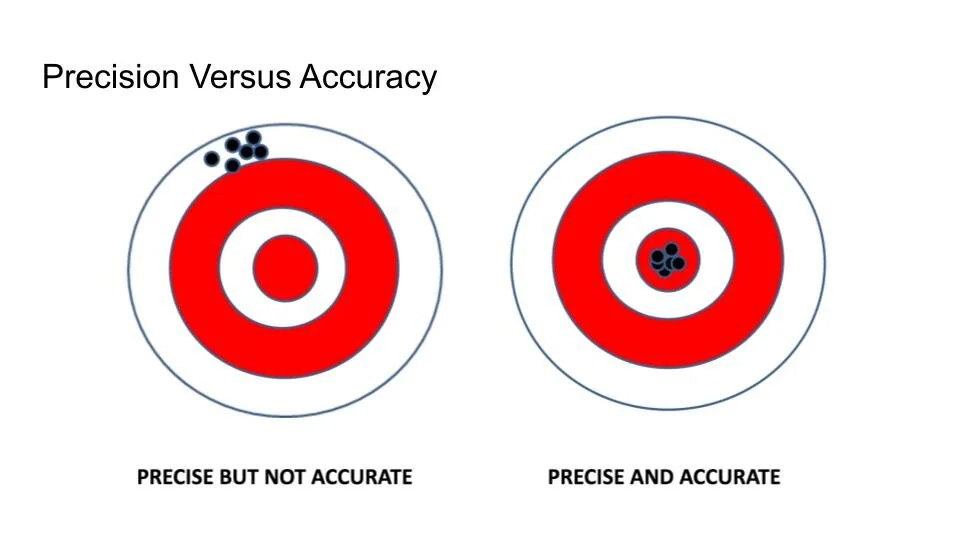
Let me illustrate this by showing you the difference between accuracy and precision. So on the left, that's precision.
17:43-17:46
Precision is how close the shots are to each other.
17:46-17:47
Precision is a good thing.
17:48-17:50
We want to have precision when we're shooting at something.
17:51-17:58
However, accuracy is more important because it doesn't matter how close your shots are if you're hitting the wrong target or off the target altogether.
17:59-18:02
Accuracy is how close the shots are to the center of the target.
18:03-18:07
So unity is how close we are to each other, which is a good thing.
18:08-18:09
But truth is how close we are to reality.
18:10-18:12
Unity by itself is not enough.
18:13-18:18
In fact, being unified apart from truth is potentially the most dangerous situation the world can face.
18:20-18:26
Because when everybody is marching in the same direction, there is going to be nobody to tell you that you're headed towards sudden destruction.
18:27-18:32
Without a target, we have no chance of knowing if we're shooting in the right direction or aimed correctly.
18:33-18:39
Now, this isn't to say that we should only hang out with people who align with the truth.
18:40-18:43
In fact, that's supposed to be what the word tolerance means.
18:43-18:48
Your tolerance has been hijacked to mean accept all differences as equally true.
18:48-18:49
Tolerance doesn't mean that.
18:50-18:53
In reality, you only tolerate things you disagree with.
18:54-18:56
If you agree with somebody, you don't tolerate it.
18:56-18:57
You agree.
18:58-19:01
If you think something is true, you're not tolerating it by definition.
19:02-19:08
You only tolerate things you disagree with and live peaceably and not fight people that have a different view than you.
19:09-19:16
So you might say, though, that, you know, do we really choose the approval of other people over truth?
19:16-19:18
Does that really happen?
19:18-19:25
In our world of fake news, virtue signaling, and social media, do I really have to convince you that we seek the approval of other people?
19:25-19:28
Is that not in our face every single day?
19:28-19:40
Unfortunately, this idea of seeking the approval of other people is another idea that creeps into the church, another idea where, you know what, if we preach the truth too much, that might offend some people.
19:41-19:47
But thankfully at Harvest, we preach God's word without apology, as we talked about a couple of weeks ago.
19:47-19:50
But this is not a popular opinion in our world today.
19:51-19:53
But popularity isn't all it's cracked up to be.
19:54-19:58
Picture this in your mind, the entire world laser focused on a unified goal.
19:59-20:02
People shouting in agreement, almost chanting.
20:02-20:06
And the excitement is growing as the mob mentality picks up.
20:06-20:11
And the more unified they are, the more fervent that the world is towards this one goal.
20:11-20:12
What does that sound like?
20:12-20:14
Almost sounds like a religion.
20:14-20:17
So I said that building a Bible starts with religion.
20:18-20:24
I'm sorry, starts with technology, but it always turns into man-made religion, if left unchecked.
20:24-20:32
Throughout the Bible, Babylon, which originates here in our story in Genesis chapter 11, Babylon represents false religion.
20:33-20:37
It starts here in this worship of self, and let's make a name for ourselves.
20:38-20:38
That happens here.
20:39-20:46
But eventually Babylon comes back as the pagan empire who sends Judah into exile, as we read about in the book of Daniel and other places.
20:47-21:02
And finally, in Revelation, after Babylon is built back better, as the false religions last stand against God, there will come a time, not long from now, when the entire world will again be unified against God.
21:03-21:08
And I can promise you that God's response will not be the same as it is here in Genesis chapter 11.
21:09-21:14
To just give you an idea of how close we are approaching that, let me share with you a little bit of a scary example.
21:15-21:22
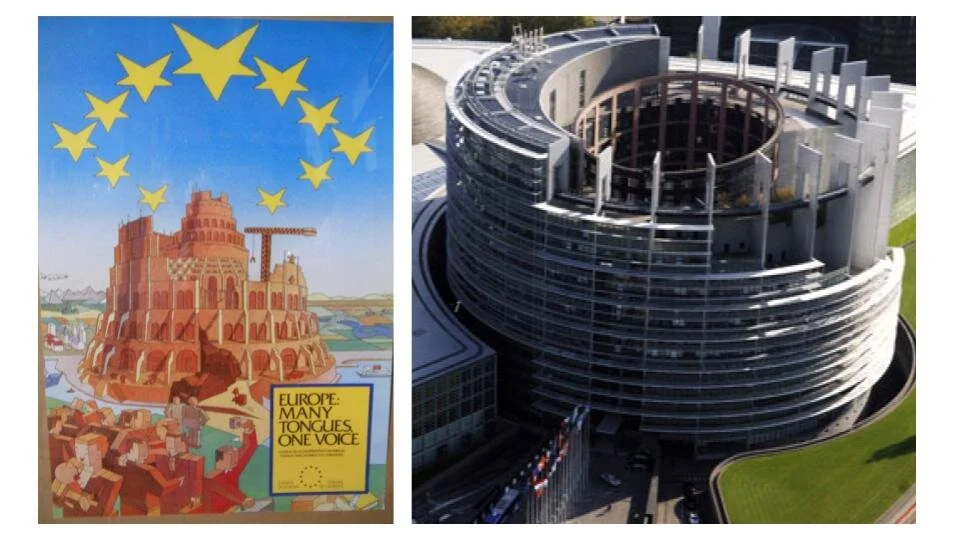
If you bring up that picture, Mike, today the European Parliament of the European Union has its official seat in Strasbourg, France.
21:23-21:29
They do most of their business in Brussels, but they do have a building here and it has a really interesting tower.
21:29-21:30
On the right is that tower.
21:31-21:40
The 1992 poster, which is on the left-hand side, looks almost identical to a really popular medieval painting of the Tower of Babel.
21:41-21:51
And the message that's on the bottom, the tagline is "Many tongues, one voice." This is a claim to overcome the confusion that God started here in Genesis chapter 11.
21:52-22:14
Now, we don't know what the real Tower of Babel looked like, but the EU's Parliament Building is deliberately an unfinished tower structure. Pretty conspicuous. So I'll leave that as food for thought. So if you want to build a babble, you need to seek the approval of other people. That's it.
22:15-22:26
It's three easy steps. So simple to follow. Let's start. Well, maybe before we start building, let's look at what God's response is to the babble of our story.
22:27-22:33
So if we look at God's response, the first thing that you should notice is is actually something sad about mankind.
22:34-22:37
Because you see, the whole world is working together on this awesome tower.
22:37-22:40
It's this great achievement, a tower that reaches to the heavens.
22:41-22:42
And then there's God.
22:42-22:44
Look what it says in verse five.
22:45-22:53
It says, "And the Lord came down to see the city "and the tower which the children of man have built." And it says it later in verse seven.
22:54-22:56
God has to come down to see this amazing tower.
22:57-23:09
Like, this is so casually written in there, but so intentionally to remind us that no matter how great of an achievement that man tries to do, God still has to condescend to be a part of it.
23:10-23:12
He can't even see it from where he is.
23:13-23:18
This is there to remind us that we cannot escape God's hugeness.
23:18-23:20
God is so much bigger than us.
23:21-23:22
And you know what?
23:22-23:25
In many ways, the people of Babel did make a name for themselves.
23:25-23:27
It just wasn't the name that they were hoping for, right?
23:28-23:37
'Cause now the people of Babel are forever enshrined in this story as people in infamy who will be always remembered as those guys that couldn't finish that tower.
23:38-23:41
So the first part of God's response is to notice kind of the sadness of man.
23:42-23:46
But there's also a sadness of God that I think you can hear in this passage.
23:47-23:49
Can you hear the disappointment of what he says in verse six?
23:50-23:51
"Behold, they are one people.
23:52-24:00
"They have all one language, "and this is only the beginning of what they will do, "and nothing that they propose to do will now be impossible for them.
24:01-24:03
God has given us everything.
24:04-24:08
And he literally gave the people of Babel, the entire earth, and they refused it.
24:09-24:18
And like a parent of spoiled children, it must pain God to see us spending so much time and energy to fight against the things that he has done for us.
24:19-24:25
But even in God's sadness, I hope you see that God's response is not random or vindictive.
24:26-24:27
His response is an act of mercy.
24:28-24:32
Mercy is when God doesn't give us something that we do deserve.
24:32-24:39
So this is an act of mercy first because God doesn't instantaneously annihilate them for their disobedience against the king of the universe.
24:40-24:40
That's mercy.
24:41-24:51
But more than that, it's mercy because this is less about punishing disobedient subjects and more about keeping out of control children from harming themselves.
24:52-25:00
When your small child runs out into the street, you discipline them to to teach them about the danger that they're going to face if they go in the street.
25:00-25:03
We put barriers across the steps.
25:03-25:06
Is that to keep our kids from having fun?
25:06-25:08
Is that because we're trying to control them?
25:08-25:12
No, it's because we care about them and we don't want them to hurt themselves.
25:12-25:14
See, it's the same thing here.
25:15-25:17
God adds a barrier to self-destruction.
25:18-25:23
He adds a barrier to unified rebellion that they were so adamant about doing.
25:24-25:31
He confuses all the languages of the earth to buy time against our bent to do things against his will.
25:32-25:33
And frankly, it's been a pretty effective move.
25:34-25:38
Even to this day, languages keep the world from total unity.
25:39-25:46
Although with current technology, software named Bemble, and other things like that, we have almost nearly overcome that.
25:47-25:49
But you need to see this as God's act of mercy here.
25:49-25:51
He's not vindictively punishing them.
25:51-25:54
He's trying to keep them from harming themselves.
25:54-25:57
And it's even benefiting us to this day.
25:58-26:04
But the last thing that you need to see about God's response is that in the end, God himself accomplishes what he commanded them to do.
26:05-26:06
Look at verses eight and nine again.
26:07-26:13
It says, "So the Lord dispersed them from there "over the face of all the earth, "and they left off building the city.
26:13-26:19
"Therefore, its name was called Babel, "because there the Lord confused "the language of all the earth.
26:20-26:24
And from there, the Lord dispersed them over the face of all the earth.
26:25-26:25
God got the job done.
26:26-26:27
This is always the case.
26:28-26:33
When we choose to do things our own way instead of God, we are never thwarting God's plan.
26:34-26:35
We are never stopping it in any way.
26:37-26:38
His will is still going to happen.
26:39-26:42
But when we build babbles, we do get two results for ourselves.
26:43-26:45
One, everything is harder like it was here.
26:46-26:48
There's confusion and now they can't work together.
26:49-26:53
But the second thing we get when we build ourselves a babel is we miss out on the blessing.
26:54-27:00
Had they obeyed what God said to fill the earth, God would have been happy to reward them for their obedience.
27:00-27:06
But instead, God accomplishes what he commanded them to do and they miss out on the opportunity to receive any blessing.
27:07-27:11
And in fact, they now have everything harder than they could have.
27:12-27:14
So, what do we do?
27:14-27:19
I think God's response should make us pause and do some self-reflection.
27:19-27:23
Building babbles is way too easy, way too easy.
27:23-27:25
And think of how often we do this in our lives.
27:26-27:36
From getting good grades in schools, to the way that we advance in our careers, from the relationships that we form, to the causes that we are adamantly passionate about.
27:37-27:41
If God is left out of these things, are we hitting the right target?
27:41-27:43
Are we just trying to make a name for ourselves?
27:44-27:46
Are we setting ourselves up for total destruction?
27:47-27:49
Look, leaving God out is way too easy.
27:50-27:59
And even scarier is how easy it is to leave God out, even when you're doing ministry in the church, even when you're preparing a sermon on the very subject.
28:01-28:03
Obviously, we don't wanna build any babbles.
28:03-28:05
So you don't really wanna do any of these steps.
28:06-28:11
So if you take your outline, and at the beginning, in front of the word, build yourself a babble, put don't.
28:12-28:15
Don't build yourself a babble in three easy steps.
28:15-28:16
We're gonna revise this.
28:17-28:21
Now that we've looked at God's direction, we don't actually wanna follow what we first wrote down.
28:21-28:27
So step one, put God's word, cross out a side and write first.
28:27-28:29
We need to put God's word first.
28:30-28:35
Step two, make it all about cross out me and write Christ.
28:37-28:43
And the last step, seek the approval of, cross out other people and write God alone.
28:43-28:46
Look, God has put it in our hearts to do amazing things.
28:47-28:51
because we bear his image, and all he does is amazing things.
28:52-28:55
And when we do awesome things, we are like our heavenly father.
28:56-29:01
But when we do anything that neglects or subverts his authority, we show ourselves to be traitors.
29:02-29:04
And as traitors, we deserve death.
29:05-29:07
The Bible says that the wages of sin is death.
29:08-29:09
And that's what we deserve.
29:09-29:15
While seeking to make a name for ourselves, the only thing we bring is infamy, confusion, and condemnation.
29:16-29:20
and without God's help, our life is nothing but an unfinished tower.
29:21-29:27
But, but, when we put God's word first, look at what it says here in Proverbs 18, 10.
29:27-29:29
The name of the Lord is a strong tower.
29:30-29:32
The righteous man runs into it and is safe.
29:33-29:41
And then in Proverbs 16, nine, it says, the heart of man plans his way, but the Lord establishes his steps.
29:41-29:46
When we put God's word first, we can see that our plans will be established.
29:46-29:50
When we put God's word first, we will see that they will not end in destruction.
29:52-30:05
And second, when we make it all about Christ, we see in Romans 10, nine, because if you confess with your mouth that Jesus is Lord and believe in your heart that God raised him from the dead, you will be saved.
30:05-30:16
And then in Acts four, it says, and there is salvation in no one else, for there is no other name under heaven, given among men by which men must be saved.
30:16-30:19
The only name that we can make for ourselves is the name of Christ.
30:20-30:23
That is the name that we should seek to apply to ourselves.
30:23-30:27
When we can make it all about Christ, we can be that finished tower.
30:27-30:31
We can be that amazing thing that God wants us to do.
30:32-30:39
And last, when we seek the approval of God alone, we can hear that amazing verse that happens in Matthew chapter 25.
30:39-30:42
God will say, "Well done, good and faithful servant.
30:42-30:44
You have been faithful over a little.
30:44-30:46
I will set you over much.
30:46-30:48
Enter into the joy of your master.
30:49-30:55
And when we seek the approval of God alone, we recognize we're not just building our own tower to make a name for ourselves.
30:55-31:00
God is building us into something greater than our own little tower that God has to come down and see.
31:00-31:02
Look at what it says in 1 Peter 2.
31:03-31:15
You yourselves, like living stones, are being built up as a spiritual house to be a holy priesthood, to offer spiritual sacrifices acceptable to God through Jesus Christ.
31:16-31:28
When we put the approval of God as the main thing that we're seeking after, we get to be a part of the amazing work that God is doing, which is gonna last forever and not be some unfinished tower.
31:28-31:34
So my challenge to you is to do awesome things, but don't do them apart from God.
31:35-31:36
Don't build yourself a babble.
31:37-31:42
You need to involve God in the planning and execution of everything that you do.
31:43-31:43
Let's pray.
31:44-31:46
Father God, I thank you for your word.
31:47-31:53
God, I thank you for the way that you are patient with your people, even when we are disobedient to you, God.
31:54-32:05
I pray now that as we think about what your word has said to us and think about our lives and evaluate where we're rebuilding ourselves, Babels, God, I pray that you would convict us.
32:06-32:10
God, that you would bring to mind the areas that we are leaving you out of.
32:11-32:20
God, that you would teach us that we need to put your word first, that we need to make it all about Christ and that we need to seek the approval of you alone.
32:21-32:23
God, I thank you that you're patient.
32:24-32:30
I thank you that you've given us your word preserved for all of time for us to learn from and to benefit from, God.
32:30-32:38
And I thank you for the group of believers that are here that we can encourage each other and tear down the babbles in our own life, Lord.
32:38-32:45
God, I pray that we would be a people unified, but a people unified for your truth above all else, Lord.
32:46-32:52
And I thank you that you are with us in all of this, God, that you are empowering these efforts to serve you.
32:53-32:58
And so I pray, God, that we would do nothing apart from you, but do everything for your glory.
32:58-33:00
In Jesus' name we pray, amen.
Small Group Discussion
Read Genesis 11:1-9
What was your big “take-away” from this passage / message?
What babels have you built before? Are you building any now?
What is one thing that you learned from this passage? And how will this change you?
Applying the revised 3 steps, what practical and specific steps can you take to ensure that you don't build a babel?
Breakout
Pray for one another.