
Introduction:
For to us a child is born,
to us a son is given;
and the government shall be upon his shoulder,
and his name shall be called
Wonderful Counselor, Mighty God,
Everlasting Father, Prince of Peace.
~Isaiah 9:6
You Will Call Him... (Isaiah 9:6)

How Can a Baby Be an Everlasting Father?
- Everlasting: Born , but without Beginning .
Luke 2:25-32 - ...waiting for the consolation of Israel...
...revealed to him by the Holy Spirit that he would not see death before he had seen the Lord's Christ.
...my eyes have seen your salvation
that you have prepared in the presence of all peoples,John 8:56-58 - "Truly, truly, I say to you, before Abraham was, I am."
- Father: Unique , but Exactly Identical .
Hebrews 1:2-3 - ...the exact imprint of his nature"
Colossians 1:15-19 - in him all the fullness of God was pleased to dwell...
...you do know him and have seen him."John 14:6-10 - Whoever has seen me has seen the Father."
- Provider (Luke 11:9-13)
- Role Model (Eph 4:32-5:2)
- Selflessness
What Do We Need from a Father?
Sermon Notes (PDF): BLANK
Hint: Highlight blanks above for answers!
-
01:20-01:33
Good morning, everyone. In the late 1920s, Walter Chrysler, the president, owner of Chrysler Motor Company, had a dream. He wanted to build the world's tallest building in New York City.
01:34-01:40
Chrysler involved himself in every aspect of that construction, its design.
01:40-01:43
It was going to be a monument to himself, to his company.
01:45-02:05
He poured over the drawings that his architect would send him, and he made changes, and he wanted to incorporate automotive elements, things like hubcaps on the outside of the building and gargoyles in the shape of eagles that looked like the eagles that they put on the hood ornaments of his cars.
02:06-02:09
And he just invested himself in every way in this building.
02:09-02:11
He paid the full price out of his own pocket.
02:12-02:17
And he had an elaborate office built for himself in the building.
02:17-02:23
He had an apartment, including what he liked to boast was the highest bathroom in the city of New York City.
02:25-02:29
He was going to have a showroom on the first couple floors of the building.
02:29-02:33
and it was ultimately going to be Chrysler's world headquarters.
02:34-02:42
It was just an Art Deco masterpiece of modern design, technology, power, prestige.
02:42-02:48
Well, as I said, he involved himself in every way in the construction of this building.
02:49-03:19
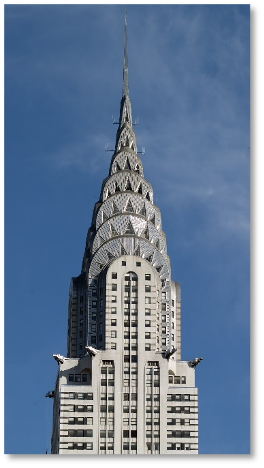
And the day after the spire was raised up through the roof and installed, Walter Kreisler and his architect William Van Allen took a construction elevator up to about the 60th floor or so and from there they started climbing ladders inside the building up to the peak of the building. Now I'm sure you've probably seen pictures of the Kreisler building, right? You're familiar with this.
03:20-03:27
It's just a beautiful building. But they climbed all the way up as high as they could go inside the building.
03:28-03:32
And then they crawled out that window at the very top.
03:32-03:36
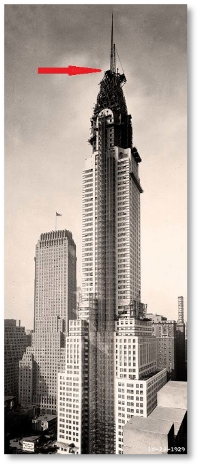
Now you can barely see it, but there's a window at the very top of that building.
03:36-03:41
They crawled out of that window onto scaffolding.
03:41-03:45
So you can see the picture of the scaffolding there, where that arrow is.
03:45-03:47
They crawled out there on scaffolding.
03:47-03:52
No railings, no harnesses.
03:52-03:54
Osho wasn't around then.
03:54-03:56
They're out there.
03:57-04:02
I'm like, "Oh my, oh my." This is insane.
04:02-04:03
But there they are.
04:03-04:10
Because Chrysler wanted to put his hand on that spire and get his picture taken doing it.
04:10-04:30
Now, if you think Walter Chrysler went to extreme measures to connect with the pinnacle of his creation, well, you ain't seen nothing yet because what God did to connect with the pinnacle of His creation is in many ways beyond our comprehension, but not beyond our ability to understand.
04:31-04:39
Because God so loved the world that He gave His only Son, that whoever believes in Him would not perish, but have everlasting life.
04:40-04:40
Let's pray.
04:41-04:44
Our gracious Father, give us eyes to see.
04:45-04:48
Give us eyes to see Jesus as our everlasting Father.
04:49-04:58
This is, it beggars the imagination that you would do this, but you have and you are.
04:59-05:00
Teach us this morning.
05:00-05:04
I ask that you help me to speak clearly so that we all understand.
05:05-05:09
And we ask in the great name of our Savior Jesus, amen.
05:11-05:13
So we return to our text, Isaiah 9.6.
05:14-05:33
For to us a child is born, to us a son is given, and the government shall be upon his shoulder, and his name shall be called Wonderful Counselor, Mighty God, Everlasting Father, Prince of Peace." Now before I get started here, I have a couple of housekeeping notes for us.
05:33-05:38
The first is that Isaiah 9.6 does not describe the Trinity.
05:38-05:41
We don't see Father, Son, Holy Spirit here.
05:42-05:54
Now there was probably a time in my walk with Christ where I first read Isaiah 9.6, "Oh, wonderful counselor, that's the Holy Spirit, everlasting Father, God the Father." All three, they're all right here.
05:54-05:58
Well, that passage does not describe the Trinity.
05:58-06:08
These are all names for the Messiah, who is 100% human, 100% God, without any blurring or blending of those two natures.
06:09-06:25
The second housekeeping note is, when Jeff gives me an opportunity to speak, I get really excited and my mind starts racing and I just think if I'm going to say something about anything, I want it to be about everything.
06:26-06:35
I want to get up here and explain this grand cosmological, Christological meta-narrative and Jeff is like, "You know what I think.
06:36-06:37
I'll tell you what I think.
06:37-06:39
I think you don't know what you're talking about.
06:39-06:43
You don't know what any of those words mean, Rich." I'm like, "Jeff, you're right.
06:43-06:44
You keep it simple.
06:45-06:47
Keep it simple, but here we are.
06:48-06:49
Here we are.
06:50-06:53
A son is given and he's an everlasting father.
06:55-07:07
The goal of today's message is not just to see how Jesus is an everlasting father, but for you to understand and for you to be able to say, "Jesus is my everlasting father." So that's our question.
07:07-07:10
How can a baby be an everlasting father?
07:11-07:12
How can this be?
07:13-07:16
Well, let's look at the two parts of this name.
07:17-07:18
First, we'll look at everlasting.
07:19-07:23
Jesus was born, but he's without beginning, right?
07:24-07:25
We have some common ideas about Jesus.
07:26-07:28
Maybe before we're saved, we have ideas about Jesus.
07:29-07:36
Maybe even after we're saved, we're like, well, let's see, Jesus came into being when he was born.
07:36-07:39
He didn't exist before he was born.
07:39-07:47
They just talked about him, but he came into being when he was born and he became divine through his good works.
07:48-07:51
God was so pleased with him, he made him a God.
07:52-07:53
That's not the case.
07:54-08:08
Or maybe Jesus became divine on the day when he was baptized and the Holy Spirit came down as a dove and the Father said, "This is my beloved son with whom I'm well pleased." That's when Jesus became God.
08:08-08:09
No, no.
08:10-08:21
And of course, there were all kinds of crazy ideas throughout the history of the church that well, Jesus wasn't even human, he was just like an aura, because the body's evil, so God couldn't take on a body.
08:21-08:28
So Jesus was just kind of like this spirit being, and not only was he not really human, he didn't even really die on the cross.
08:28-08:31
All these ideas are wrong, right?
08:31-08:33
Jesus wasn't created when he was born.
08:34-08:41
He is eternally existent, present before and at the foundation of the world.
08:42-08:43
Jesus simply is.
08:44-08:47
You see, Isaiah wasn't just predicting Jesus' birth.
08:48-08:50
He wasn't predicting his incarnation.
08:50-08:56
He wasn't looking down like in a vision through the tunnels of time, and he saw this event.
08:56-09:02
Oh, there's a baby out there, and oh, he's gonna have these names.
09:02-09:03
It's not what's happening.
09:03-09:11
He's not looking forward, and he's not standing, so to speak, in some future vision state looking at what's going on.
09:12-09:15
He saw what is.
09:16-09:17
He saw what is.
09:18-09:20
From his point in time, he saw what is.
09:20-09:33
This is hard for us to understand, but in the Hebrew, our passage, you will know it says, "To us a son is born, is given, "but then it shifts to the future tense.
09:33-09:35
"The government shall be upon his shoulder.
09:37-09:41
"His name shall be called." That's not what the Hebrew says.
09:41-09:46
For some reason when we translate this, we figure, okay, Isaiah's in the past, he's looking to the future.
09:47-10:01
The Hebrew says, "The government is upon his shoulder, "and his name is called." So Isaiah sees this child and says what he is.
10:02-10:03
He is an everlasting Father.
10:04-10:08
He is a wonderful Counselor, a mighty God, a Prince of Peace.
10:09-10:15
It's sort of like me, if I were to come up here and say, "Hey, the Steelers are Super Bowl champs.
10:16-10:23
I've seen this snowy night in February, and the Steelers are Super Bowl champs." And you'd say, "Well, of course they are!
10:23-10:33
They're six-pack." And I'm like, "No, no, let me put on my 'Seven is Heaven' hoodie, because the Steelers are Super Bowl champs." would disbelieve me.
10:33-10:37
If I was talking about the pirates winning the World Series you'd be more likely to disbelieve me.
10:38-10:48
But the fact is Isaiah is seeing what is and he's telling the people the Messiah is an everlasting father.
10:49-10:50
See we're confined by time.
10:51-10:54
Jesus is not at all confined by time.
10:54-10:54
He's eternal.
10:55-10:59
Whether he's present at creation as we read in John chapter one.
10:59-11:18
whether he appears as the angel of the Lord to Abraham or to Gideon or Moses, whether he is a newborn, whether he's transfigured on the mountain before his disciples, whether we see him as the resurrected Lord in glory in Revelation, Jesus is.
11:19-11:30
And since we're celebrating Jesus' advent, I think it's appropriate for us to turn to Luke 2 and an account that highlights Jesus' eternality as a newborn.
11:31-11:44
If you would turn to Luke 2, verse 25, "Now there was a man in Jerusalem whose name was Simeon, and this man was righteous and devout, waiting for the consolation of Israel.
11:45-11:47
And the Holy Spirit was upon him.
11:47-11:54
And it had been revealed to him by the Holy Spirit that he would not see death before he had seen the Lord's Christ.
11:55-11:57
And he came in the Spirit into the temple.
11:58-12:11
And when the parents brought in the child Jesus to do for him according to the custom of the law, he took him up in his arms and blessed God and said, "Lord, now you are letting your servant depart in peace according to your word.
12:12-12:28
For my eyes have seen your salvation, that you have prepared in the presence of all peoples a light for revelation to the Gentiles and for glory to your people Israel." See, Simeon was waiting for Messiah.
12:29-12:30
He knew the time was right.
12:30-12:33
He was looking, as it says, for the consolation of Israel.
12:34-12:35
That means he's looking for Messiah.
12:35-12:38
He's any day now, right?
12:38-12:41
And Simeon, he didn't see any miracles.
12:42-12:43
He never saw any healings.
12:43-12:47
He didn't see Jesus lay his hand on lepers and cleanse them.
12:48-12:51
Right, he didn't see any dead people raised.
12:51-12:53
He never even heard Jesus preach or teach.
12:54-12:56
He didn't see his death and resurrection.
12:57-13:02
And yet Simeon considered the work of Messiah as good as done.
13:03-13:03
Why?
13:04-13:06
Because he knew the promises of Isaiah 9.
13:07-13:11
He knew the promises that Messiah would be the salvation of all people, even Gentiles.
13:12-13:17
And of course now he is seeing the personal promise made to him by the Holy Spirit fulfilled.
13:18-13:30
For Simeon seeing the child was enough because he knew the eternality of the one who promised the eternal Messiah, whom he's now holding in his arms.
13:31-13:32
We just sang that song.
13:32-13:33
Mary, did you know?
13:34-13:37
Simeon's holding God in his arms and he knows.
13:38-13:39
It's done, it's good as done.
13:40-13:40
We're saved.
13:41-13:43
God has delivered us.
13:44-13:51
The fact that the child had been born was assurance that everything else necessary for salvation was going to be accomplished.
13:53-14:01
Simeon saw not just the baby, he saw and believed in the finished work, even though he was not going to live to see it.
14:01-14:03
But Simeon also knew there was more to come.
14:04-14:10
He knew the child would grow and become both suffering servant and the righteous ruler of Israel.
14:11-14:18
Simon knew what the law and the prophets said about Messiah, which leads us to what Jesus said as an adult.
14:19-14:22
And we've covered this with Jeff in his messages.
14:23-14:29
In John chapter eight, Jesus is contending, disputing with the Pharisees.
14:30-14:39
And he gets to the point where he says, "Your father Abraham rejoiced "that he would see my day, "and he saw it, and he was glad.
14:40-14:51
"So the Jews said to him, "'You're not yet 50 years old, "'and you have seen Abraham.' "Jesus said to them, Truly, truly, I say to you, before Abraham was, I am.
14:52-14:58
You can't get a clearer declaration that Jesus is God than that right there.
14:58-15:01
And they knew it, and they were gonna stone him for it.
15:02-15:10
Yes, Abraham, Abraham saw him, as did Moses and Gideon and Isaiah and Simeon.
15:10-15:14
They all saw the eternal Messiah, Jesus.
15:15-15:17
and seeing, as they say, is believing.
15:18-15:23
I tell you, it's difficult to have a temporary outlook on life.
15:23-15:29
It's difficult to have a temporary theology when your God says, "I am eternal.
15:30-16:13
"My steadfast love is forever." Right, when God revealed himself to Moses, he said in Exodus 34, verse six, He said, "The Lord, the Lord, a God merciful and gracious." But really what he's saying there is, "I am, I am a God merciful and gracious, slow to anger and abounding in steadfast love and faithfulness, keeping steadfast love for thousands." When we contemplate that Jesus is God and He is God with us, we can have the assurance that things aren't just gonna be okay, but everything is gonna be great.
16:14-16:15
So let's look at the next part, Father.
16:17-16:18
What do we know about Father?
16:18-16:25
Well, His everlasting Father, Jesus, is unique, but He's exactly identical.
16:26-16:29
So again, we have common ideas about God the Father, right?
16:30-16:37
In some religions, some systems of Christianity, God's mad at you.
16:38-16:39
He's really mad at you, and you know what?
16:39-16:41
Jesus isn't too pleased with you either.
16:42-16:44
So what you've got to do, you've got to pray to Mary.
16:45-16:46
She's like mom.
16:46-16:47
You know, mom's nicer.
16:48-16:49
And you can pray to the saints too.
16:50-16:51
They'll help you out.
16:54-16:58
Some people think that the Old Testament God is not like the New Testament God.
16:59-17:01
He's all wrath and anger.
17:03-17:05
Whereas the New Testament God, Jesus is love.
17:05-17:07
Everything's love. Everything's good.
17:07-17:09
No judgment zone here.
17:10-17:21
But the verse I just read, Exodus 34, a God merciful and gracious, slow to anger, and abounding in steadfast love and faithfulness, that's Jesus.
17:23-17:25
Another view is that he's kind of remote.
17:26-17:29
God the Father, it's far away.
17:30-17:33
I don't get him, I know he doesn't get me.
17:33-17:54
He's just remote, he's disconnected, he's up there, handing out rules like, "Do this, follow these rules. You better do this now or I might zap you." He's just this imposing faraway God who's totally a do as I say supreme being.
17:55-17:59
Beloved, those ideas are completely wrong. This is what the scripture says.
18:00-18:06
Hebrews chapter 1, I only have verses 2 and 3 up here, but I'm going to start at verse 1.
18:06-18:11
Long ago, at many times and in many ways, God spoke to our fathers by the prophets.
18:12-18:20
But in these last days, he has spoken to us by his son, whom he appointed the heir of all things, through whom he also created the world.
18:21-18:26
He's the radiance of the glory of God and the exact imprint of his nature.
18:27-18:36
And then Paul tells us in Colossians 1.15-19, he is the image of the invisible God, the firstborn of all creation.
18:37-18:48
For by him all things were created in heaven and on earth, visible and invisible, whether thrones or dominions or rulers or authorities, all things were created through him and for him.
18:48-18:52
And he is before all things, and in him all things hold together.
18:53-19:02
For in him all the fullness of God was pleased to dwell." See, the Greek word for imprint is character.
19:03-19:05
It's the basis of our word character.
19:07-19:12
And it can mean the tool used to engrave something.
19:12-19:16
It can also mean the one doing the engraving, creating the image.
19:16-19:26
But for our purposes, the meaning is the exact expression or a precise reproduction in every respect.
19:26-19:30
So Jesus is not like a carbon copy of God.
19:31-19:32
He's not a mimeograph.
19:33-19:33
You know what that is?
19:33-19:40
I know some of you, just by my saying mimeograph, you can see the purple print and smell that fluid.
19:42-19:43
I'm very old.
19:46-19:50
Jesus is not even like a Xerox of God, right?
19:50-19:58
Because if you know something about Xeroxes, you know, when you start making a copy, the multiple copies begin to degrade, right?
19:59-20:01
They're not like the original, right?
20:01-20:07
And you've seen copies, you know, they got all these little speckles all over 'em and they're crooked, right?
20:08-20:14
So no, Jesus is exactly like the Father.
20:15-20:22
Quite simply, Jesus is the glorious exact representation of God the Father and in him, all the fullness of God dwells.
20:23-20:44
If you wanna know who God is, what he's like, what he thinks of his creation, what he thinks of people, "What he thinks of you, look at Jesus in the scripture." And Jesus also had quite a few things to say about his relationship to the Father, and perhaps nowhere more clearly than on the night before he was crucified.
20:45-20:54
Jesus was talking with his disciples, and he's talking to Philip, and he says to Philip, "I am the way, the truth, and the life.
20:55-20:58
"No one comes to the Father except through me.
20:58-21:01
"If you had known me, you would have known my father also.
21:02-21:16
"From now on, you do know him, and you have seen him." Philip said to him, "Lord, show us the father, "and it's enough for us." Jesus said to him, "Have I been with you so long, "and you still do not know me, Philip?
21:17-21:19
"Whoever has seen me has seen the father.
21:20-21:22
"How can you say, 'Show us the father'?
21:22-21:25
"Do you not believe that I am in the father, "and the father is in me?
21:26-21:34
"The words I say to you I do not speak on my own authority, "but the Father who dwells in me does his work." It can't be any clearer.
21:35-21:36
Do you want to know the Father?
21:37-21:39
Then fix your eyes on Jesus.
21:40-21:45
Now I thought about what is it we need from a father?
21:46-21:47
Well, we need many things.
21:47-21:51
And to list them all would keep us here for a week, so I'm not gonna do that.
21:52-21:56
But I would like to look at three things that we do need from a father.
21:56-21:57
We need a provider.
21:58-22:00
We need a role model.
22:01-22:03
And we need a man who is selfless.
22:04-22:14
Now our earthly fathers, they are or they were, they demonstrated these qualities, perhaps to greater or lesser degrees.
22:15-22:22
But Jesus is the exact imprint of God the Father is all of these things far more abundantly than we can ask or think.
22:23-22:26
Let's look first at provider.
22:26-22:40
Jesus, after he taught his disciples to pray and told them a parable about asking urgently and persistently, says at Luke 11:9, he says, "And I tell you, ask, and it will be given to you.
22:40-22:42
"Seek, and you will find.
22:42-22:44
"Knock, and it will be opened to you.
22:45-22:53
"For everyone who asks receives, "and the one who seeks finds, "and the one who knocks, it will be open.
22:53-22:59
"What father among you, if a son asks for a fish, "will instead of a fish give him a serpent?
23:00-23:02
"Or if he asks for an egg, will give him a scorpion?
23:02-23:15
"If you then, who are evil, "know how to give good gifts to your children, "how much more will the heavenly father "give the Holy Spirit to those who seek him?" So as children, we need our needs provided for.
23:16-23:21
And our fathers, again, to a greater or lesser extent, took care of our needs.
23:22-23:31
My father rarely gave me all the things I wanted, but I don't think he ever gave me anything that I wanted, come to think of it.
23:32-23:33
(audience laughing)
23:33-23:37
But he always gave me the things that I needed.
23:38-23:41
And God knows we have needs.
23:42-23:43
And he wants us to ask.
23:44-23:46
But this is not prosperity gospel.
23:46-23:48
Please don't misunderstand me here.
23:48-23:49
This is not prosperity gospel.
23:50-23:51
It's not the things that we want.
23:52-23:57
God wants us to pray and talk with him about what we need.
23:57-24:04
And 'cause what happens over time is God impresses on our mind, oh, Lord, you're right, that's what I really need.
24:04-24:08
I wanted this, but you're telling me I need this and you're right.
24:09-24:14
And what he tells us most of all that we need is God himself, the gift of the Holy Spirit.
24:15-24:18
The second thing we need from a father is a role model.
24:19-24:22
And this sort of partakes of presence.
24:22-24:27
I use role model, but there's an aspect of presence to this, right?
24:28-24:31
Because as little children, we need examples.
24:32-24:37
We need an example to follow, to imitate, and to understand what right looks like.
24:37-24:42
And for that to happen, it requires the father to be present.
24:43-24:46
And I understand, some of us, we haven't always had a father who was present.
24:47-24:49
And that was a bad role model.
24:50-24:52
But we're looking at a good role model this morning.
24:53-24:57
And by being present, we speak even without words.
24:58-25:04
I was reminded of this recently by my grandson who is staying with us.
25:04-25:07
He loves to help me feed the cats at night.
25:07-25:16
We have three cats and he's like, "I help, I help, eat, eat, I help." And he gets up there and he helps me put the food in the bowls.
25:16-25:18
Well, one of our cats has to take some medication.
25:19-25:21
So I smash that up in there, mix it up in the food.
25:22-25:23
And then we'd go down and we'd put the bowls down.
25:25-25:29
And because the one cat has medicine, we don't want the other two eating it.
25:30-25:32
Well, the other two, they're dum-dums, they don't know that.
25:33-25:39
So we got a gray cat, he just like comes over, pushes the orange one out of the way and tries to eat his food.
25:39-25:45
And I have to stand there and watch them and I'm like, okay, no, I promise you, I don't kick my cats.
25:45-25:47
but I just move him with my foot.
25:48-25:50
Go back to your own bowl.
25:51-25:53
My grandson's standing there watching this.
25:55-25:57
He's pushing the cats around.
25:57-26:05
And I'm like, wow, I have to be careful what I say and do because he's going to copy me instantly.
26:06-26:14
So as you can see, I by no means hold myself out as a paragon of fathering or an ideal to follow.
26:14-26:20
But Jesus, yes, he is the ultimate fatherly role model for us to imitate.
26:21-26:31
Listen to the qualities that Jesus models and that Paul says we should imitate in Ephesians 4:32-5.
26:32-26:38
He says, "Be kind to one another, tenderhearted, "forgiving one another, as God in Christ forgave you.
26:39-26:52
"Therefore, be imitators of God as beloved children and walk in love as Christ loved us and gave himself up for us, a fragrant offering and sacrifice to God.
26:53-26:54
You see, our culture denies it.
26:55-27:03
We ourselves may not always be conscious of it, but a father is the center point around which children's lives orbit.
27:04-27:10
For good or for ill, the father is the one to whom we all refer back.
27:11-27:21
Even when we're grown, even as adults, even if our fathers are gone, we look back and we either have a good example or there's absence.
27:21-27:32
And for some looking to our father, that's soulless and for others it's pain because they yearn for a father who wasn't present.
27:33-27:37
But for us, the good news is Jesus is always present.
27:38-27:51
The Bible says, "I will never leave you nor forsake you." And Jesus said, "Behold, I am with you always to the end of the age." In John 14, verse 18, he says, "I will not leave you as orphans.
27:51-28:00
I will come to you, yet a little while, and the world will see me no more, but you will see me, because I live, you also will live.
28:01-28:13
In that day, you will know that I am in my Father, and you in me, and I in you." Jesus is the God-man who connects us directly to the triune God.
28:14-28:15
There's no separation.
28:15-28:17
He's got a hand on us.
28:17-28:18
He's laid hold of us.
28:18-28:24
He's laid hold of the Father, and he connects us directly to the Trinity.
28:25-28:27
There's no separation.
28:27-28:30
Jesus is always present with us.
28:31-28:35
And then the last thing, we need a Father who is selfless.
28:36-28:41
You see, a good father will give time, spend time, give attention to his children.
28:42-28:43
And that partakes of sacrifice.
28:44-28:49
It partakes of laying down one's life a little bit at a time.
28:49-28:55
A father has to set aside his own wants and desires for his children's needs.
28:56-28:57
And again, not all fathers do this.
28:59-29:01
But a good father would do this.
29:02-29:10
And I dare say a good father would give his life for his child, would substitute his own life if it meant that his child could live.
29:11-29:21
You know, go back to Walter Kreisler, standing up there in the wind and the cold on top of his building, you know, kind of teetering up there.
29:21-29:26
What if he had fallen headlong off the building, plunged to the sidewalk below?
29:27-29:30
That's all we would remember about Walter Kreisler, wouldn't it?
29:30-29:41
"Oh yeah, that guy that fell off of his building 'cause he was just so proud he wanted to go up there and touch the top of it." What a fool, what folly.
29:41-29:45
You know, we wouldn't think about this beautiful Art Deco building anymore, right?
29:45-29:51
We would, oh, we would remember about Walter Chrysler as he's the guy that plunged headlong off his building.
29:52-29:52
Guess what?
29:53-29:57
Jesus plunged headlong into our existence.
29:58-30:06
He emptied himself by taking on the form of a servant and being born in the likeness of men and selflessly gave his life to redeem ours.
30:06-30:12
Jesus gave the last full measure to connect with us, the pinnacle of his creation.
30:13-30:24
This might seem like foolishness and folly to some people, but we know the foolishness of God is wiser than men and God chose what is foolish to shame the wise.
30:25-30:43
Now you may be wondering, "Well, what do I do in response to this message?" "I really don't want you to do any specific thing." "I don't want you to do something." The goal of this message is to renew your mind and cause you to think about Jesus in ways perhaps you haven't before.
30:44-30:54
Because as your mind is renewed and transformed and conformed to the truth of God's word, you will quite naturally do what God wills.
30:55-30:58
and it will come naturally to keep God's commands.
30:59-31:28
See, in our case today, whether you've had a great earthly father or you're among those of us who did not, I want you in your inmost being to lean into the truth that you have an everlasting father in Jesus who provides what you need, who is always present, and who selflessly gave himself and gives of himself for you who loves you with a steadfast everlasting love.
31:29-31:37
I want you to say with great confidence that indeed Jesus is my everlasting Father.
31:37-31:38
Let's pray.
31:39-31:44
Oh great God, merciful, kind, loving, gracious.
31:45-31:52
We praise you for the gift, for your indescribable gift of our Lord Jesus Christ.
31:53-32:03
Help us, Lord, to see Him always as our wonderful Counselor, our mighty God, our everlasting Father, our Prince of Peace.
32:04-32:07
And it's in His great name we ask, amen.
Small Group Discussion
Read Isaiah 9:6
What was your big “take-away” from this passage / message?
Do you think of Jesus as eternal? How has your understanding of Jesus’ eternality increased as you have matured in Him?
If available, read different translations of Isaiah 9:6 (HBC uses the English Standard Version, or ESV). How do those translations differ, if at all? How does the present tense of the verb “to be” (used in the Hebrew text) affect your understanding of Jesus?
In what ways are we helped by knowing Jesus is “the exact imprint” of God? How does that affect your understanding of God?
What are ways Jesus models God the Father for us?
If you do not or did not have a positive relationship with your earthly father, how can Jesus as your everlasting father transform and satisfy your need for that essential relationship?
Breakout
Pray that Jesus will reveal Himself to you as your everlasting father.