
When Life Seems Empty

Finding Balance in an Unbalanced World

Introduction:

How Can I Live a Balanced Life:
(Ecclesiastes 7:15-8:1)

  1. By choosing to be Godly Instead of Unrighteous and Self-Righteous . (Eccl 7:15-20)

In God you come up against something which is in every respect immeasurably superior to yourself. Unless you know God as that - and, therefore, know yourself as nothing in comparison - you do not know God at all. As long as you are proud, you cannot know God. A proud man is always looking down on things and people; and, of course, as long as you are looking down, you cannot see something that is above you.

- C.S. Lewis

  1. By choosing to be Wise Instead of Arrogant and Foolish . (Eccl 7:21-29)
  1. By choosing to Stand Out Instead of Blend In . (Eccl 8:1)

    Isaiah 5:20 - "Woe to those who call evil good and good evil, who put darkness for light and light for darkness, who put bitter for sweet and sweet for bitter."

Sermon Notes (PDF): BLANK
Hint: Highlight blanks above for answers!

  • 00:49-00:53

    All right, so you can open your Bibles to Ecclesiastes chapter 7.

    00:54-00:56

    Now for those of you who know me, I've preached many times at this church.

    00:56-01:01

    This is my first sermon as the associate pastor, so I'm not going to play it safe.

    01:01-01:03

    I'm going to be a little bit dangerous.

    01:04-01:06

    I'm going to pull someone out of the audience to help me with my opening illustration.

    01:07-01:10

    I can hear stomachs churning. I can hear knees knocking.

    01:10-01:18

    I can hear people thinking, "I knew I didn't like this guy. I knew something was off about him." You know what? I'm not going to pull someone out of the audience, but I will ask for a volunteer.

    01:18-01:20

    Who would love to help me with my opening illustration?

    01:22-01:22

    Anybody?

    01:24-01:24

    Brian?

    01:25-01:25

    Brian, you wanna help me?

    01:26-01:26

    All right, man.

    01:27-01:28

    Everyone give Brian a round of applause.

    01:31-01:33

    Brian just asked if he's gonna regret it.

    01:33-01:33

    You might.

    01:34-01:35

    So we're gonna see what's gonna happen.

    01:35-01:37

    So Brian, I want you to go open that door.

    01:37-01:38

    I want you to bring out what you find over there, okay?

    01:40-01:41

    Well, just the first thing.

    01:44-01:45

    Oh yeah, bring that over here.

    01:46-01:48

    So Brian, this is my office chair.

    01:48-01:49

    I want you to sit down in it, okay?

    01:51-01:51

    Yes, right there's good.

    01:53-01:54

    All right, do you get dizzy?

    01:56-01:58

    Okay, well, we're definitely gonna find out.

    01:58-02:03

    All right, so I would have done this myself, but I get bad vertigo sometimes.

    02:03-02:05

    I kinda need my mind working for the rest of this sermon.

    02:06-02:11

    What we're gonna do, Brian, is that we're gonna spin you around in my nice office chair and we're gonna see if you can walk in a straight line after that.

    02:12-02:12

    How's that sound?

    02:13-02:13

    Will you catch me?

    02:15-02:15

    You know what?

    02:16-02:18

    We have a volunteer to catch Brian if he falls over here.

    02:18-02:19

    Anybody's willing to do that?

    02:20-02:21

    Anybody, you wanna do that?

    02:21-02:22

    All right, you stand over there.

    02:23-02:24

    All right, I'll do that just for you.

    02:24-02:26

    How many spins should I do, what do you think?

    02:27-02:29

    20, it sounds like way too much.

    02:29-02:30

    Okay, I don't know about that.

    02:30-02:31

    How about 10, how about 10?

    02:32-02:33

    So you count each spin, okay?

    02:34-02:35

    Make sure you keep me honest.

    02:35-02:35

    All right, we ready?

    02:36-02:37

    Assume the position.

    02:38-02:39

    I guess that's the position.

    02:40-02:41

    All right, are you ready?

    02:44-02:45

    You're heavier than I thought.

    02:46-02:46

    (laughing)

    02:51-02:52

    Oh, an extra one.

    02:53-02:54

    All right, go.

    02:57-02:58

    We good, are we good?

    02:59-03:01

    All right, everybody give Ryan a round of applause for that.

    03:01-03:02

    Thank you so much.

    03:06-03:10

    Now some of you are thinking, Taylor, that was really funny and all, but what was the point of that?

    03:11-03:12

    We've all had that experience, right?

    03:13-03:15

    where you feel totally dizzy and off balance.

    03:15-03:18

    I hate that feeling.

    03:19-03:21

    How often does life feel like that?

    03:23-03:41

    We're spun around, round, and around by world events, difficult trials, the frustrations of daily life, and we feel totally unable, totally unequipped to walk on the path that God has laid out for us in his word.

    03:42-03:48

    Life is a difficult journey, and we can lose our footing at any time.

    03:49-03:52

    That's how Solomon feels at this point in the book of Ecclesiastes.

    03:52-04:05

    This book is all about Solomon searching for wisdom and meaning, and he has reached the ceiling of what this world has to offer, and he realizes it's all meaningless apart from God.

    04:06-04:12

    He's come face to face with the reality that he's been wrong about a lot of things for a very long time.

    04:12-04:23

    His search has spun him around and around and around, and he desperately desires the balance and stability that only God can provide.

    04:24-04:37

    In Ecclesiastes 7, verse 15, through chapter eight, verse one, Solomon presents living life God's way as a high wire act, with sinful and deadly extremes on either side.

    04:38-04:44

    And walking this tightrope successfully involves making three choices every single day.

    04:44-04:49

    And we're gonna spend the rest of this message unpacking those three choices.

    04:50-04:52

    So let's jump into the first section of our passage this morning.

    04:52-04:56

    It's Ecclesiastes chapter seven, verses 15 through 22.

    04:57-04:58

    Solomon writes this.

    04:59-05:02

    In my vain life, I have seen everything.

    05:03-05:05

    So Solomon seems like he's in a really good mood right off the bat.

    05:06-05:16

    There is a righteous man who perishes in his righteousness "When there is a wicked man who prolongs his life "and his evil doing, be not overly righteous "and do not make yourself too wise.

    05:17-05:18

    "Why should you destroy yourself?

    05:19-05:21

    "Be not overly wicked, neither be a fool.

    05:22-05:24

    "Why should you die before your time?

    05:25-05:29

    "It is good that you should take hold of this "and from that withhold not your hand.

    05:29-05:32

    "For the one who fears God shall come out from both of them.

    05:32-05:36

    "Wisdom gives strength to the wise man, "more than 10 rulers who are in a city.

    05:36-05:41

    "Surely there is not a righteous man on earth does good and never sins.

    05:42-05:46

    Do not take to heart all the things that people say, lest you hear your servants cursing you.

    05:47-05:52

    Your heart knows that many times you yourself have cursed others.

    05:53-05:56

    So I want each of you to ask yourself this one question this morning.

    05:57-05:59

    How can I live a balanced life?

    06:00-06:02

    How can I live a balanced life?

    06:02-06:08

    Number one, by choosing to be godly instead of unrighteous and self-righteous.

    06:09-06:14

    by choosing to be godly instead of unrighteous and self-righteous.

    06:17-06:32

    So Solomon points out a really harsh reality that we all come face to face with every single day. Those who do the right thing often seem to suffer for it, while those who are content to do the wrong thing seem to be doing just fine.

    06:33-06:43

    Anybody else besides Solomon ever notice, "Friend, you're struggling at work to make any progress or have any success, but that guy who always cuts corners and tells lies, he's always getting the promotion.

    06:44-06:54

    You turn on TV and you see shady and corrupt people living in the laps of luxury while you're sitting at your kitchen table cutting giant eagle coupons and struggling to save for the future.

    06:56-07:01

    At first glance, it seems like Solomon is telling us, you know what, righteousness is a waste of time.

    07:03-07:04

    Let's read that again.

    07:05-07:11

    There is a righteous man who perishes in his righteousness wicked man who prolongs his life and his evil doing.

    07:11-07:14

    Be not overly righteous and do not make yourself too wise.

    07:14-07:16

    Why should you destroy yourself?

    07:17-07:18

    Is he saying, yeah, you know what?

    07:18-07:19

    There's no point.

    07:19-07:21

    Nice guys finish last.

    07:21-07:23

    Don't bend over backwards to be godly.

    07:23-07:24

    Is that really what he's saying?

    07:25-07:30

    It can't be because it goes totally against the teaching of the rest of scripture.

    07:30-07:33

    And he also tells us, don't be wicked either.

    07:34-07:37

    That path leads to death and destruction.

    07:37-07:52

    In the original Hebrew, when Solomon says, "Do not be overly righteous," this could also be translated as, "Do not pretend to be righteous," or "Do not be self-righteous." Do not be self-righteous.

    07:52-07:54

    In other words, don't be a religious figure going through the motions.

    07:55-07:59

    Don't be a judgmental person who looks down your nose at other people.

    08:00-08:07

    Find the biblical balance between these two things, between unrighteousness and self-righteousness.

    08:07-08:08

    What is that middle ground?

    08:09-08:12

    It's genuine, true godliness.

    08:13-08:23

    It's being a person of humble integrity who does the right thing, not because you have to, but because you want to, because you love God and you want to please Him.

    08:25-08:26

    Now, I know what many of you are thinking right now.

    08:26-08:27

    Taylor, you know what?

    08:27-08:28

    I get it.

    08:28-08:29

    Self-righteous is bad.

    08:30-08:30

    It's horrible.

    08:31-08:33

    I just don't really struggle with it very much.

    08:35-08:36

    I heard somebody laughing, so that's a good sign.

    08:37-08:37

    You know, what's wrong with this?

    08:37-08:39

    Are you really sure about that?

    08:40-08:41

    Let me give you some examples.

    08:42-08:51

    Have you ever had someone in your life do something really stupid, really wrong, and you look at them and think, man, what an idiot, I would never do that in a million years.

    08:52-08:53

    Is that self-righteous?

    08:54-08:56

    Oh yeah, and we do that all the time.

    08:57-09:05

    We play the comparison game where to make ourselves feel better about what we're doing, we look at somebody else who appears to be doing something much worse.

    09:05-09:15

    "You know what, I'm not the best, I'm not perfect, but at least I'm not cheating on my spouse and getting drunk every night." Bravo, what a high bar to clear, right?

    09:16-09:25

    You've had a hard time accepting a word of rebuke from a fellow Christian who in love comes to you and says, "You know what, I'm just really concerned about how you're talking to your wife.

    09:26-09:31

    Really concerned how you're treating your kids and really worried that you're allowing work to just take over your life.

    09:32-09:38

    Instead of humbly receiving that, You turn the tables on them, and you make them out to be the bad guy.

    09:38-09:42

    You make them to be the self-righteous one, not you.

    09:43-09:44

    How about this?

    09:44-09:52

    Has your opinion of a fellow believer ever dropped because they didn't hold to certain standards that you have that aren't even biblically commanded?

    09:53-09:56

    They drink and you don't, and you think, why do they do that?

    09:56-09:57

    It makes you think a lot less of them.

    09:57-10:04

    Or maybe someone in this church dresses too casually for your liking on Sunday mornings it makes you think a little bit less of them.

    10:05-10:12

    Without even realizing it, we can be like the Pharisees and come up with these man-made rules and put them on other people.

    10:14-10:19

    Let's look at another example of self-righteousness in chapter seven, verses 21 through 22.

    10:20-10:26

    Solomon writes, "Do not take to heart "all the things that people say, "lest you hear your servants cursing you.

    10:27-11:14

    "Your heart knows that many times "you yourself have cursed others." You may be shocked to hear this, but Christians struggle with gossip and slander like the rest of the world does. Let me give you a second to pick your jaws up off the floor. Christians struggle with gossip, name-calling, rumors. These aren't just small, "Oops, whoops, I shouldn't have done that." These are massive sins that can ruin people's lives and ruin your life, too. These are sparks that can cause a huge fire. How often do we get bent out of shape when someone says something rude about us, but we're so slow to own up to how we talk out of turn about other people. I can't believe what they said. They said this about me.

    11:14-11:19

    What about the time you bad-mouthed them last week? How about that?

    11:20-12:03

    Solomon's not approving of either of these things. He's saying it's all bad, but so often we play the victim and we refuse to own up to how we sin in this area of our lives. I could go on and on but I think you get the point. No matter who you are, how old you are, you struggle with self-righteousness in some way, shape, or form. You know, I'm a big movie fan and my family actually labels me as a movie snob. Apparently I look down on them for watching Hallmark movies around the Christmas time. I don't know. Who likes Hallmark movies? Who's brave enough enough to admit that. Or so some of you are like, "Yeah, I'm not a fan." Now, I reject this notion that I'm a movie snob. I just like to think that I like good movies.

    12:04-12:53

    That was pretty snobbish to say, wasn't it? I really have to work on that. Now, we all don't struggle with being movie snobs like I do, but we can all admit that we struggle with being Christian snobs at times. You'll have to wrestle with this sinful, natural desire to want to be at the top of the heap and step to other people, to get there, to make yourself feel like you're better than everyone else. By God's grace, we have to resist this urge to be self-righteous and instead embrace true righteousness instead. How does this happen? How can you be a person of genuine righteousness? Well, your understanding of who you are has to be shaped by your understanding of who God is. When you compare yourself yourself to other people around you, you can look pretty good.

    12:54-13:02

    When you compare yourself to the holy and perfect God of the universe, you begin to see how sinful and needy you really are.

    13:03-13:11

    Taking your eyes off of yourself and other people and gluing them onto God changes how you view your own acts of goodness and righteousness.

    13:13-13:16

    Listen to what the famous Christian writer C.S. Lewis had to say about this.

    13:16-13:17

    I can't say it any better than he did.

    13:18-13:24

    "In God, you come up against something which is in every respect immeasurably superior to yourself.

    13:25-13:32

    Unless you know God as that, and therefore know yourself as nothing in comparison, you do not know God at all.

    13:33-13:35

    As long as you are proud, you cannot know God.

    13:36-13:44

    A proud man is always looking down on things and down on people, and of course, as long as you're looking down, you cannot see something that is above you.

    13:46-13:49

    None of us, Pastor Jeff and myself included, are perfect.

    13:50-13:53

    We sin every single day and in many ways.

    13:54-13:56

    And Solomon backs this up in verse 20.

    13:56-14:09

    "Surely there is not a righteous man on earth "who does good and never sins." This verse is totally true, but I do wanna add on a biblical note that becomes very clear in the New Testament.

    14:10-14:18

    "Surely there is not a righteous man on earth "who does good and never sins, except for Jesus." except for Jesus.

    14:18-14:23

    He is the only truly perfect, righteous man who's ever walked the face of this earth.

    14:24-14:29

    He lived the perfect life you couldn't live and then died the death that you deserve to die.

    14:29-14:35

    Because of his sacrifice on the cross, he now looks at you as blameless and righteous.

    14:36-14:37

    How awesome is that?

    14:38-14:44

    When the Father looks upon you, he isn't focused on your sin, on your imperfections and your flaws.

    14:44-14:50

    Instead, he sees the perfect obedience of his one and only Son.

    14:52-14:57

    We must never forget that we are sinners saved by the amazing grace of our God.

    14:59-15:18

    We didn't choose him, he chose us. As we were running away from him, he ran us down and grabbed us in his loving embrace. A true understanding of the gospel of grace obliterates any hint of self-righteousness and pride in our lives.

    15:19-15:55

    Because we are nobodies saved by the biggest somebody in the universe. Pride and self-righteous have no place in the life of a Christian. They are dangerous and obnoxious weeds that have to be pulled out by the root before they choke out your growth and spiritual maturity. So how do we do that? Well as I just said, by preaching this gospel of grace to yourself every single day, by reminding yourself what God has done for you, by being in his word, not just reading it, but actually putting it into practice, actually doing it, by being an honest community with other believers.

    15:56-15:59

    A great way to do that is to join a small group this upcoming week.

    15:59-16:10

    On Wednesday, you'll get an email to give you online signups to sign up for a small group, whether you wanna sign back up for your small group from last year, or maybe you're new around here and you need a new small group, you can sign up online.

    16:10-16:16

    We'll also have in-person sign-ups on next Sunday after service, as well as September 4th after service.

    16:16-16:21

    Joining a small group is a way to be an honest, transparent community with other believers.

    16:21-16:22

    Because you know what?

    16:22-16:24

    Christianity is not a solo sport.

    16:25-16:29

    Avoiding self-righteousness and becoming righteous cannot be done by yourself.

    16:29-16:31

    It has to be done in community.

    16:32-16:37

    And pulling out these spiritual weeds of self-righteousness, it's hard work.

    16:38-16:43

    It requires brutal honesty with God, with others, and yourself.

    16:45-16:47

    All right, secondly, how can I live a balanced life?

    16:47-16:51

    By choosing to be wise instead of foolish and arrogant.

    16:53-16:57

    By choosing to be wise instead of foolish and arrogant.

    16:59-17:06

    Let's continue on to see what Solomon has to say about wisdom and finding balance in that area of our lives in verses 23 through 29.

    17:07-17:09

    All this I have tested by wisdom.

    17:09-17:12

    I said I will be wise, but it was far from me.

    17:12-17:15

    That which has been is far off, deep, very deep.

    17:15-17:16

    Who can find it out?

    17:16-17:24

    I turn my heart to know and to search out and to seek wisdom in the schemes of things and to know the wickedness of folly and the foolishness that is madness.

    17:25-17:27

    And I find something more bitter than death.

    17:28-17:31

    The woman whose heart is snares and nets and whose hands are fetters.

    17:32-17:35

    He who pleases God escapes her, but the sinner is taken by her.

    17:36-17:44

    Behold, this is what I found, says the preacher, while adding one thing to another to find the scheme of things, which my soul has sought repeatedly, but I have not found.

    17:45-17:48

    One man among a thousand I have found, but a woman among all these I have not found.

    17:49-17:54

    See this alone I found, that God made man upright, but they have sought out many schemes.

    17:55-18:04

    There's a lot going on in these verses I can't fully unpack this morning, but I will post on the website, on the blog, just to unpack some of these things I can't cover this morning.

    18:04-18:09

    So if you're interested in learning how to avoid women with snares and nets for hearts, go check that out.

    18:09-18:10

    That's really interesting.

    18:11-18:13

    But again, you should definitely read it.

    18:13-18:14

    You all sound interested.

    18:15-18:23

    But again, in these verses, the ones that we just studied, it seems like Solomon is bagging on wisdom like he seemed to be bagging on righteousness.

    18:24-18:26

    Is he telling us again, you know, wisdom is pointless?

    18:27-18:30

    Of course not, because he tells us don't be foolish.

    18:30-19:15

    And he says in verse 19, "Wisdom gives strength to the wise, man more than 10 rulers who are in a city. He's saying wisdom is powerful, it's effective. This is the guy who wrote the book of Proverbs, which is all about the importance of wisdom and pursuing after it. So it's obvious that Solomon values wisdom, which is knowledge and action. It's the God-given ability to understand his word and put it into practice. But at the same time, Solomon wants us to understand that this world is complex, it's confusing, it's broken. No matter how knowledgeable you are, no matter how mature you are, there are gonna be times when you don't know what to do. Anybody else besides me feel that way sometimes?

    19:15-19:43

    You don't know what to do. You don't know what to think about this situation. You don't know why this hard thing is happening to you or a loved one. We all feel like Psalm and in verse 23, "All this I've tested, I'll be wise, but it was far from me." That which has been is far off and deep, very deep. Who can find it out? You're praying for and seeking after wisdom, but it feels like it's a million miles away.

    19:44-20:16

    You're seeking after wisdom about issue with your kids, with your job, but you come up with nothing. In those moments we come face to face with our limitations and our weaknesses as human beings. You know as I mentioned earlier I'm a big movie fan or movie snob depending on who you ask and my favorite genre of movies is 80s and 90s action movies. Anybody else? And the best part of those movies isn't the action, isn't the explosions, those are all cool, it's the cheesy action movie one-liners, right?

    20:17-20:18

    Who's most famous for that?

    20:20-20:21

    Schwarzenegger, obviously.

    20:22-20:22

    Who else?

    20:23-20:24

    Stallone, Bruce Willis.

    20:25-20:26

    Can we throw out some of these?

    20:27-20:29

    What's one from Arnold Schwarzenegger we can think of?

    20:30-20:31

    Hasta la vista, baby.

    20:32-20:33

    Or I'll be back.

    20:34-20:36

    Or when he throws the knife to the guy in Commando and says stick around.

    20:36-20:38

    I always like that one a lot.

    20:39-20:49

    But another actor who does this really well is Clint Eastwood, who's very well known for being Dirty Harry, who's a cop who shoots first and asks questions way, way later.

    20:50-20:54

    He's famous for saying things like, go ahead, make my day.

    20:55-20:57

    Or, do you feel lucky?

    20:57-20:59

    Well, do ya, punk?

    21:00-21:10

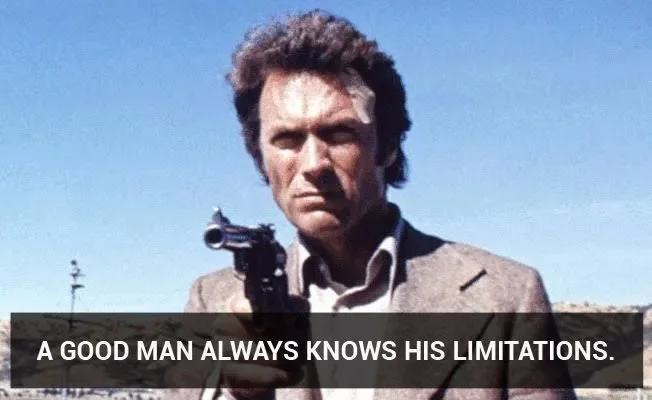
    My favorite is at the end of the second movie, where he blows up the bad guy in this massive fireball explosion, and he looks all cool at the car and says, a man's got to know his limitations.

    21:12-21:18

    Beyond the coolness of that line, there is a hint of biblical truth in it.

    21:18-21:24

    The essence of true wisdom is understanding your own limitations as a human being.

    21:25-21:29

    This even involves understanding the limitations of wisdom.

    21:30-21:36

    As I said earlier, you'll never, ever, ever be able to understand everything that you want to in this life.

    21:37-21:38

    You'll never even come close.

    21:39-21:41

    Don't be arrogant and think that you can.

    21:41-21:43

    You are not God.

    21:44-21:49

    You don't have an eternal perspective on this world and this universe as he does.

    21:49-21:52

    We have a teeny tiny perspective.

    21:53-21:56

    It's like trying to look at a massive painting through a small keyhole.

    21:57-22:00

    We can see bits and pieces, but we can't see the whole picture.

    22:01-22:08

    With the trust that our all powerful God not only sees the whole picture, but he's in complete control of it.

    22:11-22:14

    And this is so easy for me to stand up here and say this to you all.

    22:14-22:16

    It is so hard to live this out.

    22:17-22:21

    It's easy for me to say, you know what, yeah, trust God in the midst of the death of a loved one.

    22:21-22:26

    Trust God when you have an adult child who's running away from the Lord, even though you pray for them every single day.

    22:26-22:31

    Trust God while your marriage seems to be falling apart and you have no idea what to do.

    22:31-22:36

    In these moments we're spun around by life, it's so hard to trust God.

    22:36-22:40

    It's so hard to give our fears and anxieties over to Him.

    22:41-22:44

    But brothers and sisters, what other option do we have?

    22:45-22:49

    The alternative is despair and hopelessness, and that's no way to live.

    22:50-22:51

    That is not the path of wisdom.

    22:52-22:54

    That is the path of foolishness.

    22:55-23:04

    Instead, let's entrust ourselves and our families to our all-wise Heavenly Father who knows exactly what He is doing, even when it seems like He does not.

    23:06-23:09

    All right, finally, how can I live a balanced life?

    23:10-23:13

    By choosing to stand out instead of blend in.

    23:13-23:15

    By choosing to stand out instead of blend in.

    23:19-23:25

    So Solomon closes out his teaching on balanced living with the results of leading a godly life.

    23:25-23:28

    He says this in chapter eight, verse one, "Who is like the wise?

    23:29-23:31

    "And who knows the interpretation of a thing?

    23:31-23:42

    "A man's wisdom makes his face shine "and the hardness of his face is changed." In other words, all the rough edges begin to be smoothed out by God.

    23:43-23:48

    So according to Solomon, true wisdom leads to a changed life that cannot be ignored.

    23:49-23:55

    You know, we live in a culture that only acts foolish, but celebrates foolishness on a daily basis.

    23:57-24:06

    Isaiah 520 tells us this, "Woe to those who call evil good and good evil, "who put darkness for light and light for darkness, who put bitter for sweet and sweet for bitter.

    24:07-24:10

    Can you think of a better verse to describe America in 2022?

    24:10-24:11

    Right now, I know I can't.

    24:12-24:24

    You turn on the TV, you see politicians, news anchors, social media influencers, celebrating the things that break the heart of God and labeling his ways as hateful and unloving.

    24:25-24:35

    In the darkness of this foolishness, God is calling us as his followers to shine the light of his word, to shine the light of his wisdom and righteousness.

    24:37-24:48

    Back in the book of Exodus, as Moses comes down from Mount Sinai, as he spent all this time with God, his face literally shone like a light bulb from being in the presence of God.

    24:49-24:54

    Moses was changed by his time with God, and it caused him to stand out from the crowd.

    24:55-24:56

    Is that true of you?

    24:58-25:00

    Has your relationship with God changed you?

    25:00-25:03

    Has your relationship with God caused you to stand out?

    25:04-25:05

    Are you blending in with everybody else?

    25:06-25:08

    Do you look just like everybody else?

    25:09-25:16

    You know, as a teenager, I desperately wanted to fit in, and I would act like a chameleon at times so that people would like and accept me.

    25:17-25:20

    I would put other people down 'cause it made my friends laugh.

    25:20-25:25

    I would talk in a certain way, and I even pretended to like Pittsburgh sports, which I did not care about.

    25:26-25:27

    You can all boo me right now if you want.

    25:27-25:29

    Just go ahead, get it over with.

    25:30-25:31

    All right, thank you, thank you.

    25:31-25:33

    What a great welcome to my first sermon.

    25:33-25:34

    Just getting a bunch of booze.

    25:35-25:41

    If you try to talk to me about sports, you'll see my eyes quickly glaze over as I daydream about something more interesting to me.

    25:42-25:48

    No, but in all seriousness, no matter how old you are, deep down, we all want people to like and accept us.

    25:48-25:53

    Doesn't matter if you're five years old, 13 years old, or 85 years old.

    25:54-25:55

    We don't wanna go against the flow naturally.

    25:56-25:57

    We don't wanna stand out as different.

    25:57-25:59

    We want to go with the flow.

    26:00-26:03

    But that totally goes against our call as Christians.

    26:03-26:07

    We're not called to blend in, but to stand out.

    26:08-26:13

    We're to care more what God thinks about us than what other people think about us.

    26:13-26:16

    We obey the word even when it costs us something.

    26:17-26:27

    This requires a willingness to stand out as different at work by not gossiping, putting other people down, cutting corners, like I said, or putting down the boss.

    26:27-26:28

    How hard is that last one, by the way?

    26:30-26:41

    Or standing out in your neighborhood by loving your neighbors, by showing them the love of Jesus Christ, it requires a willingness to be different.

    26:43-26:45

    I used to say this to my youth group kids all the time at my last church.

    26:45-26:49

    If you want to be cool and popular, then Christianity probably isn't for you.

    26:51-27:05

    We are commanded to go against the grain of this culture and hold to things that are not popular, like the sanctity of unborn life, the truthfulness of God's word, and the reality that Jesus Christ is the only way to eternal life and a relationship with God.

    27:05-27:07

    Yeah, these things aren't very popular right now, are they?

    27:08-27:18

    And it's so sad to me to see so many churches across this country sacrificing faithfulness to God's word to blend in and fit in with everybody else.

    27:21-27:24

    How thankful should we be that we're in a church that that's not gonna happen?

    27:25-28:15

    Because the Word is our supreme guide and not this culture. We cling to this instead of what other people think about us. Let me ask you a few questions. Can you be content knowing that you're pleasing other people more than you're pleasing God? Can you be content to cover up the light of Jesus Christ because it's much more convenient to do so? I hope the answer to these questions is no because we live in a time that needs Christians with spines of steel who are willing to lovingly and graciously stand in the gap for the truth and hold their God-given convictions no matter what. We live in a time that needs balanced, wise, and righteous Christians who are shining the light of Jesus Christ.

    28:17-28:23

    So after hearing this word from Solomon, you may feel convicted that your life is is unstable and off balance right now.

    28:24-28:31

    Instead of being discouraged by that, I want you to be encouraged that God has given you a fresh chance to find stability in him.

    28:32-28:37

    The good news is God does not expect perfection from you in this life, 'cause that is impossible.

    28:37-28:39

    But he does expect progress.

    28:40-28:50

    You will fail and you will fall off this high wire, this tight rope, but the great news is that God is always there to catch you and put you back on track.

    28:51-28:58

    But like any successful tightrope walker or balance beam, gymnast-- I don't know what the term even is-- this requires dedication.

    28:59-29:01

    This requires practice.

    29:02-29:05

    God is there to offer you his help, to offer you his power.

    29:06-29:13

    But right now, today, are you willing to grab a hold of it and put in the dedication and effort that is necessary?

    29:15-29:16

    The band can come up.

    29:16-29:18

    I want you all to bow your heads and close your eyes.

    29:21-29:22

    And I want us to spend a few minutes with the Lord.

    29:24-29:30

    All of us, myself included, should admit that we're off balance and unstable in many ways right now.

    29:31-29:34

    I don't know what that is, but you do, and so does God.

    29:36-29:49

    Go to the Lord and ask Him for His help to change, to make that progress, to embrace godliness, to embrace wisdom, and to embrace this responsibility to be a Christian witness.

    29:50-29:54

    a minute or two with the Lord, and I'll close us in a final prayer, and then we'll go to the Lord and worship.

    29:56-30:02

    God, as we just sung a few minutes ago, we thank you that you're the God of second chances.

    30:03-30:09

    We thank you that you didn't leave us where you found us, but you pulled us out of the mess of our sin and gave us new life.

    30:10-30:16

    If there's anybody in this room, Lord, who doesn't know you, doesn't have a relationship with you, Lord, I pray you'd open up their heart to the gospel of grace.

    30:18-30:20

    they would accept Jesus Christ their Lord and Savior.

    30:21-30:27

    And find that stability that only you can provide in this crazy world that's trying to shake us down.

    30:29-30:34

    Lord, for the rest of us, help us to find, again, that stability yet again.

    30:35-30:37

    To walk in the ways of your word, even when it's hard.

    30:38-30:42

    To trust you, even when we have no idea what you're doing, but we know that you do.

    30:43-30:45

    Lord, we thank you for your word.

    30:45-30:48

    We thank you, you've given us this light in a dark place.

    30:49-30:56

    Lord, help us to lead lives of balance, wisdom, and righteousness this week and for the rest of our lives.

    30:56-30:58

    In Jesus' name, amen.

Small Group Discussion
Read Ecclesiastes
7:15-8:1

  1. What was your big take-away from this passage / message?

  2. How can you see yourself being a bit self-righteous at times? How should you deal with this temptation/attitude when it arises?

  3. What is wisdom and why is it so important? What did Taylor mean when he said that we need to admit our own limitations as well as the limitations of wisdom?

  4. How is the Lord calling you to stand out from the crowd and shine the light of wisdom right now? (Ecc. 8:1)

Breakout
Pray for one another.
How Can Adversity Be Good

Introduction:

5 Fantastic Things You Only Get from Adversity:
(Ecclesiastes 7:1-14)

  1. Perspective . (Eccl 7:1-4)
  2. Maturity . (Eccl 7:5-6)
  3. Patience . (Eccl 7:7-9)
  1. Wisdom . (Eccl 7:10-12)

    Numbers 11:4-6 - Now the rabble that was among them had a strong craving. And the people of Israel also wept again and said, "Oh that we had meat to eat! We remember the fish we ate in Egypt that cost nothing, the cucumbers, the melons, the leeks, the onions, and the garlic. But now our strength is dried up, and there is nothing at all but this manna to look at."

  2. Reliance . (Eccl 7:13-14)

Sermon Notes (PDF): BLANK
Hint: Highlight blanks above for answers!

  • 00:00-00:01

    All right, we're going to start with a little game.

    00:01-00:02

    You want to play a game?

    00:04-00:07

    I love the enthusiasm from both of you.

    00:09-00:11

    This is an easy game, okay?

    00:12-00:14

    We're going to play which is better.

    00:14-00:24

    I'm going to give you two things, and I'm going to give you a second to think about it, and then you're going to raise your hand on which one you think is better, okay?

    00:25-00:25

    All right.

    00:27-00:27

    Coke and Pepsi.

    00:28-00:29

    How many?

    00:30-00:31

    That's not how the game works.

    00:32-00:35

    Those of you who said neither, that's not how it works.

    00:35-00:37

    I'm gonna, let me explain again.

    00:37-00:42

    I'm gonna give you two things, and you're going to say which one is better, all right?

    00:45-00:47

    There's always a couple in every crowd, isn't there?

    00:48-00:50

    All right, Coke and Pepsi.

    00:51-00:52

    How many of you would say Coke is better?

    00:53-00:53

    Show of hands.

    00:55-00:56

    Wow, how many Pepsi?

    00:58-01:00

    Looks like there's more Coke people here.

    01:01-01:02

    All right.

    01:04-01:05

    Ford and Chevy.

    01:06-01:08

    How many people-- no, don't say Toyota.

    01:08-01:10

    How many people say Ford?

    01:12-01:12

    All right, Chevy?

    01:14-01:15

    That's a lot.

    01:16-01:18

    Looks like we're leaning a little more towards Ford.

    01:18-01:19

    OK, this is an easy one.

    01:21-01:23

    Marvel movies and DC movies.

    01:26-01:28

    How many of you say Marvel movies are better?

    01:29-01:30

    Yeah, that's the right answer.

    01:30-01:32

    How many of you say the DC movies are better?

    01:33-01:34

    A couple of you.

    01:38-01:38

    Well, party on.

    01:40-01:43

    All right, iPhone or Android?

    01:43-01:45

    How many of you say iPhone is better?

    01:47-01:49

    All right, Android.

    01:51-01:53

    I'm gonna give you one more, you ready?

    01:54-01:57

    Which is better, prosperity or adversity?

    01:58-02:00

    I'm gonna give you a second to think about that one.

    02:02-02:05

    How many of you would say that prosperity is better?

    02:08-02:10

    It just got really uncomfortable in here.

    02:11-02:17

    If you're watching this stream at home, or you're watching this recording later, you can cut the tension in this room with a knife right now.

    02:18-02:23

    Because it's like, I know what, okay, how many say adversity is better?

    02:27-02:35

    Really? I mean, let's think about this for a second. If I were to say to you, which is better, getting a new job or getting fired from a job, which would you say is better?

    02:38-02:41

    You're like, "It depends on the job." That's not how the game works!

    02:43-02:51

    But, okay, if you, if I were to say, um, which is better, getting a raise or getting a major demotion. Which is better?

    02:55-03:04

    That's not how you just voted though. I would say which is better going to a baby shower or going to a funeral? Which is better?

    03:06-03:08

    But that's not how you voted.

    03:10-03:23

    And you see we're on this quest for meaning through Ecclesiastes and you could say that this book is really an extended spirit-inspired rant.

    03:24-03:26

    Samuel, do the kids still call it a rant?

    03:27-03:28

    Ok, thank you.

    03:29-03:30

    That's a current term.

    03:31-03:31

    But it's a rant.

    03:31-03:39

    It is a spirit-inspired rant of Solomon saying, this is what gives meaning to life, and this is not going to help.

    03:39-03:45

    And last week we saw - and this was a hard sell - money won't make you happy.

    03:47-03:50

    Last week we saw Solomon said prosperity isn't always good.

    03:51-03:57

    And today we're looking at the other side of the coin, where he says adversity, it isn't always bad.

    03:59-04:11

    And if we were to have Solomon sitting here and say which is better, prosperity or adversity, I believe that he would say hands down adversity is better than prosperity.

    04:14-04:15

    Why is that?

    04:17-04:17

    And here's the sermon.

    04:19-04:21

    Adversity will make you a better person.

    04:22-04:24

    So much more than prosperity ever will.

    04:27-04:34

    There have been so many people throughout history who have become stronger through adversity.

    04:35-04:43

    And if we're honest, prosperity has ruined more people than adversity ever has or ever will.

    04:45-04:45

    That's the sermon.

    04:47-04:48

    You can go if you like.

    04:49-04:56

    But if you're still not convinced, you're outlined five fantastic things you only get from adversity.

    04:57-05:07

    There are things - I wouldn't just say important things, but probably the most important things about life - you only get it through adversity.

    05:09-05:11

    And that's where Solomon takes us here.

    05:11-05:13

    Number one, write this down - perspective.

    05:14-05:17

    Here's something you only get from adversity perspective.

    05:17-05:18

    Look at verse 1.

    05:18-05:30

    He says, "A good name is better than precious ointment, and the day of death than the day of birth." Interestingly, something you don't see in the English is this is a play on words in the Hebrew.

    05:31-05:41

    Because the word for name in Hebrew is "shem." And the word for ointment or perfume is "shemen." So it's kind of a pun.

    05:41-05:47

    He's like, "A good shem is better than a good shemin." What's your point, Solomon?

    05:47-06:00

    He says, "Well, perfume doesn't last very long, but a good name absolutely does." And then he says, "The day of death is greater than the day of birth." Like what are you talking about?

    06:00-06:05

    Well, you're going to see as we go through these verses, he's taking us to the funeral home.

    06:06-06:06

    Right?

    06:06-06:08

    That's where he's going with this.

    06:08-06:12

    And what he's doing in doing that is giving us perspective.

    06:14-06:23

    In other words, it's better to evaluate a life well lived than to evaluate a life not yet lived.

    06:23-06:24

    You see?

    06:24-06:28

    That's why he's talking about it's better to have a good name.

    06:29-06:30

    Look at verse 2.

    06:32-06:33

    Here's his point.

    06:33-06:47

    He says, "It is better to go to the house of mourning than to go to the house of feasting, For this is the end of all mankind and the living will lay it to heart." Again, like a lot of things in God's Word, it seems backwards.

    06:49-06:58

    I mean, if I called you up on a Saturday morning and said, "Hey, what are you doing?" You're like, "Nothing." I'm like, "Hey, I'd like to hang out with you.

    06:58-07:03

    Would you rather go to a party tonight, or would you rather go to a funeral tonight?

    07:04-07:06

    Which would you rather attend?

    07:08-07:35

    And honestly, I would guess Not giving the Sunday school answer. Okay, but I would guess a hundred percent of us would say I'd rather I'd much rather go to a party into a funeral Solomon says no, it's better To go to the house of mourning. He says the living lay it to heart Meaning it gets us It changes our lives by the way that we think about it.

    07:36-07:37

    Go on here, look at verse 3.

    07:37-07:52

    He says, "Sorrow is better than laughter, for by sadness of face the heart is made glad." Actually, "made right" is a better translation than "made glad." The heart is put right in approaching life.

    07:52-07:54

    And again, verse 4, same point.

    07:54-08:26

    He says the house of the wise or the heart of the wise is in the house of mourning But the heart of fools is in the house of mirth See see his point it's about taking an honest assessment of your life It's about perspective and Solomon's point in these four verses is if you're wise Looking death in the face is going to make you evaluate your own life.

    08:29-08:36

    Because as it's been said so often, every funeral we attend anticipates our own.

    08:38-08:47

    Someday people are going to be lining up to pay their last respects to you, and your name is going to be on the little marquee outside the room.

    08:49-08:51

    That's going to happen to you and it's going to happen to me.

    08:53-08:56

    And attending funerals now should make us think about that.

    08:57-09:04

    To think, "You know, someday I'm going to die." I hope that wasn't a spoiler alert for anybody here.

    09:04-09:10

    But someday, your life on this earth is going to be over.

    09:13-09:37

    And the question you have to ask regarding that is, "What's going to be said about me?" In other words, "How did I spend my time here? What was my life about?" Those are the questions that we should consider that should change our lives, knowing that death is coming for us.

    09:40-09:46

    You know, in my time I've done a lot of what are called community funerals.

    09:49-10:00

    And there are people that die that they don't have a church home or a pastor, so they call me up and they're like, "Hey, would you do a funeral for us?" The funeral home calls.

    10:01-10:06

    I've got to tell you, some of those are the most heartbreaking stories.

    10:09-10:16

    I remember one time years ago there was a 28-year-old girl who died in an automobile accident.

    10:16-10:27

    And in these cases when I don't know the person, you know, personally, I like to sit down with some family members and just say, "Hey, can I get some general just information?

    10:27-10:40

    "I don't wanna be presumptuous and stand up "and pretend like I know the person, "but you know, just to give some general eulogy information "and kind of set the table for the family "to share personal things, right?" So I'll sit down with a family member to talk about this.

    10:40-10:42

    And I sat down with this girl's father.

    10:44-10:54

    And I said, "So tell me a little bit about her." And he just kind of looked down and kind of stuttered and muttered a little bit.

    10:54-11:31

    And he's like, "I don't know what to say." I said, "Well, what kind of hobbies did she have?" And he's, "I don't, I don't, uh, "she really didn't have any hobbies." I'm like, "Well, what kinds of things "was she interested in?" I'm like, "You're not really giving me anything here." I said, "Is there anything that she liked to do?" I'll never forget the look in this man's face.

    11:33-11:53

    I said, "Is there anything that she liked to do?" and he looked up at me, and with a perfect mixture of anger and sadness, he said, "She liked to do drugs." And I'm thinking, "Oh." It's a sad legacy to leave behind, isn't it?

    11:54-12:00

    To think this girl lived 28 years on this earth, and that was the one thing her father could say about her?

    12:01-12:01

    Really?

    12:03-12:04

    It's heartbreaking.

    12:04-12:05

    It is so heartbreaking.

    12:07-12:13

    But you see, that's what Solomon's saying here is going to a funeral makes us think about what kind of legacy are we leaving?

    12:13-12:15

    What's gonna be attached to our name?

    12:16-12:17

    What are you doing with your life?

    12:19-12:20

    See, it's about perspective.

    12:22-12:27

    Nobody at a party is thinking about their time coming to an end.

    12:29-12:32

    Nobody at a party is thinking, am I living on purpose?

    12:33-12:41

    And while funerals are some of the hardest events that we experience in life, there's something fantastic about them.

    12:41-12:43

    They give us perspective, don't they?

    12:44-12:47

    Number two, five fantastic things you only get from adversity.

    12:48-12:51

    Here's something else that you get only from adversity, maturity.

    12:52-12:53

    Look at verses five and six.

    12:54-13:01

    He says, "It is better for a man to hear "the rebuke of the wise than to hear the song of fools.

    13:02-13:07

    "For as the crackling of thorns under a pot, so is the laughter of fools.

    13:07-13:19

    This also is vanity." Okay, speaking of partying fools that he sort of introduced in the previous section, he says they're like crackling thorns.

    13:19-13:21

    Like what's he talking about?

    13:21-13:27

    Well, thorns in the fire, they burn quick and they give no heat and they make lots of noise.

    13:29-13:30

    In other words, they're useless.

    13:32-13:32

    They're useless.

    13:33-13:37

    They just make a lot of noise, but they don't really help much.

    13:37-13:38

    Those are burning thorns.

    13:39-13:41

    And he said that's what the laughter of fools is like.

    13:42-13:48

    And I always think one time, Aaron and I were at a restaurant, and there were these two adult women in the booth behind us.

    13:49-13:51

    Adult women in the booth behind us.

    13:51-13:57

    And we were by no means eavesdropping, which I'm sure he'll be convinced of here in a minute.

    13:57-13:59

    But they were talking so loud.

    13:59-14:04

    Have you ever been to a restaurant where people are talking so loud it's like they want everybody to hear what's going on?

    14:04-14:04

    Do you know what I'm talking about?

    14:05-14:07

    Well that's what these ladies were doing.

    14:08-14:10

    And this was the content of their entire conversation.

    14:10-14:25

    "Oh my gosh, last Friday night I got so hammered!" "Oh I must have drank six and then whatever, I can't remember, fireballs or whatever." But they were naming the alcohol.

    14:25-14:28

    "Oh I was so hammered!" You thought you were...

    14:28-14:30

    I was so wasted!

    14:30-14:32

    I was sloshed!

    14:33-14:36

    And that went on and on and on.

    14:37-14:38

    These were adults.

    14:38-14:39

    Did I mention that?

    14:39-14:41

    On and on and on.

    14:42-14:48

    And just bragging about how much we drank, how drunk we were.

    14:49-14:51

    And Solomon says, "You know what that sound is like?

    14:52-14:54

    It's like thorns on the fire.

    14:54-14:58

    Lots of noise, but really..." Senseless.

    15:00-15:04

    Some people never grow up, and some people never grow out of that mindset.

    15:07-15:21

    And Solomon's here says, "Better than that noise of the thorns on the fire, better than that noise is hearing the rebuke of a wise person." I suppose we can file that under adversity, right?

    15:22-15:23

    It's never fun.

    15:24-15:31

    When you mess up and you refuse to acknowledge it, and then God sends somebody to point that out, ooh, let the good times roll.

    15:33-15:35

    Rebukes are hard to hear, aren't they?

    15:36-15:39

    And if you've ever been on the receiving end of one, you know.

    15:40-15:51

    But a rebuke can be so good for you, because if it's accurate, and if you receive it, it changes your course, and it makes you a better person.

    15:51-15:52

    It leads to maturity.

    15:53-15:57

    And I know some of you right now are saying, "What's a rebuke?" And I would say, yeah, exactly.

    15:58-16:01

    Because it's hard in our day because we're taught we have to affirm everything.

    16:03-16:11

    Your orientation, your preferred pronouns, who you prefer to be with intimately.

    16:11-16:14

    We have to affirm everything.

    16:15-16:18

    That constant affirmation is a little more than thorns in the fire.

    16:19-16:28

    This could be a whole other sermon, Listen, we have to have the courage to prayerfully and humbly and wisely address people who are out of line.

    16:30-16:34

    And we need people in our lives who aren't afraid to tell us when we're out of line.

    16:35-16:36

    Do you have somebody like that in your life?

    16:38-16:39

    Do you?

    16:40-16:45

    Do you have somebody in your life that when you're out of line, they're not afraid to tell you, "Hey, knock it off.

    16:46-16:51

    you're thinking so wrong about this.

    16:51-16:52

    Do you have somebody in your life like that?

    16:53-16:54

    Because you need someone.

    16:55-16:58

    Here over the next few weeks, we're going to be relaunching our small groups.

    16:59-17:01

    That's one of the key purposes of small groups.

    17:01-17:03

    We need to be watching each other's backs.

    17:04-17:06

    Not harsh, not condemning, but loving.

    17:07-17:10

    Solomon says that's wisdom, right?

    17:10-17:13

    Five fantastic things you only get from adversity.

    17:13-17:14

    You get perspective, you get maturity.

    17:14-17:15

    Thirdly, you get patience.

    17:16-17:17

    You get patience.

    17:17-17:17

    Look at verse 7.

    17:18-17:26

    He says, "Surely oppression drives the wise into madness, and a bribe corrupts the heart." He gets real specific here.

    17:27-17:28

    "Have you ever been oppressed?

    17:28-17:32

    Have you ever been treated unfairly, treated unjustly?

    17:32-17:37

    If not, get ready, you will." And it's infuriating if you've been on the other end of that.

    17:38-17:39

    You just want to retaliate.

    17:39-17:40

    This isn't right.

    17:40-17:41

    You shouldn't treat me like this.

    17:41-17:43

    You shouldn't treat anybody like this.

    17:43-18:17

    I'm on the receiving end of this and you just want to you just want to lash out then and look at verse 80 says Better is the end of a thing then it's beginning and the patient in spirit is better than the proud in spirits So the first part of the phrase he's saying first of all things will get better. No trial. No adversity lasts forever The second part of this is a another figure of speech He said the patient in spirit is better than the proud in spirit of another way you could say that is it's better to be long in spirit than to be high in spirit.

    18:18-18:32

    In other words, he says this trial you're going through right now and we know a lot of you are, whatever this adversity is that you're going through right now, you want to get to the other side like a champ, you want that to be your testimony?

    18:32-18:39

    Like yeah, I persevered, I endured, I grew and God brought me through. Do you want that to be your testimony?

    18:39-18:43

    He says patience is going to get you there, and pride will not.

    18:43-18:45

    Like, well, what will pride do?

    18:46-18:47

    I'm so glad you asked.

    18:47-18:48

    Look at verse nine.

    18:48-18:59

    He says, "Be not quick in your spirit to become angry, "for anger lodges in the bosom of fools." Pride is at the very root of anger.

    19:02-19:05

    The second things don't go our way, we lose it.

    19:07-19:15

    And if you're an angry person, you know, I don't think I'm an angry person, well, let's use some synonyms and see if that fits.

    19:15-19:18

    Are you a person that is very easily annoyed?

    19:18-19:22

    Are you a person that is extremely frustrated all the time?

    19:24-19:27

    Are you a person that constantly feels put out?

    19:28-19:34

    See, the problem is that turns into resentment, that turns into bitterness, and he says that lodges in your heart.

    19:36-19:39

    In other words, it makes its home in you.

    19:39-19:44

    It dishonors God, it makes you miserable, and you will never be equipped to deal with adversity.

    19:45-19:50

    You see, learning patience is one of the greatest lessons you will ever learn.

    19:51-19:58

    Because as the old cliche goes, life is not a sprint, but it's a marathon.

    19:59-20:00

    You've heard that one too, right?

    20:01-20:04

    But listen, it's a marathon in every arena of your life.

    20:05-20:11

    In other words, you have to learn how to go the distance in everything.

    20:12-20:12

    Right?

    20:14-20:16

    Married people, it's a marathon.

    20:17-20:20

    You have to learn how to go the distance.

    20:21-20:26

    And if you have children, you have to learn how to go the distance.

    20:27-20:31

    At your job you have to learn how to go the distance.

    20:31-20:33

    At school you have to learn what?

    20:34-20:35

    How to go the distance.

    20:35-20:37

    Go the distance if you're dealing with a chronic illness.

    20:39-20:40

    You have to learn how to go the distance.

    20:41-20:44

    And see, this is the love and the wisdom of God.

    20:44-20:53

    He allows adversity in our lives to teach us patience because we need patience in every single area of life that's worthwhile.

    20:54-20:56

    You only get that from adversity.

    20:57-20:59

    You don't learn patience in prosperity.

    21:01-21:03

    You see, five fantastic things you only get from adversity.

    21:04-21:07

    Well, you get perspective, you get maturity, you get patience.

    21:08-21:10

    Number four, you get wisdom.

    21:12-21:13

    You get wisdom.

    21:14-21:17

    Here's something that people say when facing adversity.

    21:18-21:31

    Verse 10, "Say not, 'Why were the former days better than these?'" Solomon says, "For it is not from wisdom that you ask this." Let's be honest, how many people have said that at some point?

    21:32-21:36

    the good old days. The good old days. Come on, just me. All right. Awesome.

    21:37-21:46

    Just me. All right. A couple of you, a couple of you DC movie lovers back in the good old days.

    21:46-21:50

    When I was a kid, when I was a kid, people didn't act like that.

    21:50-21:53

    When I was a kid, it was so much better. People were nicer.

    21:54-21:58

    When I was a kid, uh, there wasn't all this garbage on TV.

    21:59-22:03

    You know, back in the day, back in the good old days, things were easier.

    22:04-22:09

    And looking back, everything looks so much better than it actually was.

    22:10-22:15

    And Solomon reminds us that sometimes, it seems like time dims our memories.

    22:16-22:20

    Because when you lived through those times, they weren't really any better than things are now.

    22:21-22:22

    They really weren't.

    22:24-22:25

    Right? They really weren't.

    22:26-22:28

    Like when I was a kid, I couldn't wait to get to high school.

    22:29-22:33

    And then when I was in high school, I couldn't wait to get out of high school and get to college.

    22:33-22:35

    And then when I went to college, i couldn't wait to graduate from college.

    22:35-22:37

    And when I graduated from college, I couldn't wait to start my career.

    22:37-22:40

    And then when I started my career, I couldn''t wait to get married.

    22:40-22:41

    When I got married, I couldn't wait to have kids.

    22:41-22:44

    And then when I had kids, I'm like, I can't wait till my kids are older and I can do stuff with them.

    22:45-22:48

    And now I'm like, I just wish I was a kid again.

    22:48-22:49

    Right?

    22:50-22:52

    Because things were soo much better back then.

    22:53-22:54

    But they weren't.

    22:55-22:56

    They really weren't.

    22:57-22:58

    And do you realize?

    22:59-23:06

    In 10 years, if our Lord doesn't return before then, in 10 years, today is going to be the good old days.

    23:07-23:11

    You're going to look back at 2022 like, man, remember how awesome 2022 was?

    23:12-23:13

    Oh, those were the good old days.

    23:15-23:16

    True or false?

    23:18-23:22

    You can't face the difficulties of one age by pining for another, it is pointless.

    23:23-23:24

    It's pointless.

    23:26-23:26

    You know what we're like?

    23:27-23:28

    We're like Israel.

    23:29-23:29

    We're like Israel.

    23:30-23:39

    Do you remember Israel, you know, slaves in Egypt, and the Lord sent Moses, you know the whole story, Moses led the Israelites out of Egypt, and there was all these problems along the way.

    23:39-23:46

    They were heading to the promised land, and God promised Abraham, and all along the way there was just a lot of complaining.

    23:47-23:47

    Right?

    23:48-24:04

    Well, Numbers chapter 11, it says, "Now the rabble that was among them had a strong craving, and the people of Israel, look at this, also wept again and said, "Oh, that we had meat to eat.

    24:05-24:52

    "We remember the fish we ate in Egypt to cost nothing, "the cucumbers, the melons, the leeks, "the onions, and the garlic, "but now our strength is dried up, "and there is nothing at all but this manna to look at." First of all, just look at that last phrase, "There is nothing at all but this manna to look at." your brain around how obnoxious that is. You mean the food, the perfect food that God miraculously provided for you every day by putting it on the ground and all you had to do was bend over and pick it up and you had this this perfect food from heaven that God gave you? "Oh we don't have anything but that." Wow. Talk about being an ingrate. But secondly about, you know what I'm calling baloney on?

    24:52-24:54

    as them pining for the leaks.

    24:55-24:55

    Come on.

    24:56-25:03

    Who in the history of mankind has ever been like, "Oh, I miss the leaks!" No, you don't.

    25:04-25:05

    But you see the point.

    25:05-25:10

    They look back on, "Oh, life in Egypt was so much better than being out here.

    25:10-25:12

    It was so much better.

    25:12-25:13

    Oh, life in Egypt.

    25:13-25:17

    Remember the good old days?" Yeah, do you remember the good old days in Egypt?

    25:17-25:18

    Do you know what else was in Egypt?

    25:19-25:19

    Slavery.

    25:20-25:23

    Do you know what else was in Egypt abuse?

    25:24-25:26

    Do you know what else was in Egypt? How about in fantasy side?

    25:27-25:28

    The good old days, huh?

    25:29-25:45

    We're just like him and you're look you're gonna go through adversity Nobody goes through life without it The question is you're gonna do it as a fool. Are you gonna do it as a wise person?

    25:45-25:53

    Are you going to do it as a wise person that has right perspective, and is growing in maturity, and is growing in patience, and becoming even wiser?

    25:54-26:04

    You see, in Solomon's point in all of this is, adversity should be teaching you wisdom, because wisdom is your advantage in every single chapter of your life.

    26:04-26:18

    That's why he says in verse 11, "Wisdom is good with an inheritance, an advantage to those who see the sun, for the protection of wisdom is like the protection of money." And the advantage of knowledge is that wisdom preserves the life of him who has it.

    26:19-26:21

    That's a call back to last week, right?

    26:21-26:24

    Money won't make you happy, but you do need it to live.

    26:24-26:26

    And he uses it as an illustration.

    26:27-26:28

    Money is a protection.

    26:29-26:30

    It is.

    26:31-26:35

    But so much more so, wisdom is protection.

    26:37-26:40

    And hopefully, you're wise enough to learn.

    26:42-26:43

    you're wise enough to catch it.

    26:45-26:52

    That adversity will bring wisdom into your life that ultimately will protect you from future and worse harm.

    26:53-26:54

    Are you paying attention?

    26:55-26:57

    Some kind of wisdom you only get from adversity.

    26:59-27:02

    All right, finally, five fantastic things you only get from adversity.

    27:04-27:05

    The last one is reliance.

    27:06-27:07

    Reliance on God.

    27:09-27:10

    Reliance on God.

    27:11-27:12

    takes us back to the conclusion.

    27:13-27:15

    Verse 13, "Consider the work of God.

    27:16-27:21

    Who can make straight what He has made crooked?" What does he mean crooked?

    27:22-27:23

    What's that mean?

    27:24-27:28

    Well, crooked is just, it's a bucket.

    27:29-27:51

    It's a bucket that just catches all pain and injustice and mistreatment, and poverty, and sickness, and accidents, and trials, and adversity, and here he calls it the work of God.

    27:52-28:02

    And look, we can sit around all day and be like, "Well, does God cause it, or does God allow it?" Does it matter what the terminology is really?

    28:03-28:03

    Does it matter?

    28:05-28:06

    He has a purpose.

    28:06-28:08

    And you can't stop Him.

    28:09-28:11

    God has a purpose for your life.

    28:13-28:14

    Look at verse 14.

    28:15-28:17

    It says, "In the days of prosperity, be joyful.

    28:18-28:28

    And in the day of adversity, consider God has made the one as well as the other." You've got to mark this down.

    28:29-28:33

    We have this thing that we think, good days are from God.

    28:34-28:39

    And on bad days, well, I guess God didn't show up.

    28:41-28:42

    I guess God really wasn't there that day.

    28:44-28:45

    That's not true.

    28:46-28:48

    It says they're both from God.

    28:49-28:50

    It all comes from Him.

    28:50-29:06

    God, out of His infinite wisdom and His perfect love that we had just sung about, He has chosen for you this course for your life He wants to bring maximum benefit.

    29:06-29:07

    He wants to bless you.

    29:07-29:11

    And he's going to bring glory to his name through it.

    29:12-29:13

    But it's all from him.

    29:15-29:19

    And finally, it says, you know, like, why would why would God do this?

    29:20-29:24

    Why would God bring prosperity and adversity into my life?

    29:24-29:26

    And here it is. Look at this.

    29:26-29:29

    So that man may not find out anything that will be after him.

    29:31-29:36

    In other words, life is so full of the unexpected, so that we learn that we're not in control.

    29:37-29:40

    God brings good times and bad so that we learn reliance on Him.

    29:41-29:53

    So often when we're struggling, some well-intended person comes along and says, "Well, you know, God doesn't give you any more than you can handle." That is not in the Bible.

    29:54-30:03

    And if you're struggling with something and somebody comes up and says that to you, somebody that's from this church, if somebody from this church says that to you, God doesn't give you any more than you can handle.

    30:04-30:05

    You have my permission to bite them.

    30:08-30:13

    And I don't mean like hard enough to break the skin or like that would get the police involved.

    30:13-30:15

    I just mean hard enough so they know what time it is.

    30:15-30:20

    But this whole God won't give you any more than you can handle, that is, that's a lie.

    30:21-30:29

    God does give you much more than you can handle so that you learn that you need Him.

    30:30-30:48

    And you would say, "Well, you know what, Pastor Jeff, I think it's a tragedy to consider that this hard stuff that I'm going through my life, that God's allowing it or bringing it about, that seems so tragic to me, Jeff.

    30:49-30:59

    And I would say, "No, I think the bigger tragedy would be if God allowed you to go through life thinking that you didn't need Him." I got this.

    31:01-31:03

    You're not going to give me any more than I can handle?

    31:03-31:03

    Thank you.

    31:04-31:09

    Then I'll take care of this and I won't need you." That's tragedy.

    31:11-31:18

    And it is at this point in the message when somebody hears all this and says, "You know, I'm still not sold.

    31:18-31:32

    I'm still not sold that good can come from adversity." And it is my job to remind you again that God demonstrated once and for all that it is His specialty.

    31:34-31:40

    I would suggest to you it's His favorite thing to do, is to bring good out of adversity.

    31:41-31:47

    You know, if you're still not convinced that God brings good out of adversity, I just want you to consider the cross of Jesus Christ.

    31:48-31:50

    Just want you to think about the cross.

    31:51-31:55

    Can God bring good from adversity on the cross?

    31:56-31:57

    I mean, just think about that.

    31:59-32:05

    There's one sense in which you could say the cross is the worst thing that's ever happened, right?

    32:05-32:06

    I mean, think about it.

    32:08-32:09

    God himself came to the earth.

    32:10-32:17

    Our creator became a man and lived among us to teach us who he is and what he's like.

    32:17-32:19

    And he lived among us.

    32:19-32:24

    He never did anything but good and to love people.

    32:24-32:24

    And what did we do?

    32:27-32:28

    We hated him.

    32:29-32:40

    And we beat him and we pulled his beard out and we mocked him and we insulted him and we beat him with a stick.

    32:42-32:46

    And then we nailed him to a cross and we hung him in public shame.

    32:48-32:50

    That's the worst thing that's ever happened.

    32:51-32:55

    That God showed up and we would treat him like that.

    32:56-32:59

    But you see, God used that in his providence and in his sovereignty.

    33:00-33:07

    He used that to make that the best thing that's ever happened because it's through the death of Jesus Christ that our sin is taken away.

    33:09-33:12

    He is the lamb of God whose blood washes away our sin.

    33:13-33:19

    And it is through his sacrifice on the cross that we can be adopted children of God.

    33:21-33:23

    We can be co-heirs with Christ.

    33:24-33:26

    We have the promise of heaven.

    33:27-33:32

    We have the promise of his presence as his Holy Spirit indwells all of his people.

    33:35-33:38

    And nothing can ever take any of these promises away.

    33:40-33:42

    He rose from the dead to give us the promise of eternal life.

    33:43-33:52

    So when you look at the cross, Can you see how God took the worst thing that ever happened and he turned it into the best thing that ever happened?

    33:54-34:01

    So whatever you're going through right now, you're going to be tempted to think there's no way God can bring good out of this.

    34:02-34:07

    How could God possibly bring good out of this horrible situation?

    34:08-34:15

    You gotta look at the cross and know that not only can he, but he will.

Small Group Discussion
Read Ecclesiastes
7:1-14

  1. What was your big take-away from this passage / message?

  2. Why is attending a funeral more beneficial than attending a party? Has a death of a loved one ever brought you to self-evaluation?

  3. How well do you handle a rebuke? How do you typically respond?

  4. Are you apt to rebuke a brother or sister in Christ when you see that they are out of line? How do you go about that, or do you try to avoid / ignore it?

  5. Tell of how the Lord has used, or is using, adversity in your life. How have you grown?

Breakout
Pray for one another.

How Can Prosperity Be Bad?

Introduction:

Money Won't Make You Happy:
(Ecclesiastes 5:8-6:12)

  1. More money brings more Problems . (Eccl 5:10-17)
    1. More money = more Dissatisfaction . (Eccl 5:10)
    2. More money = more Moochers . (Eccl 5:11a)
  1. More money = more Disappointment . (Eccl 5:11b)
  2. More money = more to Worry about. (Eccl 5:12)
  3. More money = more Hurting . (Eccl 5:13-14)
  4. More money = more to Leave behind . (Eccl 5:15-17)
  1. Unless God gives you Power to enjoy it. (Eccl 5:18-6:9)
  2. Because God Said so . (Eccl 6:10-12)

Sermon Notes (PDF): BLANK
Hint: Highlight blanks above for answers!

  • 00:50-00:52

    Open up Ecclesiastes chapter five.

    00:52-00:53

    I probably said that like 20 minutes ago, right?

    00:54-01:01

    So just a quick review on ramp for us or catching us all up if you haven't been with us.

    01:01-01:07

    Ecclesiastes is Solomon, the wisest man who ever lived.

    01:07-01:08

    It's his quest for meaning.

    01:10-01:12

    And that's where he started this book.

    01:12-01:14

    He says, you know, life seems empty.

    01:15-01:19

    Life seems nothing but like endless repeating cycles.

    01:20-01:26

    And he said pleasure and projects and possessions, they don't matter.

    01:28-01:31

    And he was purely looking at life under the sun.

    01:31-01:36

    He goes, "If this is all there is, let's forget spiritual God, heaven, all of that stuff.

    01:36-01:44

    If this existence is all there is, then it's pretty empty." But then he introduces the Lord, right?

    01:44-01:48

    And he tells us that God appoints seasons for us, good and bad.

    01:49-01:57

    He puts eternity in our hearts and he calls us to fear him and meaning in life only comes from faith.

    02:00-02:06

    But there are some anomalies to that and that's sort of where we left off last time.

    02:06-02:09

    So let's bow our heads as we approach the word of God.

    02:09-02:13

    I'm going to ask that you would pray for me and I will pray for you.

    02:16-02:21

    Father in heaven, this church was planted on the belief that Your Word does Your work.

    02:23-02:24

    We still believe that.

    02:25-02:27

    We still see it changing lives.

    02:30-02:32

    We still see it bringing the dead to life.

    02:34-02:34

    Healing marriages.

    02:36-02:37

    Breaking addiction.

    02:39-02:52

    And I pray today, Father, that it would just simply do one thing, one of the biggest lies that we still want to tell ourselves.

    02:55-02:58

    Let your word destroy that today, Father, we pray in Jesus' name.

    02:59-03:03

    And all of God's people said, "Amen." Where did we leave off last time?

    03:03-03:07

    Chapter 5 and verse 8, you there?

    03:08-03:17

    It says, "If you see in a province the oppression of the poor and the violation of justice and righteousness, do not be amazed at the matter.

    03:19-03:24

    For the high official is watched by a higher, and there are yet higher ones over them.

    03:24-03:41

    But this is a gain for a land in every way, a king committed to cultivated fields." This is a callback to the beginning of chapter 4 when he talks about people being oppressed.

    03:42-04:17

    He circles back to that and he says, "Hey, hey, hey, look, don't be shocked when you see injustice because someone's always higher and someone's always higher and someone's always higher and maybe if there's injustice, somebody's going to see the injustice and they're going to correct it." But he says in verse 9, basically to paraphrase, he's saying, "Even though things sort of get Messy with the hierarchy, he says, bad government is better than no government, right?

    04:19-04:19

    Right?

    04:21-04:22

    I knew this was going to be a hard sell.

    04:25-04:29

    Because some of you are like, is it though?

    04:30-04:32

    I'm gonna take another run at that.

    04:33-04:35

    Bad government is better than no government, right?

    04:37-04:40

    That was not much better.

    04:43-04:44

    Bad government is better than no government.

    04:46-04:49

    So you just have to trust the Lord on that one, all right?

    04:50-04:51

    Bad government is better than no government.

    04:51-04:52

    Let's move on now.

    04:52-04:57

    Let's move on because I know what you're thinking, right?

    04:58-05:03

    And Solomon certainly knew what you'd be thinking at this point because again, he's talking about oppression again.

    05:04-05:07

    He says the oppression of the poor.

    05:09-05:13

    And it is true, it is often the poor who are disadvantaged.

    05:14-05:17

    It is often the poor who are oppressed, so I know what you're thinking.

    05:17-05:19

    You're like, well, that is an easy workaround.

    05:22-05:24

    Just don't be poor, right?

    05:25-05:32

    I mean, honestly, if money's an advantage and poor people are oppressed, here's how you fix that.

    05:33-05:34

    Just don't be poor, all right?

    05:36-05:37

    We can get the worship team back up here.

    05:37-05:43

    We're gonna close and, but hang on, hang on.

    05:44-05:45

    Easier said than done, right?

    05:50-05:57

    Because in this next section that we're looking at, what Solomon says is this, look, money isn't the magic wand to happiness.

    06:01-06:02

    And today we're gonna talk about money.

    06:04-06:05

    Awesome, right?

    06:07-06:11

    It's on our minds a lot lately, especially very recently, isn't it?

    06:12-06:12

    Inflation.

    06:14-06:16

    Have you noticed the price of gas, ladies and gentlemen?

    06:22-06:31

    And I heard that we're in a recession, but then I heard that we're not in a recession because we've changed the parameters of what, Are we in a recession or not?

    06:33-06:35

    Okay, we'll go with whatever you just said.

    06:36-06:40

    But look, we're gonna talk about money here 'cause that's where the text goes.

    06:40-06:45

    And there are so many lies that surround money.

    06:46-06:52

    And one of the big ones is promoted in the world today from worldly people, rich people are bad, right?

    06:53-06:53

    No, they're not.

    06:56-06:59

    And then you go to church and here's a lie about money.

    06:59-07:01

    If you have enough faith, you'll be wealthy.

    07:03-07:03

    No, you won't.

    07:04-07:05

    That's a lie.

    07:06-07:11

    But today we're going after the biggest lie surrounding money, and it's this one.

    07:12-07:13

    More money would make me happy.

    07:15-07:26

    If I just had more, if I got like this big raise, this big windfall, if a big inheritance, if I just had more, I would be happier.

    07:27-07:29

    And that is the worst lie.

    07:32-07:40

    So on your outline, if you're taking notes, and we always encourage you to do that, here's your heading, money won't make you happy.

    07:41-07:51

    And I know you make a statement like that, and you're saying, "I still kind of think it might." Well, let's see what God says.

    07:52-07:54

    Money won't make you happy, number one, write this down.

    07:55-07:57

    More money brings more problems.

    08:00-08:01

    More money brings more problems.

    08:04-08:10

    You know, when I originally wrote this down, I had like, "Mo' money, mo' problems." Can I confess something to you?

    08:10-08:12

    This isn't in my notes, but I gotta confess something to you.

    08:13-08:24

    When I wrote that down, 'cause I referenced that back when we talked about this before, I thought I was being kind of like hip and current and like, I'm gonna resonate with the kids because I thought that was like kind of new-ish.

    08:25-08:27

    So I did a quick Google search.

    08:27-08:30

    Do you know that's from like a song from the 90s?

    08:31-08:32

    You knew that?

    08:33-08:33

    You knew that?

    08:34-08:38

    And not one of you said anything to me the last time I thought I was cool saying that.

    08:43-08:46

    All right, more money brings more problems.

    08:46-08:51

    In other words, Solomon's going to drop a bomb on us.

    08:53-08:57

    Despite what you hear some preachers say, listen, prosperity isn't always good.

    08:59-09:02

    And he gives us six problems surrounding it.

    09:02-09:06

    First of all, more money brings more dissatisfaction.

    09:07-09:07

    Look at verse 10.

    09:08-09:14

    He says, "He who loves money will not be satisfied with money, nor he who loves wealth with his income.

    09:14-09:19

    This also is vanity." Note, he says it twice so you don't miss it.

    09:19-09:22

    Listen, loves money.

    09:22-09:24

    Loves, well, do you see that?

    09:24-09:26

    Money is not the problem.

    09:27-09:30

    Loving money is the problem.

    09:31-09:40

    And these are just these strange paradoxes that are absolutely true about life that God's word points out that we want to deny.

    09:42-09:47

    But here it is, listen, the more you have, the more you want.

    09:48-09:49

    And you think it's opposite, right?

    09:49-09:52

    The more I have, the less there is that I should want.

    09:52-09:54

    You think that's what it is, but that's not true.

    09:54-09:57

    The more you have, the more you want.

    09:57-10:04

    And he says, again, another paradox, "The more you get, the less it satisfies." Again, we think it's the opposite, right?

    10:05-10:11

    The more I get, the more satisfied I should be because there's not as much stuff that I don't have.

    10:11-10:12

    And he goes, "That's the opposite.

    10:14-10:17

    The more you get, the less you're satisfied." Think about it this way.

    10:19-10:32

    Let's say that you give Jay Leno your car, because you know, he has like every amazing exotic car in the world, and you're like, "You know what?

    10:32-10:43

    He would love to have my Honda Civic as part of his collection." But I'm going to give you a newsflash here, it's not going to impact him that much.

    10:46-10:51

    He might throw it in the back with some of his other ones and not give another thought.

    10:51-10:59

    "Surely that was my car, that thing was so valuable." Not to somebody who has that much.

    11:00-11:12

    But on the other hand, if you go to one of these Thai villages where these kids have nothing and you give them a wicker ball, they will be ecstatic.

    11:15-11:28

    from experience in that. More money is more dissatisfaction. When you love money, it's never enough. It never satisfies. Secondly, let's look at the first part of verse 11.

    11:28-11:42

    More money equals more moochers. More moochers. Look at verse 11. He says, "When goods increase, They increase who eat them.

    11:45-11:45

    Stop there.

    11:47-11:52

    So the more money you get, here comes the parade of the parasites.

    11:55-11:56

    True or false?

    11:57-12:02

    The more you have, the more people come who want a piece, including the government.

    12:04-12:04

    True or false?

    12:07-12:09

    You know something that fascinates me?

    12:10-12:13

    a lot of things, but in particular right now, I'm thinking about the lottery.

    12:15-12:18

    I heard somebody say the lottery is just a tax on people who are bad at math.

    12:21-12:27

    But did you see last week, the one lottery went over a billion dollars.

    12:27-12:28

    Did you see that?

    12:31-12:37

    Well, because of like lottery fever happening, I had an article, you know, these articles go out.

    12:37-12:42

    I had an article emailed to me just with a list of things, but I clicked on it because it caught my attention.

    12:42-12:44

    It was talking about a man named Tim Schultz.

    12:45-12:52

    He won $28 million in 1999 in the Iowa Powerball.

    12:53-12:54

    And they interviewed him about that.

    12:55-12:56

    Like, what was your experience like?

    12:57-13:05

    And he said, "I felt like an outcast." And this was the quote that caught my attention.

    13:05-13:13

    He said, "If I wanted to go on vacation, I had to pay for other people to go." How annoying would that be?

    13:14-13:20

    Like we're going to get away from a little family time, you know, we're just going to have a little time with my wife and kids.

    13:20-13:21

    Oh, you're going on vacation.

    13:22-13:25

    Okay, we'll go, we'll pack, but you're going to pay.

    13:25-13:28

    He said it was just like nonstop, right?

    13:28-13:35

    And it reminds me, I saw years ago this television program, I don't know if it's still on, it was called "Lottery Ruined My Life." You ever see that?

    13:36-13:39

    I just remember this guy they interviewed who won how many millions of dollars.

    13:40-13:41

    And he was getting all these letters from people.

    13:41-13:43

    He had no idea who they were.

    13:43-13:47

    It's like, I got a sick kid, I got a flat tire, I got, you know, whatever.

    13:47-13:50

    And like, he's like, I'm trying to meet all these needs.

    13:50-13:51

    I'm sending all of these checks.

    13:51-13:52

    It was never enough.

    13:52-13:55

    And that's Solomon's point here, right?

    13:55-14:00

    The more you have, the more people are gonna come and say, hey, why don't you give me some of that?

    14:00-14:01

    More money's more moochers.

    14:03-14:06

    And thirdly, more money is more disappointment.

    14:09-14:11

    More money is more disappointment.

    14:12-14:14

    Look at the second part of verse 11.

    14:14-14:15

    I love this.

    14:16-14:27

    He says, "And what advantage has their owner "but to see them with his eyes?" In other words, the more you have, the more you realize it doesn't meet your real needs.

    14:28-14:29

    What's the advantage?

    14:30-14:32

    What's the advantage you get with more stuff?

    14:33-14:36

    Ooh, you get to look at it with your eyes.

    14:39-14:40

    Isn't that amazing?

    14:42-14:52

    Did you see last week the Honus Wagner baseball card from about 1909 sold for $7.25 million.

    14:53-14:54

    And there it is.

    14:57-14:57

    Handsome fellow.

    15:00-15:01

    He is, look at him.

    15:05-15:08

    That's old for seven and a quarter million dollars.

    15:09-15:14

    That article, I saw that article so many times, the pop-ups and those pushes and stuff.

    15:15-15:18

    I saw that so many times, but that's not the thing I'm interested in.

    15:19-15:22

    I wanna hear the story about like, then what?

    15:22-15:25

    Like, let's talk to that guy in two weeks.

    15:27-15:32

    Like, "Hey, what you doing with that Honus Wagner card?" You know what his answer is?

    15:33-15:39

    "I occasionally get to look at it." You spent seven and a quarter million dollars on something to look at?

    15:40-15:42

    I got that for free off of Google Images.

    15:43-15:43

    (audience laughing)

    15:47-15:50

    Now, true or false, I can do the same thing that that guy did.

    15:51-15:52

    Look at that, right?

    15:53-15:54

    And now you're looking at it for free.

    15:55-16:00

    We can do the same thing, and we didn't spend seven and a quarter million dollars.

    16:03-16:04

    That's what Solomon said.

    16:04-16:07

    We think more stuff will make us happy.

    16:08-16:10

    It won't, it'll just bring more disappointment.

    16:12-16:13

    Here's another thing.

    16:13-16:17

    More stuff is more to take care of, right?

    16:17-16:18

    And that's a pain.

    16:19-16:27

    Somebody's like, "Hey, Pastor Jeff, I got a boat." I'm like, "No, you got a part-time job." More money is more disappointment.

    16:28-16:30

    Moving on, more money is more to worry about.

    16:31-16:32

    More money is more to worry about.

    16:32-16:33

    Look at verse 12.

    16:35-16:49

    He says, "Sweet is the sleep of the laborer, whether he eats little or much, but the full stomach of the rich will not let him sleep." He says, "The working man gets a good night's sleep.

    16:49-16:53

    The rich man cannot get a good night's sleep because he's got too much going on.

    16:53-17:00

    "I can't unwind, I just got so much to think about." You know the primary reason for insomnia?

    17:00-17:01

    Do you know what it is?

    17:01-17:02

    Tension.

    17:03-17:05

    Do you know what the primary reason for tension is?

    17:07-17:07

    Money.

    17:09-17:11

    That's what Solomon's talking about here.

    17:12-17:26

    He goes, "It's hard for rich people to get the rest because it's worry, it's so much worry." They lay down and, "Well, what if the stock market crashes, or what if it dropped, what if you have a significant drop again?

    17:27-17:31

    Am I going to be able to get this tax thing figured out that I've been working on all week?

    17:31-17:33

    Oh, I'm going to call some people about that.

    17:33-17:36

    And how's inflation going to affect my spending?

    17:37-17:38

    Because we really had to adjust some things.

    17:39-17:40

    Oh, I've got to make sure I talk to accounting.

    17:41-17:42

    You see?

    17:45-17:46

    The more you have, the more you have to worry about.

    17:48-17:58

    Perhaps that's why in Matthew 6, in the Sermon on the Mount, Jesus taught about treasure, and then immediately, He taught about worry.

    18:01-18:02

    Maybe there's a connection.

    18:03-18:06

    Next, where money is more hurting, look at verses 13 and 14.

    18:07-18:12

    He says, "There is a grievous evil that I've seen under the sun.

    18:14-18:17

    Riches were kept by their owner to his hurt.

    18:19-18:21

    And those riches were lost in a bad venture.

    18:22-18:25

    And he is a father of a son, but he has nothing in his hand.

    18:28-18:29

    More money is more hurting.

    18:30-18:32

    Ouch, ouch, ouch, ouch, ouch, ouch.

    18:32-18:32

    Did you see it?

    18:33-18:36

    Three times in this passage, here comes the pain.

    18:37-18:40

    First, he hurt himself by hoarding.

    18:43-18:49

    You're like, "Well, how do you hurt yourself by hoarding?" Speaking of another TV show, have you ever seen that show "Hoarders"?

    18:51-18:53

    Okay, that's how you hurt yourself by hoarding.

    18:53-18:54

    Just watch an episode of that.

    18:57-19:07

    So he hurt himself by hoarding, then he hurt himself by losing it all suddenly, which you know how easily that can happen, an illness, crime, fraud, bad investment, lawsuit, et cetera.

    19:08-19:13

    Then there was hurt by not having anything to leave his son.

    19:15-19:18

    Solomon's point here is yeah, yeah, yeah, money will hurt you.

    19:19-19:25

    The love of money will hurt you, but sadly it will hurt those closest to you as well.

    19:27-19:30

    More money is more hurting and then more money is more to leave behind.

    19:32-19:34

    More money is more to leave behind, right?

    19:34-19:50

    Look at verse 15, it says, "As he came from his mother's womb, he shall go again naked as he came "and shall take nothing for his toil "that he may carry away in his hand." You can't take it with you, right?

    19:50-19:51

    Guess what?

    19:51-19:57

    Someday you're gonna leave the earth and you are taking with you exactly what you brought with you to the earth.

    19:58-20:01

    You've never seen a hearse pulling a U-Haul, right?

    20:03-20:06

    I read this past week about the top earning dead celebrities.

    20:07-20:08

    Did you know this was a thing?

    20:09-20:10

    They track this.

    20:10-20:23

    There are celebrities, people who have been dead for a long time, but because of like album sales and royalties and et cetera, et cetera, et cetera, they're still making tens of millions of dollars.

    20:26-20:28

    Here's the top five, are you interested?

    20:28-20:29

    Let me skip this part.

    20:31-20:34

    Okay, number five, we're gonna count down five to one, okay?

    20:35-20:37

    Number five, Elvis.

    20:38-20:39

    Tens of millions of dollars, Elvis.

    20:39-20:41

    Who had Elvis on their list?

    20:41-20:43

    Under dead celebrity, top-earning bingo card.

    20:43-20:45

    Thank you very much, thank you very much.

    20:47-20:48

    Yeah, Elvis.

    20:48-20:50

    Next is number four, Arnold Palmer.

    20:51-20:53

    Shocker, shocking entry on this list.

    20:54-20:54

    Arnold Palmer.

    20:56-21:01

    Number three, probably the most surprising to me on this list, Charles Schultz.

    21:03-21:05

    You know, the Charlie Brown guy, the Snoopy guy.

    21:06-21:07

    Still making tens of millions of dollars.

    21:10-21:14

    Number two, Dr. Seuss.

    21:15-21:17

    I found out, not a real doctor.

    21:18-21:25

    And then number one, the number one top earning dead celebrity, do you know who it is?

    21:26-21:27

    Anybody take a guess?

    21:27-21:28

    I thought I heard somebody say it, say it loud.

    21:30-21:31

    Michael Jackson, right?

    21:32-21:32

    (laughing)

    21:33-21:36

    Yeah, Michael Jackson, top earning dead celebrity.

    21:36-21:38

    And here's the point, here's my point in sharing this.

    21:39-21:41

    None of these people are seeing a dime of that money.

    21:44-21:46

    Tens of millions of dollars, they're not seeing it.

    21:48-21:48

    Why?

    21:49-21:51

    Because the more you make, the more you leave behind.

    21:52-21:58

    Verse 16, he says, "This also is a grievous evil.

    21:59-22:01

    "Just as he came, so shall he go.

    22:01-22:04

    "And what gain is there to him who toils for the wind?

    22:05-22:08

    Moreover, and this verse is sad.

    22:08-22:12

    I know we're having fun and kind of joking around and stuff here, but this is sad.

    22:12-22:14

    Look at verse 17.

    22:14-22:23

    Moreover, all his days he eats in darkness and much vexation and sickness and anger.

    22:25-22:32

    Here Solomon says, if you make your life about money, you're still gonna die.

    22:32-22:45

    "you're just going to die unhappy and unfulfilled." And he says the love of money ultimately brings, you see this picture, the guy's like sitting alone and eating and he has everything in the world.

    22:46-22:47

    But you see what else he has, three things.

    22:47-22:52

    He says vexation, that's like all the fighting and greed that come with it.

    22:55-23:11

    He says sickness, that's from all the worry, the sleepless nights, the ulcers and anger, so much bitterness and resentment surround people who love money.

    23:13-23:22

    So getting more will make you happy is literally the oldest lie in the world.

    23:25-23:26

    We're still buying it.

    23:28-23:31

    When it comes to money, Solomon says, look, more is not better.

    23:31-23:34

    More is just more problems.

    23:35-23:37

    All right, money won't make you happy.

    23:38-23:39

    Number two, write this down.

    23:40-23:42

    Unless God gives you power to enjoy it.

    23:43-23:55

    I'm gonna go through this part quickly because way back when we started the series, we had a whole sermon just about this topic, but we're addressing it again because it's in the text again and Solomon keeps hammering the point home.

    23:56-23:56

    Why?

    23:56-23:58

    because people don't believe it.

    23:59-24:01

    This is like the theme of Ecclesiastes.

    24:01-24:02

    Look at verse 18.

    24:02-24:40

    He says, "Behold, what I have seen to be good and fitting is to eat and drink and find enjoyment, and all the toil with which one toils under the sun the few days of his life that God has given him, for this is his law." He says, "Everyone also to whom God has given wealth and possessions, and" - here it is - "power to enjoy them, and to accept his lot and rejoice in his toil, this is the gift of God." Stop there.

    24:43-24:46

    Just a word here for the person that's like, "Yeah, you know what?

    24:46-24:47

    You're right.

    24:47-25:00

    Rich people are bad and greedy." If you think wealth and possessions are bad, he reminds us that God gives that.

    25:02-25:03

    God gives wealth and possessions.

    25:04-25:17

    So when you look at disgust with somebody that has stuff, or you want to criticize or condemn someone who has stuff, I want to remind you where they got it.

    25:18-25:21

    Because according to God's word, He is the one who gives it.

    25:24-25:25

    So you can take it up with Him.

    25:26-25:31

    But money, listen, this is why we're so backwards on this.

    25:32-25:33

    Money isn't bad.

    25:34-25:37

    It's not inherently good either.

    25:38-25:39

    Money's a tool.

    25:41-25:41

    That's really all it is.

    25:42-25:45

    And what's bad or good is your attitude towards it.

    25:47-25:50

    What determines my attitude towards it?

    25:50-25:51

    He tells us again right here.

    25:52-25:54

    It's when God gives you the power to enjoy it.

    25:56-25:57

    That makes the difference.

    25:58-25:59

    That's a call back to chapter 2.

    26:00-26:02

    Enjoyment is a gift from God.

    26:02-26:07

    You have to have, you have to live a life of faith.

    26:10-26:17

    You're like, "Well, okay." Now that you say that, that does sound familiar, but what does the life of faith look like?

    26:17-26:43

    like? Well, he tells us. Look again at verse 19, this is so important. He says, "To accept your lot and rejoice in your work." You see that? Accept your lot and rejoice in your work. Do you know another way of saying that? It's called contentment. That's what that This is where I am.

    26:44-26:44

    This is what I do.

    26:45-26:46

    And I'm okay with that.

    26:47-26:48

    Contentment.

    26:51-26:52

    Joy is knowing God.

    26:54-27:05

    Joy is taking everything in life from the hand of God with gratitude and being content with whatever He gives you.

    27:08-27:09

    Think of verse 20.

    27:09-27:17

    He says, "For he will not much remember the days of his life, because God keeps him occupied with the joy in his heart." There it is again.

    27:17-27:20

    God keeps him occupied with the joy in his heart.

    27:20-27:21

    What does that sound like?

    27:23-27:27

    Same thing, contentment, contentment.

    27:29-27:34

    Some people only live in the past, good or bad, right?

    27:34-27:36

    Some people only live in the past.

    27:36-27:38

    Back in the day, I was awesome and I was in shape.

    27:38-27:43

    You should have seen me back then and I was good looking and I was really something.

    27:43-27:47

    I was really amazing back in high school.

    27:47-27:50

    Like that was years ago.

    27:52-27:55

    But for some people, they live in the past, the bad.

    27:56-28:03

    You don't understand when I was in fourth grade, a teacher said something mean to me and I haven't really been able to get over it.

    28:03-28:05

    And it was just so hard.

    28:05-28:13

    And you know, when I was growing up, my parents would only buy the generic Rice Krispies and you don't know how hard my life was.

    28:13-28:16

    And some people just, they live in the past.

    28:16-28:21

    And he's like, "No, no, no, "when you live life from the hand of God, "I'm just focusing on today.

    28:22-28:39

    "Everything he has for me today, "everything that he's giving me today, "everything he wants me to do today, "I'm just gonna rejoice in that." Look at chapter six, he says, "There's an evil that I've seen under the sun, and it lies heavy on mankind.

    28:41-28:47

    A man to whom God gives wealth, possessions, and honor, so that he lacks nothing of all that he desires.

    28:48-28:54

    Yet God does not give him power to enjoy them, but a stranger enjoys them.

    28:54-28:55

    This is vanity.

    28:56-29:02

    It is a grievous evil." Again, you can have it all, but not the power to enjoy it.

    29:02-29:05

    God has to enable enjoyment.

    29:05-29:10

    And again, Solomon keeps talking about it because we can't get it in our heads.

    29:10-29:12

    We're like, "No, no, no, I deserve this.

    29:12-29:13

    I have a right to this.

    29:14-29:19

    I'm gonna get this and it's gonna make me so happy." Not without God, it isn't.

    29:22-29:27

    Look at verse three, he says, and you'll notice a little hyperbole inserted here.

    29:28-29:35

    He says, "If a man fathers a hundred children, You know that family would come to this church.

    29:38-29:39

    True or false?

    29:41-29:59

    If a man fathers a hundred children and lives many years so that the days of his years are many but his soul is not satisfied with life's good things and he also has no burial, I say that a stillborn child is better off than he.

    30:00-30:03

    comes in vanity and goes in darkness and in darkness its name is covered.

    30:04-30:13

    Moreover, it has not yet seen the sun or known anything, yet it finds rest rather than he." More hyperbole here.

    30:13-30:24

    He says even though he should live a thousand years, twice over, yet enjoys no good, you and it all go to one place?

    30:27-30:37

    Long life, big family without enjoyment, without contentment, it's grievous.

    30:37-30:45

    And he uses a pretty hard illustration here, doesn't he?

    30:47-31:03

    He says, "A stillborn child is better off than a man who lives a long life and has everything, but doesn't enjoy anything." Why is that, Solomon?

    31:03-31:28

    He goes, "Look, you have this stillborn child, and you have this rich guy that never enjoyed it." He goes, "Look, they're both going to die, but the stillborn child has the advantage because they never had to face the pain of an empty life apart from God." He says, "All the toil of man is for his mouth, yet his appetite is not satisfied." Like, how much is enough?

    31:29-31:30

    It's never enough.

    31:32-31:34

    "What advantage has the wise man over the fool?

    31:35-31:39

    And what does the poor man have who knows how to conduct himself before the living?

    31:40-31:42

    Better is the sight of the eyes than the wandering of the appetite.

    31:42-31:53

    This also is vanity and a striving after wind." Look, he's just saying, look, it has to come from God.

    31:53-32:05

    It has to come from where you can't get it by your own efforts, not hard work, not wisdom, not charm, enjoyment, satisfaction, contentment, all of that only comes from God.

    32:08-32:12

    Again, church, listen, money isn't good or bad.

    32:14-32:30

    But I have to say this, the rich people are at a huge spiritual disadvantage according to Jesus.

    32:32-32:36

    Remember Jesus said how hard it is for the rich to enter the kingdom of heaven.

    32:39-32:42

    And it's not because God doesn't love the rich.

    32:44-32:50

    It's because in many cases, the rich don't love God.

    32:51-33:03

    Because their affections have been so spent on everything else, and their capacity to seek and pursue and love is spent on so many other things, there's none for God.

    33:06-33:11

    There's no recognition of need at all.

    33:14-33:17

    And it's so hard to preach the gospel here.

    33:20-33:34

    In this area, and I know there are people that stream this all over the world, I'm talking about geographically where this church sits, and geographically where most people are coming from in this neighborhood to this church.

    33:35-33:42

    This is a hard place to preach the gospel because listen, if you're sitting there today with your arms folded and you're like, "Shame on those rich people.

    33:43-33:51

    Shame on those rich people." Listen, every single person in this room and who is usually in this room, we are all rich people.

    33:54-33:54

    We're all rich.

    33:55-33:57

    Every single one of us have more than we need.

    33:57-34:04

    Who can honestly stand today and say, "I am seriously lacking something." Anybody at all.

    34:05-34:10

    Anybody, anybody in all here say, you know, I'm not sure when my next meal is coming.

    34:14-34:20

    And that's not to condemn you for having stuff because wealth and possessions come from God.

    34:20-34:31

    But listen, Solomon's point here is if you're not living in conscious gratitude and contentment, that means God hasn't given you the power to enjoy what you have.

    34:31-34:35

    And you will never be satisfied no matter what you acquire.

    34:38-34:42

    So money won't make you happy unless God gives you the power to enjoy it.

    34:42-34:46

    And then finally, and I know this was a chunk, but listen, I didn't preach for a month.

    34:47-34:50

    I've just been stockpiling this stuff for a month.

    34:50-34:51

    You had to know this was coming.

    34:54-34:55

    You had to know.

    34:55-34:58

    Money won't make you happy, number three, right this time because God said so.

    34:59-35:01

    You're like, man, you should have started with that.

    35:02-35:03

    because that's like settles it, right?

    35:05-35:07

    Money won't make you happy because God said so.

    35:09-35:11

    And that's the fun thing about money.

    35:12-35:14

    Because as soon as you mention it, it starts arguments.

    35:15-35:15

    Right?

    35:16-35:20

    Do not raise your hand, but how many of you have had arguments in your home about money?

    35:23-35:23

    It happens.

    35:25-35:29

    Don't raise your hands, but how many of you have had arguments at work about money?

    35:30-35:35

    How many of you have been in a church that has argued about money?

    35:37-35:39

    Money brings arguments, right?

    35:39-35:41

    But here's the worst, people don't wanna argue with God.

    35:42-35:43

    And that's where we're going here.

    35:43-35:58

    Solomon says, "Despite everything that I just said, "there are still going to be some people "that wanna argue with God about this." Like, yeah, I know what you're saying, and that's for other people, and that doesn't really apply to me because I'm gonna be honest with you, if I did have more, I would be happy.

    35:58-36:04

    I wouldn't be one of those discontented people, and I don't know why my arm's waving like a noodle, but I wouldn't be that guy.

    36:07-36:08

    Money will make me happy.

    36:09-36:10

    Money will make me enjoy life.

    36:11-36:25

    Having more won't ruin me, because I'm not like that." Well look at what he says, "Whatever has come to be has already been named.

    36:26-36:36

    And it is known what man is, and that he is not able to dispute with one stronger than he." The more words, the more vanity, and what is the advantage to man?

    36:38-36:41

    He's saying, "You're going to argue with God on this?

    36:42-36:46

    Really?" He says, "God knows what we are.

    36:47-36:48

    God knows how we function.

    36:49-37:11

    God knows what will satisfy us, and God knows what will not satisfy us, because He created us. He's like, "My whole thesis of real joy only coming from the hand of God, that's as indisputable, that's as unchangeable as the law of gravity." He's still not convinced.

    37:12-37:30

    Two more questions. He says, "For who knows what is good for man while he lives the few See, the first question, he says, "Who really understands what's good for man?

    37:31-37:35

    Who knows what truly brings value to life?

    37:35-37:39

    Who knows?" The problem is we think we do.

    37:39-37:40

    I know.

    37:40-37:41

    I know what's best for me.

    37:41-37:42

    I know.

    37:44-37:49

    Have you ever really wanted something so desperately and then you got it and you instantly regretted it?

    37:49-37:50

    Has that ever happened to you?

    37:52-37:56

    Are you really arrogant enough to think that you always know what's best for you?

    37:58-38:00

    That's what Solomon's saying here, like, no, no, no.

    38:01-38:02

    God knows what's best for you.

    38:04-38:05

    God knows how you were made.

    38:08-38:09

    Look at the second question.

    38:09-38:20

    He says, "For who can tell man "what will be after him under the sun?" In other words, who knows what's coming ahead?

    38:20-38:20

    Who knows?

    38:22-38:25

    Who? God does.

    38:25-38:30

    Who knows the consequences of the choices that we're making today?

    38:33-38:38

    So is it possible that we don't always know what's best for us?

    38:40-38:43

    That the one who created us knows us better than we know ourselves?

    38:43-38:44

    Is that possible?

    38:47-39:18

    And that's sort of Solomon putting his final stamp on this to say, "Well, money's not gonna make you happy because God said so." Church, trying to be happy using money is not only wrong, is not only completely unsuccessful, but it's impossible because it's just not how we were made.

    39:21-39:26

    If you gave a salad to a lion, would he be satisfied?

    39:29-39:31

    Kind of violates nature, doesn't it?

    39:32-39:36

    If you gave a steak to a cow, would she be satisfied?

    39:37-39:38

    She'd be a little offended.

    39:41-39:42

    But that violates nature.

    39:43-39:57

    Listen, in the same way, You are a spiritual being, and you cannot satisfy the spiritual with the material.

    39:58-40:00

    It goes against nature.

    40:00-40:01

    It doesn't work.

    40:02-40:04

    It never has, and it never will.

    40:04-40:16

    And Solomon tells us, and a couple thousand years ago, Jesus told us again, God's word today, sitting in your lap, still tells us money will not make you happy.

    40:17-40:21

    Not just it won't, but it can't.

    40:22-40:25

    There's only one thing that can satisfy the spiritual.

    40:27-40:33

    There's only one thing that can really bring contentment to the inner person.

    40:34-40:37

    And that's having a relationship with your God.

    40:39-40:41

    It's having your sin forgiven.

    40:44-40:46

    Because the Bible says we're all guilty before God of sin.

    40:47-40:51

    and we all deserve eternal separation from Him.

    40:51-40:52

    That's our real need.

    40:53-40:59

    But the Bible says that God met that need when Jesus Christ died on that cross.

    41:00-41:05

    He died to take your sin away so that you can stand before God forgiven.

    41:06-41:13

    And Jesus rose from the dead so that we might have His righteousness, so we can stand before God perfect.

    41:16-41:17

    That's the need.

    41:18-41:20

    That's the biggest need that we have.

    41:22-41:36

    And you're never going to find enjoyment or satisfaction in anything because you're a spiritual being and you need satisfied on the spiritual level.

    41:39-41:55

    And you have to get to this place where you stop chasing after the things, when I get this promotion, when I get this raise, when I get this new job, when I get this, when I am able to buy that boat, when I'm able to get...

    41:58-42:07

    None of that's gonna matter until you get to the place where you say, Jesus Christ is enough for me.

    42:08-42:09

    So I want you to stand.

    42:11-42:15

    And today, I want that to be the declaration of your heart.

    42:18-42:22

    That maybe there are some people that have been there and you're like, I haven't been there in a long time.

    42:23-42:24

    I kind of drifted from that.

    42:25-42:27

    Can we renew that commitment today?

    42:27-42:29

    Say, no, no, no, Christ is enough.

    42:31-42:37

    Maybe there are some people here that need to make that declaration for the first time.

    42:38-42:44

    Say, yeah, I've spent my life chasing after stuff and you're right, Solomon's right, it hasn't brought me any happiness.

    42:45-42:47

    Jesus Christ, He is what I need.

    42:50-42:54

    But as a church, I want this to be the declaration of our hearts.

    42:56-42:58

    That we lift up our voices before the Lord.

    42:59-43:02

    We say, Christ is enough.

    43:02-43:04

    Christ is enough.

    43:06-43:07

    Christ is enough.

Small Group Discussion
Read Ecclesiastes
5:8-6:12

  1. What was your big take-away from this passage / message?

  2. Why do you think people look to money for happiness, despite the fact that the Bible and history both say that this has never happened?

  3. Have you ever seen someone hurt themselves in the pursuit of more, or when they got more (no names!)? Do you have a personal experience in this?

Breakout
Pray for one another to go after healthy relationships.

Why Would God Allow This?

Introduction:

5 Ways to Fail at Relationships:
(Ecclesiastes 4:1-5:7)

  1. Don't show Compassion . (Eccl 4:1-3)
  2. Work for the wrong reasons. (Eccl 4:4-8)
    1. Envy : bad motivation. (Eccl 4:4-6)
    2. Greed : bad motivation. (Eccl 4:7-8)
  1. Don't see the Benefits of relationships. (Eccl 4:9-12)
    1. You get More (and Better) work done. (Eccl 4:9)
    2. You have help when you're in Trouble . (Eccl 4:10-11)
    3. It's Safer . (Eccl 4:12)
  2. Refuse to take Action . (Eccl 4:13-16)
  3. (Regarding God) Talk , don't Listen . (Eccl 5:1-7)

    2 ways to "guard your steps":

    1. Come expecting to Learn from God. (Eccl 5:1-3)
    2. Don't try to Bribe God. (Eccl 5:4-7)

    Matthew 22:37-39 - And he said to him, "You shall love the Lord your God with all your heart and with all your soul and with all your mind. This is the great and first commandment. And a second is like it: You shall love your neighbor as yourself."

Sermon Notes (PDF): BLANK
Hint: Highlight blanks above for answers!

  • 00:40-00:44

    Open up your Bibles with me please to Ecclesiastes 4.

    00:47-00:52

    And in Ecclesiastes we are following Solomon's quest for meaning.

    00:54-00:57

    He says that life seems empty on its own.

    00:58-01:02

    Meaning only comes from a life of faith.

    01:03-01:05

    A message just as relevant today.

    01:06-01:10

    Your life is empty if you live as if this is all there is.

    01:11-01:25

    And you are invited, you are commanded to receive the provision that God made, to have your sin forgiven, the provision that God made to give you eternal life, and that's the death and the resurrection of his son, Jesus Christ.

    01:25-01:27

    That is the only thing that will give meaning to your life.

    01:28-01:33

    Anything else is going to fail, and that's what Solomon is walking us through here.

    01:33-01:41

    You have to have faith in God, and we saw last week that God appoints seasons for us, good and bad.

    01:41-01:46

    He put eternity on our hearts and He has called us to fear Him.

    01:49-01:52

    But that presents another problem.

    01:54-02:02

    The problem is, okay, okay, okay, Solomon, you're saying that God is in charge and God appoints seasons and God is sovereign.

    02:02-02:03

    Yeah, yeah, yeah, that's right.

    02:04-02:13

    Okay, so if that's true, why is there so much that happens in the world that God wouldn't approve of, right?

    02:14-02:20

    In other words, why is there so much that we look at in the world and say, why would God allow this?

    02:21-02:22

    Why would God allow this?

    02:25-02:30

    And you see that kicks off this section where he starts discussing anomalies.

    02:31-02:33

    He's like, look, yes, God is sovereign.

    02:33-02:34

    Yes, God is in control.

    02:34-02:37

    Yes, seasons of life from God, et cetera, et cetera, et cetera.

    02:37-02:47

    But, but there's sure, there's a lot of stuff in life that doesn't seem to add up, doesn't feel good, doesn't make sense.

    02:50-02:57

    And he immediately turns to what brings the most trouble in life.

    02:58-03:01

    And today we're going to talk about relationships.

    03:03-03:12

    That is the word of the day, relationships, because you're going to see in this passage, everything that he's talking about has to do with relationships.

    03:13-03:28

    And this is the most important thing as we're discovering this quest for meaning, because reality is this, nothing in your life brings more joy than your relationships.

    03:29-03:37

    And, and nothing in your life brings more heartache in your life than relationships.

    03:37-03:38

    True or false?

    03:39-03:39

    True or false?

    03:39-03:40

    True, true.

    03:41-03:42

    Think, just think for a second.

    03:42-03:45

    Just think of the happiest moments of your life.

    03:45-03:46

    Just think about them.

    03:47-03:48

    What were the happiest moments of your life?

    03:48-03:51

    There was somebody else involved in that moment with you, wasn't there?

    03:56-03:57

    Think of the saddest moments of your life.

    03:59-04:00

    The most heartbreaking moments.

    04:01-04:03

    It had something to do with somebody else, didn't it?

    04:05-04:07

    And that's why Solomon takes us here.

    04:11-04:22

    And if we're going to be honest, which I certainly encourage in church, most of the troubles in our relationships are our fault, not God's, right?

    04:24-04:28

    Most of the problems in our relationships are our fault, not God's.

    04:28-04:38

    So on your outline today, as we go through Ecclesiastes, Solomon observes five ways people fail in relationships with other people, all right?

    04:39-04:47

    So if you were looking for a great word of encouragement and exhortation today at Harvest Bible Chapel, here it is on your outline.

    04:47-04:50

    I'm going to give you five ways to fail at relationships.

    04:51-04:52

    Yay!

    04:54-04:55

    Here's how to do it.

    04:56-04:59

    You can fail in all your relationships, five easy steps.

    04:59-05:02

    Number one, I write this down, don't show compassion.

    05:04-05:07

    Solomon says this is the first relationship fail.

    05:08-05:13

    Right out the gate, he says, "Don't show compassion." Look at verses 1-3.

    05:14-05:23

    He says, "Again I saw all the oppressions that are done under the sun, and behold the of the oppressed.

    05:25-05:26

    They had no one to comfort them.

    05:28-05:34

    On the side of their oppressors there was power, and there was no one to comfort them.

    05:36-05:51

    And I thought the dead, who are already dead, more fortunate than the living who are still alive, but better than both, is he who has not yet been, and has not seen the evil deeds that are done under the sun.

    05:54-05:56

    He's talking about defenseless people, helpless people.

    05:56-05:59

    And listen, look, look, look, let's just be honest.

    06:00-06:03

    We live in a day of victim mentality, right?

    06:03-06:05

    Everybody's a victim of something.

    06:07-06:09

    Everybody's a victim of someone.

    06:09-06:17

    And it's easy for us, it's easy for us to roll our eyes when we hear this, oh, somebody's oppressed, you know, somebody's a victim.

    06:21-06:34

    Listen, we can't let people that are crying "wolf" make us apathetic to the fact that there are people who are really being oppressed today.

    06:37-06:49

    You know, we hear all the claims of racism, or the claims of abuse, or the claims of oppression.

    06:49-06:52

    Listen, there are people who are really oppressed.

    06:53-07:03

    There are people who are really, honestly, truly victims of racism, and other forms of oppression and abuse.

    07:05-07:07

    We can't be apathetic towards those.

    07:11-07:24

    Most of us, if we're honest, most of us that are listening to this don't know this kind of pain that he's talking about here, where death is a better alternative than living a life of constant oppression.

    07:25-07:33

    Oppression's so wicked, he goes, "You know the best person is a person "that's never even been here "to see how horrible people treat other people, right?

    07:33-08:12

    "How horrible people treat other people." the worst." He said, "The best people are those that didn't get to see that." They're like, "Well, what's the problem exactly, Solomon?" Well, he says it twice in verse 1. Did you see it? Here's the problem. He said they had no one to comfort them. They had no one to comfort them. And listen, this is a big fail. When you look at people who are genuinely oppressed by others, there's so much that you can't do. Right?

    08:15-08:28

    You can't give all of the practical like provisions and helps that that person needs, meeting all their needs. You can't do that. You can't stop the oppression.

    08:28-08:41

    You can't get the people that are in power that he's talking about here, you You can't get them to repent, but you realize there's something literally every single one of us can do.

    08:45-08:47

    And that's give comfort, right?

    08:49-08:52

    There's so much I can't do for these people, but there's one thing I can.

    08:53-08:54

    I can comfort them.

    08:55-08:56

    I can come alongside them.

    08:57-08:58

    I can pray with them.

    08:59-09:01

    I can encourage them with the Word of God.

    09:01-09:02

    You can too.

    09:07-09:20

    And you know, it's so easy to write people off, especially in our day of apathy, our day of being jaded, looking at somebody going through stuff, going, "Oh, you know, it stinks to be them, but that's not my problem.

    09:20-09:33

    It's not my problem, I got my own problems." And I would just challenge you, church, If Jesus' people aren't going to show compassion to people who are oppressed, then who's going to?

    09:36-09:44

    Right now, God has put someone in your life that just needs you to show them that somebody cares.

    09:46-09:46

    That's it.

    09:49-09:52

    Not showing compassion is a relationship fail.

    09:54-09:57

    "That's where Solomon starts." You wanna fail at your relationships, don't show compassion.

    09:58-10:05

    Number two, write this down, way to fail at relationships, work for the wrong reasons.

    10:08-10:10

    Work for the wrong reasons.

    10:10-10:11

    Hang on a second.

    10:13-10:21

    Jeff, I can see obviously you're having a hard time speaking this morning, but apparently you're having a hard time thinking because what does work have to do with relationships?

    10:21-10:23

    You kind of change subjects on us.

    10:24-10:24

    No, I didn't.

    10:27-10:37

    Because you're going to see here that what Solomon is saying is that work can hinder our relationships when we are wrongly motivated to work.

    10:38-10:39

    This is still about relationships.

    10:40-10:44

    You're like, "What wrong reasons would I have to work?" Well, here's two.

    10:44-10:47

    He gives us, write this down, envy, bad motivation.

    10:49-10:49

    Look at verse 4.

    10:51-10:59

    He says, "Then I saw that all toil and all skill in work came from a man's envy of his neighbor.

    11:00-11:14

    This also is vanity and a striving after wind." People don't want stuff as much as they want to be admired for having the stuff.

    11:15-11:15

    Right?

    11:17-11:21

    It's like, man, my neighbor drives a Lexus.

    11:22-11:29

    I can't be seen driving this Honda because people are gonna think that my neighbor is doing better than me.

    11:29-11:42

    So I gotta go into debt and I gotta try to buy a car and pay for a car that I can't afford because I can't have people thinking that my neighbor's doing better than me because he's not.

    11:45-11:48

    Envy, we are so driven by envy.

    11:51-11:56

    And we will work just to try to keep up with the Joneses.

    11:58-12:04

    Or, you know, as we do as humans, we will go from one extreme to the other.

    12:06-12:15

    It's go from, I will work just to keep up with the neighbor to, you know what, I'm kind of done with all that.

    12:15-12:16

    We'll jump to laziness.

    12:18-12:19

    We'll jump to laziness.

    12:19-12:20

    Why bother?

    12:20-12:20

    What's the point?

    12:21-12:22

    I'm just not gonna work.

    12:22-12:24

    Well, we've seen a lot of that in the last couple of years, haven't we?

    12:24-12:25

    I'm just gonna quit working.

    12:26-12:30

    We recently had a whole sermon about laziness from 2 Thessalonians.

    12:30-12:34

    And I tell you this, this is from the Lord, but if you can work, get a job.

    12:35-12:36

    All right?

    12:36-12:37

    That is from God.

    12:40-12:40

    True or false?

    12:41-12:41

    True.

    12:42-12:43

    Get a job.

    12:44-12:46

    And Solomon just makes one comment on the laziness here.

    12:46-12:52

    He says, "The fool folds his hands and eats his own flesh." What a picture of laziness.

    12:52-12:58

    Just a person that sits back and folds his hand and just starts eating himself, consuming himself.

    13:00-13:02

    Meaning laziness is self-destructive.

    13:03-13:04

    That's what he says.

    13:06-13:17

    And look at verse six, "Better as a handful of quietness than two hands full of toil and a striving after wind." Like, what are you talking about here, Solomon?

    13:17-13:17

    What are you talking about?

    13:18-13:20

    He's talking about something we preach here often.

    13:20-13:22

    There has to be balance, right?

    13:23-13:24

    He gave the extremes.

    13:24-13:30

    You got the guy working himself to death because his neighbor has a Lexus and he's working for the wrong reasons, it's out of envy.

    13:30-13:36

    And then you have the guy that's like, well, I ain't working, I'm just gonna let the government feed me and he's consuming his own flesh.

    13:36-13:37

    He says there has to be balance.

    13:38-13:41

    Do you see the very picturesque way he talks about balance?

    13:41-13:52

    A handful of quietness, implying we're still working, but we're not killing ourselves, it's balance, versus two hands full of toil.

    13:52-14:00

    And the interesting thing, that second word for hands in the Hebrew literally refers to cupping your hands to take as much as possible.

    14:00-14:14

    Like if I had a giant bucket of M&Ms, and I'm like, you can have a handful, you wouldn't be like, "Oh, okay, I'll take a handful." You'd be like, "I'm gonna take as much as I can." That's the Hebrew concept here for hands.

    14:14-14:16

    And he's talking about people that do that with work.

    14:16-14:22

    Like, "I'm just gonna work as much as I can constantly and no time for family or living or anything else.

    14:22-14:29

    It's just work, work, work, work, work." He goes, "That's not good either." He says, "There has to be balance." There has to be balance.

    14:32-14:39

    Wisdom says, "Don't be lazy." But don't overwork so that you miss out on life.

    14:39-14:45

    And speaking of, envy is a bad motivation, but here's another bad motivation, it's greed.

    14:47-14:48

    Greed.

    14:48-14:49

    Look at verses 7 and 8.

    14:51-15:04

    He says, "Again I saw vanity under the sun, one person who has no other, either son or brother, yet there is no end to all his toil." Why?

    15:05-15:49

    look, it says, "And his eyes are never satisfied with riches, so that he never asks, 'For whom am I toiling and depriving myself of pleasure?' This also is vanity and an unhappy business." So not only does envy a bad reason to work, bad for relationships, he says greed is too. You have people that become workaholics when they don't need to. The only reason they're working, he says, they're just continuing to accumulate. They don't know anything else. They don't have anything else. They don't have anyone else. I'm just I just gonna work. Well don't you have enough? No, no, I gotta get more. I gotta get...

    15:50-16:19

    They're never satisfied, he says. They always need more and they forfeit, according to Solomon, they forfeit enjoying life. Like, you know, I have enough that I could retire and I could serve the Lord and I could enjoy my grandkids and I could fish or golf on occasion or whatever no no no no I gotta I gotta get to work because I gotta earn that cheddar!

    16:22-16:33

    Justin, do the kids still say cheddar? As far as you know? Okay. Is there a more "recent slang for money." All right, we're going with cheddar then.

    16:36-16:38

    But that's the mentality here.

    16:40-16:43

    And he never, this guy, he's like, you're just constant work, work, work, work.

    16:43-16:46

    And like, you never stop and ask, why am I doing this?

    16:46-16:48

    Like, who am I doing this for?

    16:50-16:52

    And he tells us in verse eight, well, this is a sad verse.

    16:52-16:55

    He says, "He has no other." He has no other.

    16:55-17:03

    Well, you've lived your whole life You've worked your tail off and you've obviously encountered people and you don't have anybody in your life, nobody.

    17:05-17:06

    Like, how did that happen?

    17:07-17:09

    How in the world did that happen?

    17:09-17:10

    He tells you how it happened.

    17:10-17:12

    You care more about work than relationships.

    17:14-17:17

    And some of you do, and some of you need to repent of that.

    17:20-17:23

    Says this guy cared more about getting stuff than knowing people.

    17:23-17:25

    So do you see how work affects relationships?

    17:26-17:26

    Do you see?

    17:28-17:30

    Envy has never fueled a great friendship.

    17:31-17:32

    Never has, and it never will.

    17:34-17:39

    And making work the highest priority has never made for a healthy relationship.

    17:44-17:47

    You know, being a pastor, I've been with a lot of people who were dying.

    17:48-17:51

    Deathbed, nursing home, hospice.

    17:53-18:02

    Fortunately, I mean it's great to be there with those people to pray in comfort and courage, but it's hard.

    18:03-18:04

    It's hard to be there.

    18:04-18:05

    Some of you have been there.

    18:06-18:21

    And I can tell you emphatically in the last 20 some years of ministry that I've never been with somebody who was on their last moments of death say, "Pastor Jeff, would you please pull my Lexus around front?

    18:22-18:24

    I just want to spend a little more time with my Lexus.

    18:26-18:28

    Like, Pastor Jeff, what do you have against Lexus cars?

    18:32-18:33

    It's called a sustained illustration.

    18:36-18:39

    But I've never heard the person say, I just, I want to see my Lexus, please.

    18:42-18:44

    But many times I've heard, I just want to see my family.

    18:46-18:53

    I've never been with that person that says, you know what, Pastor Jeff, I just, oh, as I look back at my life, I just wish I would have spent more time at work.

    18:56-18:59

    I wish I would have spent more time at home, is what they say.

    19:00-19:04

    So Solomon says, yes, yes, yes, work, of course work.

    19:05-19:15

    But no, don't work for the wrong reasons because working out of envy or greed, that is a relationship fail.

    19:16-19:18

    All right, five ways to fail relationships.

    19:19-19:23

    Number three, don't see the benefit of relationships.

    19:25-19:26

    Here's how you can fail.

    19:26-19:30

    Just don't recognize the benefits of having relationships.

    19:32-19:36

    Because we become so self-dependent.

    19:37-19:38

    I don't need anyone.

    19:39-19:41

    I have been burned too many times.

    19:41-19:42

    I don't trust anyone.

    19:43-19:44

    I'm not letting anyone else in.

    19:45-19:47

    Fail, that's a fail.

    19:48-19:55

    And here Solomon lays out some real practical benefits of good relationships.

    19:57-19:57

    Right?

    19:58-20:02

    First benefit, you get more and better work done.

    20:03-20:04

    Look at verse nine.

    20:05-20:12

    He says, "Two are better than one because they have a good reward for their toil." I don't need to explain this, do I?

    20:13-20:15

    Do I need to expound on this?

    20:16-20:21

    Like if you have a job to do, two people get more work done than one person.

    20:22-20:23

    I don't need to explain this, Kaylee, right?

    20:24-20:25

    Okay, we're moving on.

    20:25-20:25

    All right.

    20:26-20:28

    He's like, that's an obvious benefit, right?

    20:29-20:31

    Here's another benefit.

    20:31-20:32

    You have help when you're in trouble.

    20:35-20:36

    That's pretty obvious.

    20:37-20:37

    Look at verse 10.

    20:37-20:46

    He says, "For if they fall, one will lift up his fellow, but woe to him who was alone when he falls and has not another to lift him up.

    20:46-20:49

    Do you see the benefits of relationship, kids?

    20:51-20:54

    Verse 11, "Again, if two lie together, they keep warm.

    20:56-20:58

    And how can one keep warm alone?

    21:00-21:02

    You have help when you're in trouble." That's a benefit, right?

    21:04-21:06

    The third benefit is it's safer.

    21:07-21:08

    It's safer, look.

    21:08-21:14

    "And though a man might prevail against one who is alone, Two will withstand him.

    21:15-21:17

    A threefold cord is not quickly broken.

    21:18-21:20

    So do you see it's safer.

    21:22-21:24

    It's safer to be with others.

    21:25-21:27

    That's a benefit of relationships, right?

    21:28-21:39

    Like if I was walking alone in the mean streets of, I was gonna say Wexford because that's where we are.

    21:39-21:40

    Are there mean streets here?

    21:42-21:42

    No.

    21:43-22:21

    What's a place that has mean streets? South side? North side? Alright, we'll go with that. We'll go with that. If I'm walking alone on the mean streets of the north side and there's a group of street toughs, ruffians, ne'er-do-wells, they would see me and they'd be like, "We're totally taking everything that guy has on him. If I'm by myself, right? But if I'm walking down the mean streets of the north side with my man Jack Ortt, do you think anybody's gonna mess with us?

    22:24-22:43

    Absolutely not. They're gonna see us together and they're like, "Well, I'm not gonna mess with those guys." Let me tell you what, let me tell you something else though. If I'm walking the mean streets of the north side and I'm with Jack Orr and I'm with Jared Siska. These ne'er-do-wells are gonna be running to me and giving me their money.

    22:47-23:31

    But you see, his point's obvious, right? It's safer. It's just safer. And no place is this more evident than the church. And listen, if you're a Christian and you're not part of the church body, that is a concept completely foreign to the New God called us to a mission and he called us to do the mission together because together we get more done. When we serve together we get more done. When we give together we get more done. And here we have help when we're in trouble. Can somebody testify? Amen. We are safer here than we are when we're alone.

    23:33-23:39

    physically, emotionally, and spiritually.

    23:41-23:52

    So to not see the benefits of relationships, to isolate yourself, to refuse to allow people into your life, that's a relationship fail.

    23:54-23:55

    Alright, two more.

    23:57-24:00

    Our fourth relationship fail is refusing to take advice.

    24:02-24:03

    Look at verse 13.

    24:06-24:19

    It says, "Better was a poor and wise youth than an old and foolish king who no longer knew how to take advice." And I want to stop here because listen, this chunk right here is extremely hard to interpret.

    24:20-24:23

    And I've spent a lot of time on this this week.

    24:25-24:30

    And I've read commentaries and...

    24:30-24:35

    I'm not gonna preach my homework to you, but I wanna tell you, this to me is what makes the most sense.

    24:36-24:42

    I think he's talking about one person in this verse.

    24:43-24:45

    Like, I see two, hang on.

    24:45-24:57

    I think what he's saying is, that guy was better off when he was poor and wise and young than he was when he got old, because he got foolish because he stopped taking advice.

    24:57-25:02

    That's what I think he's saying, because that's what makes the rest of this little chunk make sense.

    25:04-25:04

    Look at verse 14.

    25:07-25:18

    He says, "For he went from prison to the throne, though in his own kingdom he had been born poor." So this king, he went from poverty in his youth and he ascended to royalty.

    25:20-25:25

    He says, "I saw all the living who move about under the sun along with that youth who was to stand in the king's place.

    25:26-25:28

    There was no end to all of the people.

    25:28-25:30

    all of whom he led.

    25:31-25:34

    Yet those who come later will not rejoice in him.

    25:35-25:49

    Surely this also is vanity and a striving after wind." I think this is what he's saying, that this youth was so wise in his ascension to royalty.

    25:50-25:55

    You know, he was poor, but he was smart when he was young and he used wisdom.

    25:55-25:59

    And then he got old and he got foolish.

    26:00-26:08

    And very clearly here, the warning is the fact that he stopped taking advice.

    26:11-26:13

    That's why he says those who came later did not rejoice in him.

    26:14-26:18

    In other words, refusing to take advice ruined him.

    26:18-26:20

    So he wasn't remembered as being a good king.

    26:21-26:23

    He had this awesome rags to riches story.

    26:24-26:30

    But at the end of the day, they're like, he was a loser because he stopped taking advice.

    26:33-26:42

    I think the point here in Solomon's story is refusing to take advice won't end well for you.

    26:43-26:45

    We think we know best, right?

    26:47-26:50

    Here's a newsflash, we don't always know best.

    26:53-26:54

    you don't always know best.

    26:55-27:11

    Sales pitch for small groups, listen, there are other people who have been there, done that, bought the T-shirt, will wear it to small group, and they have the experience that you need to hear.

    27:13-27:15

    They're a little further down the road than you.

    27:16-27:20

    And God puts these people in our lives for a reason.

    27:22-27:31

    And when we kick off small group season again, you should be in a small group and you should sit beside these people and you should listen to every word that they say.

    27:34-27:37

    Because refusing to take advice is a relationship fail.

    27:37-27:38

    It's a fail.

    27:41-27:42

    And then number five, last one.

    27:44-27:45

    And this one is regarding God.

    27:46-27:48

    You know how to fail in your relationship with God?

    27:50-27:52

    Talk, don't listen.

    27:54-27:57

    Now this is the most important relationship, obviously.

    27:58-28:06

    And he already touched on the concept of fearing God back in chapter 3 and verse 14, and he's kind of expounding on that here.

    28:06-28:14

    Look at verse 5, he says, "Guard your steps when you go to the house of God." What's the house of God?

    28:14-28:18

    Well, in Israel, the house of God was the temple, right?

    28:19-28:21

    And where is the house of God today?

    28:24-28:24

    Biblically, you are.

    28:25-28:32

    If you have believed in Jesus Christ, the Bible says you are the temple of the Holy Spirit.

    28:32-28:35

    God resides in you.

    28:37-28:44

    So when he's talking about going to the house of God, obviously under the new covenant, he's talking about going to church.

    28:45-28:50

    Going to the place where God's Word is taught, where God's people pray, where worship is happening.

    28:51-28:53

    That was the temple today.

    28:53-28:56

    That's the principles here apply to the church.

    28:58-29:00

    And what does he say about going to church?

    29:00-29:04

    He says, "You need to guard your steps." What's that mean?

    29:06-29:07

    It means to go with reverence.

    29:08-29:10

    And I think that's something that we've lost, church.

    29:11-29:17

    I think we've so overly familiarized Jesus that we treat him like some guy we went to college with.

    29:19-29:20

    Yeah, he was in my frat.

    29:23-29:23

    Reverence.

    29:25-29:28

    You know, when Jesus taught us to pray, remember, teach us to pray.

    29:29-29:30

    Lord, would you teach us to pray?

    29:30-29:31

    Do you remember how that started?

    29:32-29:34

    Our father, remember the next part?

    29:34-29:35

    Say it if you know it.

    29:36-29:37

    You are in heaven, right?

    29:37-29:38

    So God, you're in heaven.

    29:39-29:45

    Okay, and what's the first thing he says about God besides being in heaven?

    29:45-29:46

    What's the next line?

    29:47-29:48

    Hallowed be thy name.

    29:49-29:49

    You know what that means?

    29:50-29:52

    Holy is your name, God.

    29:52-29:53

    Holy are you.

    29:53-29:55

    God, I bow before you.

    29:56-29:57

    I fear before you.

    29:57-30:01

    I revere you, God, because you are holy in heaven.

    30:01-30:09

    And God, I come to you, acknowledging first above everything that you are holy.

    30:10-30:11

    I think we've lost that.

    30:13-30:19

    And that's why Solomon says, hey, when you go to church, when you go to the house of God, guard your steps.

    30:22-30:23

    Don't be irreverent.

    30:23-30:26

    You're like, well, how would I be irreverent?

    30:26-30:30

    You know, the number one place irreverence shows up, you know where it shows up the most?

    30:30-30:30

    Right here.

    30:32-30:33

    right in your cake hole.

    30:34-30:35

    That's where irreverence shows up.

    30:38-30:41

    Like, well, what's irreverent about my speech?

    30:41-30:44

    How am I irreverent with my speech?

    30:44-30:48

    Well, Solomon says, "You need to watch your mouth." And here's two ways to guard your steps.

    30:49-30:54

    Letter A, you need to come expecting to learn from God.

    30:55-30:55

    Okay?

    30:56-30:59

    You need to come here expecting to learn from God.

    30:59-31:00

    Look at the first three verses.

    31:02-31:16

    He says, picking up where we left off in verse 1, "To draw near to listen is better than to offer the sacrifice of fools, for they do not know that they are doing evil." Don't be rash with your mouth.

    31:18-31:24

    "Nor let your heart be hasty to utter a word before God, for God is in heaven and you are on earth.

    31:26-31:39

    Therefore let your words be few, for a dream comes with much business and a fool's voice with many words." He says you need to come expecting to learn from God.

    31:40-31:44

    You know we have so many people miss church even when they're here.

    31:47-31:48

    How does that happen?

    31:49-31:51

    Because they come here to evaluate the worship.

    31:53-31:54

    I didn't really care for that song.

    31:56-31:57

    I didn't like that set.

    31:58-32:00

    They evaluate worship, they critique the sermon.

    32:02-32:05

    You know, I don't like the way he says cheddah in his sermon.

    32:07-32:09

    I think that's too hip and modern.

    32:11-32:13

    I don't think Charles Spurgeon would have approved of that.

    32:14-32:16

    We evaluate the sermon.

    32:18-32:20

    We focus on all these perceived wrongs.

    32:20-32:23

    I don't like the fact that we get into groups and pray.

    32:24-32:30

    And I'm like, so you thought you were coming to church pray? What kind of church did you think you were going to? Because we pray here!

    32:33-32:53

    And that's why people, you know, you come with that attitude of critiquing and evaluating to see if everything lines up with your preferences and then you get in the car and you leave and you're like, "Well I didn't get anything out of that." I wonder why. Are you here for God or are you here for you?

    32:56-32:57

    Here's how you need to come to church.

    32:58-33:01

    You need to come to church like this, like, "God, I'm here to worship.

    33:02-33:05

    I'm here for you because of what you've done.

    33:06-33:10

    I'm here to sing and tell you how I feel about you.

    33:12-33:13

    I want to encounter you.

    33:14-33:21

    God, I'm here today because you've said some things in your word, and I want to understand what it is you've said in your word.

    33:21-33:22

    That's why I'm here, God.

    33:23-33:34

    "Please, let my worship be pleasing to you, and let your word minister to and change me." You need to come to learn.

    33:37-33:38

    That's what Solomon says.

    33:39-33:54

    He's like, "Shut your mouth and listen to what God has for you." And letter B, finally, "Don't try to bribe God." All right?

    33:54-33:55

    Don't try to bribe God.

    33:56-33:57

    Very bad idea.

    33:57-33:58

    Look at verse 4.

    33:59-34:05

    He says, "When you vow a vow to God, do not delay paying it, for He has no pleasure in fools.

    34:05-34:06

    Pay what you vow.

    34:07-34:11

    It is better that you should not vow than you should vow and not pay.

    34:14-35:02

    not your mouth lead you into sin. And do not say before the messenger," that's like the priest or the preacher or the guy working at the house of God, right? He says, "Do not say before the messenger that it was a mistake." Well, I said that and I probably shouldn't have. Oops, my bad. Why should God be angry at your voice and destroy the work of your hands. For when dreams increase and words grow many there is vanity but God is the one you must fear." He goes, "Don't try to bribe God, all right?" Now understand in the Old Testament, vows, making vows, that was voluntary.

    35:05-35:09

    But they were often abused, even until today.

    35:11-35:24

    Now listen, I think a vow can be a good thing in the sense of I am making this commitment before the Lord.

    35:25-35:29

    It's a good thing, but only if you keep it.

    35:31-35:34

    But the real danger here, I think church is using it as a bribe.

    35:37-35:40

    And I'm not going to ask you to raise your hands, but how many of you have done that?

    35:41-35:44

    God, if you get me out of this, I will never miss church again.

    35:46-35:48

    God, I'm waiting to hear back on this report.

    35:48-35:52

    And if it's a good report, Lord, I will serve you wherever you have me.

    35:55-35:57

    Please God, get me this job.

    35:58-36:01

    Please God, get me this girl, get me this whatever.

    36:01-36:03

    I will go to church.

    36:03-36:14

    I will, I'll even help, you know, in the kids ministry, with Bible school, I'll do whatever you want God, just, if you do this for me, then I promise you that I'll do this for you.

    36:17-36:18

    Don't play games with God.

    36:19-36:25

    Solomon says your words matter, your commitment to God, it matters.

    36:26-36:34

    And it's better to not make promises at all than to make vows that you won't keep, because when you do, you're begging God for his discipline.

    36:36-36:36

    Don't play games with God.

    36:39-36:42

    Coming to church ready to talk, but not ready to listen.

    36:44-36:50

    That could be the biggest relationship fail of the lot.

    36:51-37:02

    So, every arena of your life, Home, work, church, school.

    37:03-37:06

    Look, God designed us to live in relationships.

    37:08-37:13

    And God's wisdom tells us how to avoid these fails.

    37:14-37:18

    And you're like, okay, can you recap these for me, Pastor Jeff?

    37:18-37:19

    I'll do you one better.

    37:20-37:21

    I'll do you one better than a recap.

    37:22-37:31

    Because Jesus Christ himself, He recapped the entire Old Testament with two sentences.

    37:33-37:35

    Jesus was asked what the greatest commandment was.

    37:36-37:37

    Matthew 22.

    37:38-37:39

    This was Jesus' response.

    37:39-37:48

    He said to him, "You shall love the Lord your God with all your heart, with all your soul, and with all your mind." This is the great and first commandment.

    37:49-37:53

    And you realize that answer alone would have satisfied the man's question.

    37:54-38:13

    But this is so significant that Jesus said, "Look, the second commandment is so important that I can't fail to talk about it when I mention the first." Because loving God automatically flows into the second commandment.

    38:13-38:16

    He says, "The second is like it." Here it is.

    38:17-38:19

    You want to stop failing at your relationships?

    38:21-38:22

    You want to do better in your relationships?

    38:23-38:24

    Here it is.

    38:25-38:49

    Jesus said, "You shall love your neighbor as yourself." And when you commit yourself, every relationship that God provides you, to love people the way you want to be loved, to treat people the way you would want them to treat you, that's never a fail.

    38:51-38:51

    Let's pray.

    38:53-38:59

    Father in heaven, we thank you for your Word.

    39:01-39:14

    There's times that we read your Word, and we're like, "I don't know if I fully understand or grasp all of that." But your Word, this particular passage I know, is just so obviously clear and relevant.

    39:16-39:24

    You've called us to love you first, and to love others, and to honor you in all of our relationships.

    39:24-39:33

    So Father, I pray today for all of us here, those who are watching this stream, those who will be listening to this later.

    39:36-39:55

    I pray, Father, that we would be people who reflect the character, the love, and compassion of Jesus Christ in every relationship that you provide us, Because it starts with having a proper relationship with you.

    39:57-39:58

    Let us fear before you.

    40:00-40:01

    Let us draw near to listen.

    40:04-40:07

    Praise you, Father, in the mighty name of Jesus Christ, our Lord and Savior.

    40:08-40:08

    Amen.

Small Group Discussion
Read Ecclesiastes 4:1-5:7

  1. What was your big take-away from this passage / message?

  2. How well do YOU take advice (Eccl 4:13)? Do you seek out advice? Why or why not? How do you respond to “unsolicited” advice?

  3. Is it appropriate to make a vow to God (Eccl 5:4-6)? Why or why not?

Breakout
Pray for one another to go after healthy relationships.

What's the Alternative?

Introduction:

How to Live By Faith:
(Ecclesiastes 3:1-22)

  1. Appreciate every season of life. (Eccl 3:1-8)
  2. Acknowledge there's more than this. (Eccl 3:9-11)

    Deuteronomy 29:29 - The secret things belong to the LORD our God, but the things that are revealed belong to us and to our children forever, that we may do all the words of this law.

  1. Allow God to be in charge. (Eccl 3:12-15)

    Deuteronomy 10:12 - And now, Israel,what does the LORD your God require of you, but to fear the LORD your God, to walk in all his ways, to love him, to serve the LORD your God with all your heart and with all your soul...

  2. Accept injustice (for now). (Eccl 3:16-22)

    Acts 17:30-31 - The times of ignorance God overlooked, but now he commands all people everywhere to repent, because he has fixed a day on which he will judge the world in righteousness by a man whom he has appointed; and of this he has given assurance to all by raising him from the dead.

Sermon Notes (PDF): BLANK
Hint: Highlight blanks above for answers!

  • 00:40-00:54

    Open up your Bibles with me please to Ecclesiastes chapter 3 as we continue our series when life seems empty The question for today is just simply this what's the alternative?

    00:56-00:59

    Right. What's the alternative he started this writing?

    01:02-01:12

    We're looking for the quest for meaning right in chapter 1 verse 3 He says, "What does a man gain by all his toil?" Like, "We work so hard, what do we get at the end, really?

    01:12-01:20

    What really matters?" And we saw the last couple of weeks that he says, "Life seems empty.

    01:21-01:40

    It's nothing but, it just seems like endless repeating cycles over and over on the hamster wheel we go." Last week we saw pleasure and projects and possessions, the things that we think we're going to get in life that are going to make us happy.

    01:41-01:42

    He says they don't matter.

    01:44-01:50

    And we've seen this phrase so many times, "Under the sun, under the sun." That's what Solomon is saying here.

    01:50-02:05

    He goes, "Look, if this is all there is, then life's pretty empty." At the end of chapter 2, God is brought into the picture, and that's how we closed last week.

    02:05-02:10

    Solomon makes a bold statement that enjoyment comes from God.

    02:12-02:18

    So the tone of chapter 3 that we're looking at today is radically different.

    02:19-02:28

    So if you made it through the first two sermons and you came back, and you listened to the first two and you decided you're going to stream again, congratulations.

    02:29-02:32

    Achievement unlocked, stickers will be handed out.

    02:33-02:34

    Congratulations.

    02:35-02:59

    The tone is different because spoiler alert, the alternative to hopelessly plodding through life is believing and understanding that God is there, that God is active, that God is sovereign, that God is with you.

    03:00-03:11

    So Solomon is showing us here in chapter 3 that the answer to this question of what's the meaning of life - he says faith in God is the answer.

    03:12-03:12

    But here's the thing.

    03:14-03:16

    We touched on this last week.

    03:16-03:20

    Faith is much more than saying I believe in God.

    03:21-03:24

    See, for some people, they think that's what faith is.

    03:24-03:25

    I believe in God.

    03:26-03:32

    I acknowledge that there's a higher power, and that is not the sum total of faith.

    03:34-03:35

    Though it starts there.

    03:38-03:50

    And I have to share this with you, church, because there are too many Christians, too many Christians that say they believe in God, but they don't act like they do.

    03:51-04:04

    There are too many Christians that honestly, if we followed you around with a camera crew Monday through Saturday, the truth is you act more like the world than you do like a redeemed child of God.

    04:07-04:08

    It's true.

    04:10-04:14

    Even those of us in the church can get caught up in pursuing worldly things.

    04:17-04:29

    And we saw last week that yes, God wants to give you things to enjoy, but too many Christians living like Ecclesiastes 1 and 2, thinking, "This is gonna make me happy," and it fails, and then we're in despair.

    04:29-04:46

    "I can't believe how horrible my life is." So, they were asking, "What's the alternative?" Chapters 1 and 2 have been about life under the sun, apart from God, that's what we're looking at today, is the alternative.

    04:46-04:51

    So very simply on your outline, how to live by faith.

    04:51-04:54

    All right, faith is more than just, I think God is there.

    04:54-05:04

    Solomon really gets into specific detail on here's what faith in God actively and actually looks like, all right?

    05:04-05:08

    So here it is, number one, write this down, appreciate every season of life.

    05:10-05:10

    That's faith.

    05:11-05:19

    When you learn and intentionally go after this, appreciate every season of life.

    05:21-05:22

    Look at the first eight verses.

    05:25-05:43

    "For everything there is a season and a time for every matter under heaven, a time to be born and a time to die." Now, hang on a second, I gotta stop here because I know some of you over a certain age you're going to start playing that song in your head.

    05:44-05:45

    Who sings the song?

    05:45-05:46

    Go ahead.

    05:47-05:47

    The birds, right?

    05:48-05:51

    Do everything, turn, turn.

    05:51-05:52

    You know that song?

    05:56-05:56

    Who said no?

    05:57-05:57

    All right.

    06:03-06:08

    Well, most of us will appreciate that music.

    06:09-06:13

    Some of us are going to be pleasantly surprised when we Google that later.

    06:15-06:19

    So anyways, it's really hard not to sing this, We're going to read it, alright?

    06:21-06:27

    For everything there is a season and a time for every matter under heaven.

    06:29-06:32

    A time to be born and a time to die.

    06:33-06:37

    A time to plant and a time to pluck up what is planted.

    06:38-06:40

    A time to kill and a time to heal.

    06:42-06:45

    A time to break down and a time to build up.

    06:46-06:48

    A time to weep and a time to laugh.

    06:49-06:51

    A time to mourn and a time to dance.

    06:51-06:56

    A time to cast away stones and a time to gather stones together.

    06:56-07:01

    A time to embrace and a time to refrain from embracing.

    07:02-07:04

    A time to seek and a time to lose.

    07:05-07:07

    A time to keep and a time to cast away.

    07:08-07:09

    A time to tear and a time to sew.

    07:12-07:14

    A time to keep silence and a time to speak.

    07:15-07:17

    A time to love and a time to hate.

    07:18-07:22

    A time for war and a time for peace.

    07:24-07:26

    Now look, here's the thing.

    07:26-07:30

    I could go through this list and dissect every one of these things.

    07:33-07:38

    And that would probably take me another 30 to 40 minutes.

    07:39-07:40

    But I'm not going to do that.

    07:42-07:46

    because I just don't think that's the point.

    07:47-07:56

    I think the point, what he's saying here is, look, there is an appropriate time for all life experiences.

    07:56-07:59

    And he's not just giving a description of life.

    07:59-08:02

    You know, sometimes we laugh and sometimes we cry.

    08:02-08:04

    Oh wow, that's very profound, Solomon, thank you for that.

    08:04-08:05

    He's not doing that.

    08:05-08:10

    You see, God has been brought into the picture and here's what he's saying, and you can't miss this.

    08:10-08:14

    He's saying, look, this is what God has planned.

    08:15-08:18

    These seasons of life are not accidental.

    08:19-08:22

    God planned these seasons of life for you.

    08:24-08:29

    And in this list, you see, obviously, it's two different things, right?

    08:29-08:41

    It's, we could say, to paraphrase, to sum up, there are pleasant things and there are unpleasant things, right?

    08:45-08:51

    Solomon's saying, picking up where he left off in chapter two, he goes, look, God wants you to enjoy life.

    08:51-08:53

    He absolutely wants you to enjoy life.

    08:53-09:00

    But listen, enjoying life includes all of these seasons.

    09:07-09:11

    You know, I love going to the Chinese buffet.

    09:12-09:14

    Anybody else love the Chinese buffet?

    09:15-09:16

    Come on, some of you?

    09:17-09:21

    I love the Chinese buffet, love it.

    09:21-09:26

    I go through with my plate, and first thing I'm looking for is General Tso's chicken.

    09:27-09:28

    That's the first thing I'm looking for.

    09:29-09:35

    And then you'd also like those fried chicken pieces with that bright red sweet and sour sauce you put on.

    09:35-09:36

    You know what I'm talking about?

    09:36-09:41

    Ha ha ha, oh, but I don't leave until I find the Chinese donuts.

    09:41-09:43

    Have you had a Chinese donut, ladies and gentlemen?

    09:45-09:47

    Or like me, have you had more than you should have?

    09:48-09:49

    Love those things.

    09:50-09:53

    And I make sure I know where those things are, and I load my plate up with those things.

    09:55-09:56

    And, um...

    09:57-10:00

    But of course, when I go through the buffet, there are certain things I avoid, right?

    10:02-10:08

    Like whether it's the, I don't know, the fried intestines, or the still cookies or the fish heads or whatever, I don't know.

    10:10-10:15

    But there's certain things that I'm like, "Well, I'm not...that's for somebody, but that's not for me." Right?

    10:18-10:30

    You're like, "Well, why are you telling us this?" Just simply saying this, church, if life was a buffet, we'd only choose the good parts, wouldn't we?

    10:33-10:43

    If we had the option, wouldn't you just choose the happy, the good, the cheery, the lovely, the comfortable?

    10:46-10:46

    Wouldn't you?

    10:46-10:47

    I would.

    10:49-11:02

    But God knows if we had that option and we did that, that would completely ruin us.

    11:08-11:15

    Listen to this, people who are protected from everything end up impossible to live with.

    11:19-11:32

    People protected from any hardship or bad things, they end up every time selfish and shallow and entitled.

    11:33-11:36

    Boy, we see that more than ever in our culture today.

    11:38-11:40

    You know, and this has been going on for a while.

    11:42-11:47

    You know, where you see it pretty obviously is in participation trophies for kids, right?

    11:48-12:30

    We have kids, we have kids in sports, and I know in a lot of sports, and somebody might be offended by this, and that certainly isn't my intention, but the horse is already out the born but like I just really have a hard time with that like every kid in the league gets a trophy and I listen I'm not I'm not like Scrooge okay I'm all for celebrating kids. But this idea of, "You know what? You're always a winner.

    12:31-12:50

    You're always a winner." No, you're not. I think it's about time somebody stood up and said, "Look, we're having a game today and half of y'all are gonna be losers." But Joey, Joey, you deserve a trophy, Joey.

    12:51-12:52

    No, Joey does not deserve a trophy.

    12:54-12:56

    Joey wasn't even on the field.

    12:56-13:01

    Joey's sucking oranges for the whole game on the side, and we're gonna give a trophy for that?

    13:01-13:02

    But Joey's a winner.

    13:02-13:03

    Joey's not a winner.

    13:06-13:07

    Joey needs to get his head in the game.

    13:08-13:09

    Joey needs to do better.

    13:10-13:11

    Do better, Joey.

    13:15-13:22

    Listen, your kids need to learn the sting of defeat.

    13:23-13:26

    And I know as parents, we want to protect them from that.

    13:26-13:30

    We are hurting them by protecting them from that.

    13:31-13:36

    They need to learn what it's like to get knocked down and then kicked when you're down.

    13:36-13:37

    They need to learn that.

    13:40-13:42

    Your kids need to learn how to strive to do better.

    13:43-13:49

    Your kids need to learn that wasn't a good enough performance and I need to learn from that and I need to do better.

    13:49-13:50

    Your kids need to learn that.

    13:51-13:52

    And you know who else needs to learn that?

    13:52-13:52

    You do.

    13:54-13:54

    And I do.

    13:56-14:02

    And that's why Solomon gives us both sides of the coin, just saying it in different ways.

    14:02-14:04

    He goes, "Look, there's seasons of joy and there's seasons of sorrow.

    14:05-14:07

    There's happiness and there's sadness.

    14:09-14:11

    There's victory and there's defeat.

    14:12-14:13

    There's highs and there's lows.

    14:14-14:17

    God gives us both of these seasons.

    14:19-14:20

    That's Solomon's point.

    14:20-14:29

    And you have to learn how to appreciate these seasons of life if you're going to be the person that God's creating you to be.

    14:31-14:35

    You know, I love dogs and over the course of my life I've had a lot of dogs.

    14:37-14:45

    And there is nothing in the world outside of a baby, a human baby, but there's nothing else in the world greater than a puppy.

    14:47-15:59

    And having dogs, I've had quite a few puppies, and this is going to sound like a really morbid thought, but every time I have a puppy adopted into our home, I don't know why, I don't want to be this guy, but I always think, you know, someday, someday I'm going to have to say goodbye to this dog. I know that's horrible, isn't it? I'll stop laughing. Come on! I don't know if you're burying my soul about my poor puppy that I'm going to put down and some of y'all are laughing? Man. But I think someday I'm going to have to put this puppy down and that's a horrible thought. But you know, I could choose to avoid that season of putting the dog down by never getting the dog in the first place, right? That's so hard to put a dog down. I'll just, I will just never get a dog in the first place. But you see if I do that, if I forfeit getting the puppy, you know what that means? Means I also forfeit the years of joy that I get from that dog.

    16:02-16:25

    Do you see the point? There's good seasons and there's bad seasons and God says look I'm gonna walk through both of them with you. And if we can get serious moving on from puppies to like humans right? I know there are couples that are like I don't want to have kids. Why? What if I miscarry and kids are expensive and teenagers are weird.

    16:26-16:27

    And I just...

    16:30-16:36

    It's a lot of potential heartache and hassle and pain and...

    16:36-16:37

    It is.

    16:39-16:48

    But do you know what you are forfeiting by making that choice?

    16:50-16:51

    Do you see Solomon's point?

    16:53-16:57

    You can avoid getting the puppy.

    16:57-17:03

    You can avoid trying to have the baby so you never have to experience the bad, but then you forfeit the joy.

    17:06-17:13

    God wants you to experience seasons from his hand, even hard times, and he wants you to appreciate them.

    17:13-17:14

    And you're like, "Wait, wait, wait, wait, hang on a second.

    17:15-17:27

    We were just singing about how awesome God is, and we talked about the cross, we gathered around the Lord's table." So I thought God loved me and is for me, and he is.

    17:27-17:28

    And you're like, "Okay, okay, okay, all right, all right.

    17:29-17:32

    So why in the world would God want me to experience hard times?

    17:33-17:46

    If God loves me so much, why would he want me to experience hard times?" Because you're never going to know that God is a comforter until you're in a place where you need comfort.

    17:48-17:56

    You're never going to know that God is a provider until you're in the place where you are completely lacking and you need Him to show up.

    17:58-18:04

    You're never going to know that God is present with you until He's all you got.

    18:07-18:18

    So you see, hard times, they have this way of building your faith and teaching you perseverance in ways that don't happen during good times.

    18:19-18:27

    So look, we have to learn, church, we have to learn to appreciate every season of life.

    18:29-18:29

    Right?

    18:30-18:33

    Number two, we have to acknowledge that there's more than this.

    18:34-18:35

    Look at verse nine.

    18:37-18:42

    He says, "What gain has the worker from his toil?" That's the original question.

    18:42-18:43

    That's how he started this.

    18:44-18:46

    And he circles back to that.

    18:46-18:48

    But now we're in a new point of view.

    18:48-18:50

    We're acknowledging God now.

    18:51-18:51

    See, same question.

    18:52-18:56

    But now that God's in the picture, how does that change the way that I see things?

    18:58-18:59

    Here it is, verse 10.

    18:59-19:09

    He says, "I have seen the business that God has given to the children of man to be busy with." He has made everything beautiful in its time.

    19:11-19:15

    He says everything's beautiful, some translations say appropriate.

    19:17-19:20

    helpful even when it appears to be negative.

    19:22-19:35

    And the question is, "What do I gain from my work?" Well, really, the work doesn't change, but my perspective on its purpose, that's what changes, you see.

    19:38-19:40

    Look at, picking up verse 11 still.

    19:43-19:51

    It says, "Also put eternity into man's heart." This could be a whole other sermon.

    19:52-19:53

    Eternity in man's heart.

    19:54-19:58

    Do you realize that's a quality of man that evolution just cannot explain?

    19:59-20:00

    Evolution can't explain that.

    20:01-20:05

    You look at any other animal, like the aforementioned dog.

    20:06-20:07

    Look at any other animal.

    20:09-20:23

    When its physical needs are met and it feels safe, there's no restlessness, there's no dissatisfaction, but man is different.

    20:25-20:37

    Even when our physical needs are met, there's so often this longing for more, this understanding that life is more than just like having a good meal and making sure I'm not in danger.

    20:38-20:40

    We know that there's more than this.

    20:41-20:43

    We know there's something beyond this.

    20:44-20:48

    You're like, "Well, how do we know?" It says right here, "God put that there.

    20:48-20:50

    God put that in your heart.

    20:51-21:03

    You know there's more than this." The rest of verse 11, he says, "It's so that he cannot find out what God has done from From the beginning to the end.

    21:06-21:10

    As we grow in knowledge, the more we know, the more we know we do not know.

    21:11-21:13

    And we can't comprehend God's plan.

    21:15-21:20

    And we just have to acknowledge that there's more than this.

    21:21-21:22

    That's what he's saying.

    21:22-21:25

    We can't solve all of life's mysteries.

    21:27-21:31

    And we have to acknowledge that, that there's answers that we don't know.

    21:34-21:35

    Why didn't God heal my child?

    21:37-21:42

    I prayed and I prayed and I fasted, and why didn't God heal my child?

    21:44-21:52

    Why did God provide me this job and I moved and it brought so much misery into my life?

    21:54-21:55

    Why would God do that to me?

    21:58-21:59

    I could go on.

    21:59-22:00

    There's a lot of whys.

    22:01-22:01

    Why?

    22:01-22:02

    Why would God do this?

    22:03-22:04

    Why did this happen?

    22:06-22:09

    And there's one verse really that answers all of these questions.

    22:11-22:14

    One of my favorite verses in the Bible is Deuteronomy 29.29.

    22:15-22:24

    It says, "The secret things belong to the Lord our God, but the things that are revealed belong to us and to our children forever that we may do all the words of this law." Do you see what that's saying?

    22:24-22:29

    It's saying that there's some things that God knows that you don't.

    22:30-22:33

    Please don't tell me that was a shocker to you today.

    22:34-22:36

    But sometimes it is, right?

    22:36-22:37

    Why, why?

    22:37-22:39

    The Bible says there's things that only God knows.

    22:40-22:43

    And the stuff that God wants you to know, do you know what he did?

    22:44-22:44

    He wrote it down.

    22:46-22:47

    It says here, it's right here.

    22:47-22:49

    Everything I want you to know, it's right here.

    22:51-23:07

    And you just have to acknowledge in those hard seasons of life, "Okay, I don't understand it, but God does, and I can be okay with that." That's called faith.

    23:10-23:26

    To say, "There's more than this. There's an eternity ahead, and there's an eternal God to trust with what we don't know." So what's the alternative how to live by faith? Number three, allow God to be in charge.

    23:29-23:45

    Allow God to be in charge. Look at verses 12 and 13. He said, "I perceive that there is nothing better for them than to be joyful and to do good as long as they live. Also that everyone should eat and drink and take pleasure in all his toil.

    23:46-23:53

    This is God's gift to man." So again, man can't produce lasting enjoyment on his own.

    23:53-23:56

    He says enjoyment is a gift from God.

    23:56-23:57

    That was last week's sermon.

    23:57-23:58

    We're moving on.

    23:59-23:59

    Right?

    24:00-24:01

    Same concept.

    24:02-24:07

    He says, verse 14, "I perceive that whatever God does endures forever.

    24:08-24:11

    Nothing can be added to it or anything taken from it.

    24:12-24:15

    God has done it so that people fear before Him.

    24:17-24:17

    Stop there.

    24:17-24:19

    What's verse 14 about?

    24:20-24:21

    Here's the point of verse 14.

    24:22-24:34

    Just so you don't confuse the Almighty God with Santa Claus, Solomon reminds us that God is more than just someone upstairs handing out freebies to everyone.

    24:36-24:37

    That's what he's saying.

    24:38-24:41

    You have to get to this place where you realize that God's in charge.

    24:42-24:50

    He created, He provides, He establishes these seasons, and He goes, "Look, look, you can't add to what God's doing.

    24:51-24:53

    You can't take away from what God's doing.

    24:54-24:55

    You can't stop it.

    24:55-25:04

    You can't change it because He is God and I am not." You've got to get there.

    25:07-25:11

    But when you do get there, He says you fear Him.

    25:13-25:20

    Now fearing the Lord isn't just like being scared of Him, it's reverence.

    25:20-25:23

    It is a deep reverence.

    25:25-25:26

    To say, "He is the Almighty.

    25:28-25:45

    I acknowledge Him in all my ways because He is God." Again, Deuteronomy 10, look at this, it says, "And now, Israel, what does the Lord your God require of you?" See what it is?

    25:46-25:55

    "But to fear the Lord your God." To walk in all His ways, to love Him, to serve the Lord your God with all your heart and with all your soul.

    25:57-26:02

    In other words, Solomon reminds us here, you need to allow God to be in charge.

    26:03-26:27

    I know what you're thinking. There's somebody right now going, "Allow God to be in charge." Really? Allow God? Allow God? You're like, "Newsflash, goat boy, we don't allow God to do anything." And you're right. I just needed another word to begin with the letter A.

    26:29-26:31

    Look, I was trying to alliterate.

    26:33-26:35

    They said, "Why did you stick with that one?" Here's why.

    26:38-26:51

    Because, I kept "allow" in there, because even though we know that He is God and I am not, we try to play God ourselves, and we always fail.

    26:52-26:56

    And even as Christians, we pout when our prayers aren't answered.

    26:58-27:06

    In other words, we say He's in charge, but we don't always approve of the choices that He makes.

    27:09-27:11

    This is where I'd like to remind you that God is not a vending machine.

    27:14-27:15

    Do you know how God is described?

    27:16-27:17

    He's a Father.

    27:18-27:19

    Happy Father's Day.

    27:19-27:20

    He's a Father.

    27:21-27:22

    And do you know what that means?

    27:22-27:23

    That means a lot of things.

    27:23-27:28

    But it means He gives, and it means He withholds giving.

    27:29-27:31

    And it means sometimes He takes away.

    27:32-27:35

    Because as a loving Father, He wants what's best for His kids.

    27:35-27:38

    And He knows what's best for His kids.

    27:38-27:40

    And He acts on that knowledge.

    27:43-27:46

    Verse 15, He says, "That which is already has been.

    27:47-27:57

    That which is to be already has been." "And God seeks what has been driven away." That last phrase is really hard to translate from the Hebrew.

    27:57-28:10

    My best understanding of that is he's saying, another way to translate this, "God brings back what has already passed away." And I like that translation because it really goes with the rest of the verse.

    28:10-28:11

    It goes with the context.

    28:11-28:14

    You're like, "Well, what's the point?" Remember back in chapter one, the cycle?

    28:15-28:16

    Life just seems like a cycle.

    28:16-28:17

    Life just seems like a cycle.

    28:18-28:20

    Now he's cycling back to that.

    28:23-28:25

    You see the point is in chapter one, it was despair.

    28:26-28:30

    Oh, life just seems like a miserable, endless cycle.

    28:30-28:34

    He says, you know what, when God's in the picture, it's completely different.

    28:35-28:36

    Completely different.

    28:36-28:39

    Because now, instead of despair, we see security.

    28:40-28:41

    God keeps us going.

    28:42-28:44

    He says, I don't see it as this hopeless cycle.

    28:45-28:51

    I see it as this plan that God is actively involved in making sure that it keeps happening.

    28:54-28:58

    A different perspective changes everything, doesn't it?

    28:59-29:00

    God is in control.

    29:01-29:04

    He appoints seasons, good and bad.

    29:06-29:12

    But there's a big problem for us, and that is that life sometimes doesn't seem fair.

    29:13-29:45

    where we're gonna close today. Number four, accept injustice. And I had to put parenthetically for now. Accept injustice for now. Listen, we're not delusional here. Even knowing that God is there, Even knowing that life is a gift from God, the reality is that things aren't always as they should be.

    29:45-29:46

    True or false?

    29:47-29:47

    True.

    29:48-29:48

    True.

    29:49-29:51

    Things are not always as they should be.

    29:51-29:54

    And that's what he immediately jumps into, okay?

    29:55-29:56

    Look at verse 16.

    29:56-30:09

    He says, "Moreover, I saw under the sun that in the place of justice even there was wickedness, And in the place of righteousness, even there was wickedness." The place of justice, what's that?

    30:10-30:11

    That's like court, right?

    30:12-30:14

    Place of righteousness, what's that?

    30:14-30:16

    That's like the temple, right?

    30:16-30:18

    Or we would say in our day, that's the church, right?

    30:19-30:19

    You see his point.

    30:21-30:27

    Solomon says, "You know, something kind of bugs me is justice isn't always carried out in court, is it?

    30:28-30:32

    You know what bugs me is sometimes there are rotten people at church.

    30:35-30:37

    And for the person that's reading here, and you're like, "Oh, okay.

    30:38-30:39

    God's in charge, Solomon.

    30:39-30:40

    That's what you're saying?

    30:40-30:41

    God's in charge?

    30:41-30:42

    What about injustice?

    30:43-30:54

    Are you telling me that if God's in charge and I see injustice happening, I should just accept that?" And the answer is yes.

    30:57-30:58

    There's a couple reasons why.

    31:00-31:01

    Write these down.

    31:01-31:04

    First of all, letter A. Why should you accept injustice for now?

    31:05-31:07

    Because someday God will make all things right.

    31:08-31:10

    Look at verse 17.

    31:11-31:21

    He said, "I said in my heart, God will judge the righteous and the wicked, for there is a time for every matter and for every work." Have you ever faced injustice?

    31:22-31:31

    Well, God might correct that during your lifetime, but if He doesn't, He appointed a time in the future when He absolutely will, right?

    31:32-31:39

    Acts 17 says, "The times of ignorance God overlooked, but now He commands all people everywhere to repent." Talking about turning to Christ.

    31:39-31:40

    That's how you turn to Christ.

    31:41-31:43

    Repent, change your mind.

    31:45-31:46

    Commands all people everywhere to do that.

    31:48-31:49

    Look at this next phrase.

    31:49-32:06

    It says, "Because He has fixed a day on which He will judge the world in righteousness by a man whom He has appointed, and of this He has given assurance to all by raising Him from the dead." Look, again, this is a whole other sermon, but no one's getting away with anything.

    32:08-32:10

    Someday all injustice is going to be made right.

    32:13-32:14

    So that's why you should accept injustice.

    32:15-32:15

    Here's another reason.

    32:18-32:20

    Injustice teaches us something about ourselves.

    32:22-32:23

    Look at verse 18.

    32:24-32:28

    Boy, this is a wild verse.

    32:28-32:29

    I've been chewing on this one all week.

    32:30-32:42

    He says, "I said in my heart with regard to the children of man that God is testing them, that they may see that they themselves are but beasts.

    32:44-32:47

    Injustice teaches us something about ourselves.

    32:47-32:48

    You know what injustice teaches us?

    32:49-32:51

    Injustice teaches us that we are beasts.

    32:54-33:00

    There is a beastly quality in all of us that injustice brings out.

    33:03-33:10

    Because when we suffer injury, we tend to react viciously.

    33:12-33:18

    And here he's saying that God allows injustice to show us that we all have that quality within us.

    33:19-33:28

    You're like, "I don't know who you're talking to, Jeff, but there's nothing beastly about me." We'll see.

    33:29-33:31

    We'll see if that's true when you're treated unfairly.

    33:33-33:34

    We'll see how you react.

    33:37-33:39

    Because injustice brings that out of us.

    33:41-33:49

    For me, for example, one day I was leaving here on Swindon and I was heading towards the light up here, like heading to the village of Pine.

    33:49-33:52

    And I was going to turn right at this light right here.

    33:54-33:57

    And it was a green light and I was going to turn right on green, you with me so far?

    33:57-34:01

    There was a lady coming the other way who would have been turning left on green.

    34:03-34:06

    And as I was turning right on green, she about hit me.

    34:07-34:15

    She didn't hesitate, slot and stop slot anything, slammed on the brakes, laid on the horn, and gave me the finger.

    34:17-34:21

    Now, right turn on green is still right away over left turn on green, right?

    34:22-34:23

    Okay.

    34:25-34:27

    She laid on the horn and gave me the finger.

    34:28-34:30

    And I gotta tell you, I don't know why.

    34:30-34:32

    That just bothered me for days.

    34:33-34:34

    I'm like, I was right!

    34:35-34:36

    The light was green!

    34:36-34:39

    I don't know why, when I get mad, talk like a Muppet or whatever.

    34:41-34:48

    I'm like, "I was clearly in the right! Who does she think she is?" And I'm like, "Beastly!

    34:52-35:16

    Beastly!" And I could give you probably a thousand other examples from my own life of how the Lord has shown me that when I perceive injustice, I turn into a beast. So do you. And God allows us to go through injustice so that we all have that quality in us. And you know, I was thinking about that this week.

    35:16-35:38

    I'm like, "Okay, God's allowing that to test us." But only, if only we had some sort of a role model who also dealt with injustice, but he trusted God so much that he was so graceful through the whole process.

    35:39-35:45

    If only we had somebody that suffered injustice that didn't get beastly because he had such incredible trust in God.

    35:46-35:48

    If only we had somebody like that.

    35:50-35:51

    We do, don't we?

    35:53-35:59

    And my reaction to injustice shows me how much more growing like Christ I have to do.

    36:01-36:01

    And so do you.

    36:03-36:05

    Then as we close here, we're like beasts in other ways.

    36:07-36:12

    He says verse 19, "For what happens to the children of man and what happens to the beasts is the same.

    36:12-36:14

    As one dies, so dies the other.

    36:15-36:22

    They all have the same breath, and man has no advantage over the beasts, for all is vanity." All go to one place.

    36:23-36:30

    All are from the dust, and to dust all return." He goes, "We're beastly.

    36:30-36:36

    We both breathe, we both die, we both go to the grave." What's your point here, Solomon?

    36:36-36:49

    Well, he's saying if we get away from this idea of faith and eternity and God and His purpose and His sovereignty and His seasons, if we get away from that, that's the one element that distinguishes us from the rest of the animals.

    36:52-37:02

    Verse 21, he says, "Who knows whether the spirit of man goes upward and the spirit of the beast goes down into the earth?" Actually in the Hebrew that's not a question, that's a statement.

    37:05-37:07

    Only God's revelation can tell us this.

    37:08-37:12

    Solomon's saying from a human perspective a dead man looks like a dead dog.

    37:13-37:15

    But from God's perspective it's not the case.

    37:16-37:20

    Even though we die like beasts, our spirits head in different directions.

    37:21-37:25

    And later he tells us our spirit returns to God who gave it.

    37:26-37:31

    Here the spirit of the beast ends in nothingness.

    37:34-37:35

    What's your point Solomon?

    37:35-37:45

    He's like, look, man and beast, we have different ultimate destinies, right?

    37:46-37:58

    We can't appreciate that we're actually going to be returning before holy God someday, different than the animals.

    37:58-38:04

    We can't appreciate that and live as if there's no difference between us and beasts.

    38:06-38:25

    Then verse 22, he says, "So I saw that there is nothing better than that a man should rejoice in His work for that is His lot. Summing it up. Right? Then He says, "Who can bring Him to see what will be after Him?" That's a good question. What's the answer?

    38:26-38:37

    Well, He just kind of leaves the question hanging, doesn't He? It's a rhetorical question anyways. Only God can reveal such things. But He just sort of leaves that question hanging out there.

    38:38-38:46

    So what's the alternative to the despair of an empty life?

    38:48-38:54

    It is, as Rich Sprunk preached recently, acknowledging God in all our ways.

    38:56-39:15

    Actually, I think maybe Solomon would say, "Acknowledging God in all of his ways." Circumstances, good times, bad times, he goes, "That all comes from God." And that's his choice for us.

    39:16-39:22

    And knowing that everything comes from God helps us to understand that everything really does have meaning.

Small Group Discussion
Read Ecclesiastes 3:1-22

  1. What was your big take-away from this passage / message?

  2. What does it mean that God “put eternity into man’s heart” (Eccl 3:11)? What are the implications of this?

  3. How would you explain to an unbeliever that God allows even “bad” seasons into our lives (Eccl 3:1-8)?

  4. Injustice shows our beastly side (Eccl 3:18). Can you give an example from your own life? How should faith make us adopt an attitude like Christ when He faced injustice? See 1 Peter 2:21-23.

Breakout
Pray for one another.